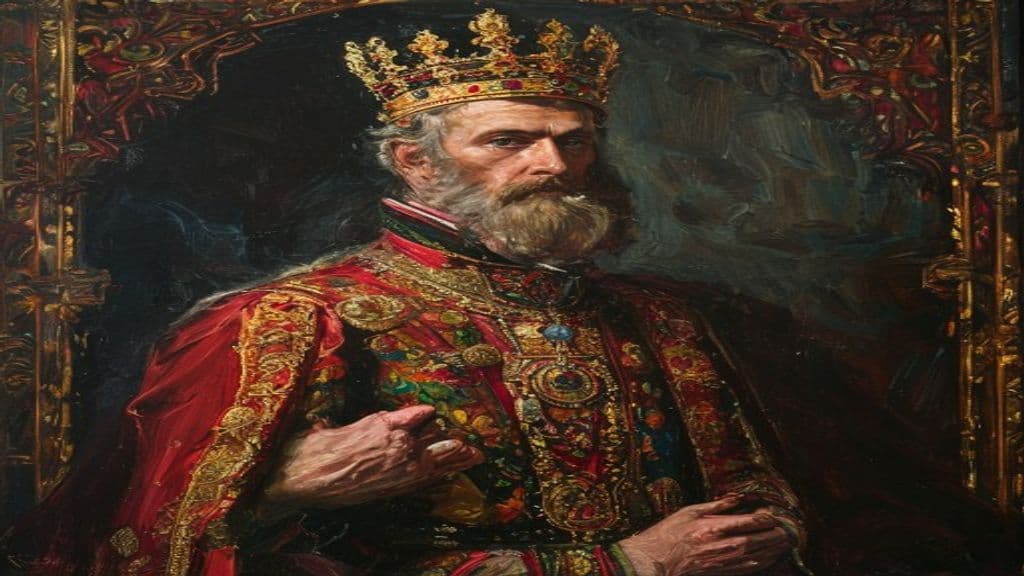
As a human leader, Prince Marko's abilities and behaviors were those of a medieval ruler. However, he holds significant cultural importance and popularity as a character in South Slavic oral tradition.
Weaknesses
- physicalvulnerability to injury or disease
Wards
None recorded.
Preta (Bhūt)
A bhoota (bhūt) is a supernatural being in Indian popular culture and some ancient texts, typically understood as the restless or perturbed spirit of a deceased person that has not properly moved on after death. Their existence is linked to failures in funerary practice, violent death, or unresolved matters in life.
Preta (Hungry Ghost)
A post-mortem supernatural being associated with extreme, unremitting hunger and thirst. In Hindu usage the Sanskrit term can mean a deceased person, while Buddhist traditions develop the category into a distinct realm of hungry spirits whose condition illustrates karmic consequences for demeritorious action.
Preto / Preta (Bhuta) — Rajasthani folk tradition (absence of sourced evidence)
Requested research on a Rajasthani entity called "Preto/Preta (Bhuta)" cannot be supported by the supplied sources. The provided materials consist of a Portuguese disambiguation for 'Preto', a Wikidata entry for Pretoria, and three municipal/archival documents from Ribeirão Preto; none contain information on Rajasthani folklore, Bhuta, or preta spirits.
Priam
Priam is the legendary king of Troy in Greek and Roman epic tradition, an aged sovereign and father figure whose grief, supplication, and death are central episodes in the narratives of the Trojan War. He is portrayed as a mortal ruler embedded in a cosmos of gods and fate rather than as a supernatural being.
Pricolici
A Romanian folkloric revenant that combines lupine characteristics with vampiric, post-mortem hostility; typically represented as a wolf- or dog-like attacker associated with violent deaths, werewolves, and other harmful undead in rural tradition.
Prince Charming
A European-derived fairy-tale stock character archetype: an idealized princely rescuer who appears at the narrative moment of resolution to liberate a heroine (by kiss, recognition, marriage, or quest-completion) and thereby complete the tale's social or romantic reward.
Prince Rabadash
Prince Rabadash is a fictional human royal antagonist from C. S. Lewis's novel The Horse and His Boy. He is a Calormene prince who plans and attempts an invasion of Archenland during the Pevensie reign of Narnia, and is later depicted unfavorably in the narrative.
Prince Rilian
Prince Rilian is a human royal character in C. S. Lewis's secondary-world of Narnia: the son of King Caspian and grandson of Ramandu the star. In The Silver Chair he has mysteriously disappeared and is held under enchantment in an underground realm by an evil enchantress, prompting a quest by children sent by Aslan to rescue and restore him.
Princess Liễu Hạnh
Liễu Hạnh is a governing figure in the Đạo Mẫu tradition, representing the Heaven realm and overseeing the Earth realm. She is one of The Four Immortals, embodying balance between earthly and divine realms. (Note: - Power tier: Lower to Greater (given the governing role but not cosmic primordial-level abilities explicitly stated) - Abilities: Provide a more specific description or eliminate this section, as no )
Printer's devil
An occupational term and folkloric scapegoat arising in printshop culture: literally a printing apprentice whose ink-stained hands earned the jocular epithet, and folklorically a mischievous devil (often conflated with Titivillus) blamed for typographical errors and textual corruption.
Prithvi
Prithvi (Sanskrit: पृथ्वी, Pṛthvī) is the Vedic personification of the Earth, a maternal cosmic principle who is simultaneously the physical ground, the universal Mother who nourishes life, and manifest matter participating in cosmogony. She is commonly paired with the sky (Dyaus) as the dyadic parents Dyavaprithivi and later becomes identified or merged with Bhūmi in classical Hindu and Buddhist contexts.
Procession of the Dead
A widely attested folkloric motif (Stith Thompson Motif E491) describing a marching retinue of ghosts, phantoms, or souls that travels through the living world. Local forms (e.g., Santa Compaña, Nightmarchers, panchabhāya) vary in appearance and meaning and are often tied to liminal times, funerary ritual, or moral repercussion.
Community Record
- [1]Wikipediawiki