
The motif is not a single genealogical entity but a recurrent cultural template: communities describe collectives of the dead moving through the landscape and link them to local cosmologies of afterlife, festival practice, funerary ritual, or moral repercussion. Scholars (e.g., Abry) record many local names across Alpine and neighboring regions, while comparative studies relate the motif to night-host/Wild Hunt-type traditions (some scholarship reads certain medieval accounts as a remythification of the Wild Hunt). Ancient civic or ritual practices (e.g., Anthesteria) and funerary iconography (e.g., Book of the Dead procession vignettes) are culturally analogous practices addressing the same boundary between living and dead rather than direct single-source origins.
Descriptions vary by region but consistently present a column or cortege of human-like souls or revenants moving in procession. Medieval chroniclers (as summarized from Orderic Vitalis by historians such as Carlo Ginzburg) describe processions composed of sinners and damned people; Nepali accounts of panchabhāya report 'five or more spirits riding on horses and dressed in white'; Raeto-Romance tales describe a procession whose last marcher is the soul of someone about to die. Other local traditions (e.g., Santa Compaña, Nightmarchers) likewise depict a moving retinue, sometimes with a discernible leader tied to the Otherworld.
The central 'ability' is collective manifestation as a moving retinue that traverses roads, fields, or villages. In some traditions the procession functions omenically: in Raeto-Romance and Portuguese tales the last figure may be the soul of someone about to die, and some accounts report a living person's double joining the retinue (attested in particular regional tales). Medieval descriptions emphasize a moral/judicial role—processions of sinners undergoing posthumous punishment. The motif can also intersect with local ritual actors: in Friuli the benandanti are recorded as beneficent protectors connected with processional conflict against malandanti. Details of interaction vary by tradition rather than forming a single, consistent catalogue of powers.
Weaknesses
- conditionproper sacramental status (e.g., complete baptism)
- otherintervention by local ritual specialists (e.g., benandanti as protective agents in Friuli)
Wards
- ritualAnthesteria (festival rites to honor and placate the dead)
- ritualChristian baptism (prevents some individuals from joining cursed retinues in Iberian/Portuguese tales)
- othercommunity ritual specialists acting as protectors (e.g., benandanti countering malandanti)
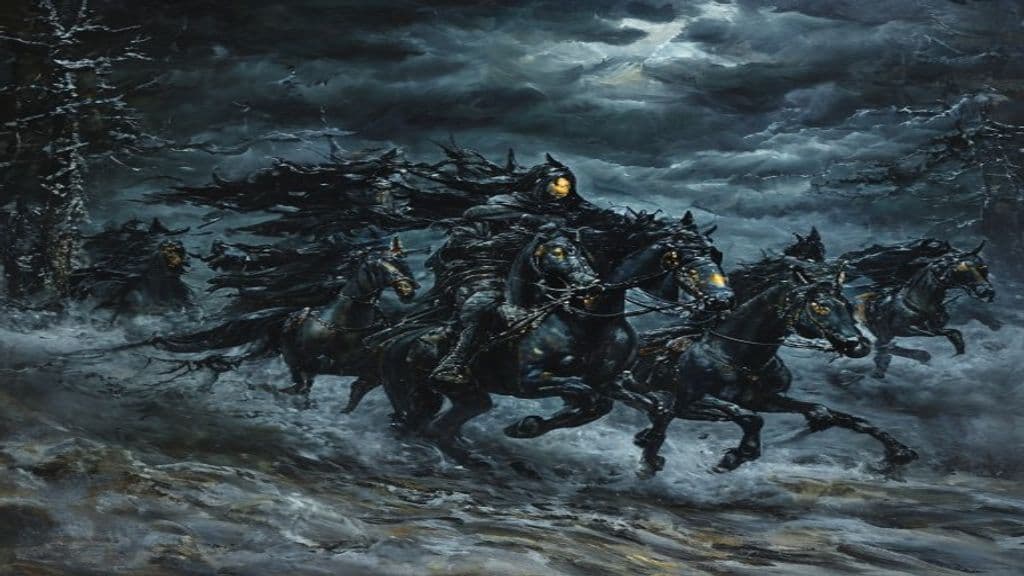
Wild Hunt
A fearsome spectral cavalcade of the dead sweeping through the winter sky — those who see it risk being carried off or killed, and its passage foretells war, plague, or catastrophe.
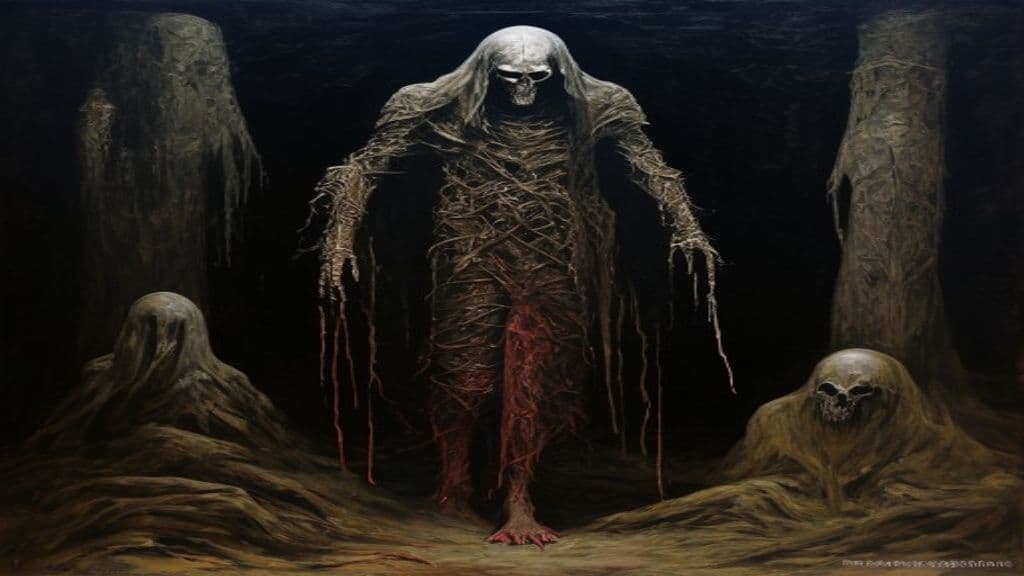
Revenant
A revenant is a deceased human (corporeal corpse or spirit) that returns from death to appear among or assault the living. The category spans multiple cultures and historical periods and includes walking corpses, barrow-dwellers, and other postmortem returns addressed by communal funerary and ritual responses.
Prince Marko
Historical figure and major character in South Slavic oral tradition, de jure Serbian king from 1371 to 1395. (Note: - Power tier: Primordial is too high; Ancient (deity-level) is more plausible given the context. - Abilities: The draft implies supernatural abilities, but the source material only describes Prince Ma)
Prince Rabadash
Prince Rabadash is a fictional human royal antagonist from C. S. Lewis's novel The Horse and His Boy. He is a Calormene prince who plans and attempts an invasion of Archenland during the Pevensie reign of Narnia, and is later depicted unfavorably in the narrative.
Prince Rilian
Prince Rilian is a human royal character in C. S. Lewis's secondary-world of Narnia: the son of King Caspian and grandson of Ramandu the star. In The Silver Chair he has mysteriously disappeared and is held under enchantment in an underground realm by an evil enchantress, prompting a quest by children sent by Aslan to rescue and restore him.
Princess Liễu Hạnh
Liễu Hạnh is a governing figure in the Đạo Mẫu tradition, representing the Heaven realm and overseeing the Earth realm. She is one of The Four Immortals, embodying balance between earthly and divine realms. (Note: - Power tier: Lower to Greater (given the governing role but not cosmic primordial-level abilities explicitly stated) - Abilities: Provide a more specific description or eliminate this section, as no )
Printer's devil
An occupational term and folkloric scapegoat arising in printshop culture: literally a printing apprentice whose ink-stained hands earned the jocular epithet, and folklorically a mischievous devil (often conflated with Titivillus) blamed for typographical errors and textual corruption.
Prithvi
Prithvi (Sanskrit: पृथ्वी, Pṛthvī) is the Vedic personification of the Earth, a maternal cosmic principle who is simultaneously the physical ground, the universal Mother who nourishes life, and manifest matter participating in cosmogony. She is commonly paired with the sky (Dyaus) as the dyadic parents Dyavaprithivi and later becomes identified or merged with Bhūmi in classical Hindu and Buddhist contexts.
Processional giant
Large hollow costumed figures carried and animated by people in civic and liturgical processions across parts of Europe (notably Belgium, France, Spain, Portugal, Italy and England). Rooted in medieval rites, they function as performative embodiments of town archetypes, biblical and legendary characters and are part of festival pageantry rather than autonomous supernatural beings.
Proctor Valley Monster
A local cryptid of Proctor Valley and Proctor Valley Road in southwestern San Diego County, California, reported in variable forms (commonly a Bigfoot-like humanoid or a bovine-like creature). The figure functions in local lore as an explanatory monster for disappearances, strange animal activity, and unexplained footprints and has been incorporated into regional popular culture.
Proetus
Proetus (Ancient Greek: Προῖτος, Proitos) is a personal name borne by several legendary mortal figures in Greek mythic genealogies and local traditions—principally kings or princes associated with Argos/Tiryns, Corinth, Thebes, and Nauplia—rather than a single supernatural being.
Professor Digory Kirke
Professor Digory Kirke is a fictional human character created by C. S. Lewis who appears in three books of The Chronicles of Narnia. The supplied sources identify him by name and list his appearances but provide no folkloric or supernatural classification beyond his role as a literary character.
Promachus
Promachus (Ancient Greek Πρόμαχος, "who leads in battle" or "champion") is a name applied to multiple mortal figures in Greek epic and myth, and as a surname/epithet of deities (e.g., Athena, Heracles, Hermes). The term also appears in modern scientific and astronomical nomenclature (a genus of robber flies and asteroid 173117 Promachus). It is not a single unified supernatural being in the cited material.
Prometheus
Prometheus is a Titan of ancient Greek myth credited as a benefactor and culture-bringer to humanity, most famously for stealing fire from the Olympian gods and giving it to people. He is portrayed as intelligent and forward-looking (etymologically associated with 'forethought'), and as punished by Zeus for his transgression.
Community Record
- [1]Procession of the dead (Wikipedia overview). Wikipedia: 'Procession of the dead' overview and motif listing (Stith Thompson Motif E491); includes alternate local names and comparative notes.wiki
- [2]List of Book of the Dead spells (Wikipedia). Notes that funerary spells are 'often accompanied with a lavish vignette showing a funerary procession' indicating procession imagery in Egyptian funerary literature.wiki
- [3]Anthesteria festival (summary cited). Summary: 'the festival of Anthesteria was performed to honor and placate the dead, who were thought to walk freely among the streets.' (as cited in the Procession of the dead entry).wiki
- [4]Carlo Ginzburg on medieval processions (summary citation). Summary reference to Ginzburg: procession 'comprised a march of sinners and damned people, being punished for their wrongdoings in life.'academic
- [5]Alpine / Occitan / Italian local names (Christian Abry listing). Christian Abry's list of regional names (curs dj’ànime; La processione dei morti; Tòtòprossenziò; kór di trapacha; procession des revenants; etc.) as recorded in the summary.wiki
- [6]Nepal: panchabhāya (summary). Summary: panchabhāya (from pancha 'five' and bhāya 'younger brother') manifest as 'five or more spirits riding on horses and dressed in white.'wiki
- [7]Additional supporting links (Book of the Dead primary text and explanatory pages). Egyptian Book of the Dead texts and commentary listing funerary spells and procession imagery in funerary contexts (cited in research notes).other