Accounts collected in modern sources offer multiple folk etiologies for pricolici. A common moral explanation holds that malicious or violent men become pricolici after death so they may continue to harm the living; in some variants, people who were werewolves in life return after death as pricolici (or as vampiric beings that take animal forms). A minority tradition recorded in survey sources also links infant feeding practices to revenant identity (a child breastfed after the mother has weaned is sometimes given among several folk causes elsewhere), but the supplied sources treat such etiologies as part of a range of local explanations rather than a single canonical origin.
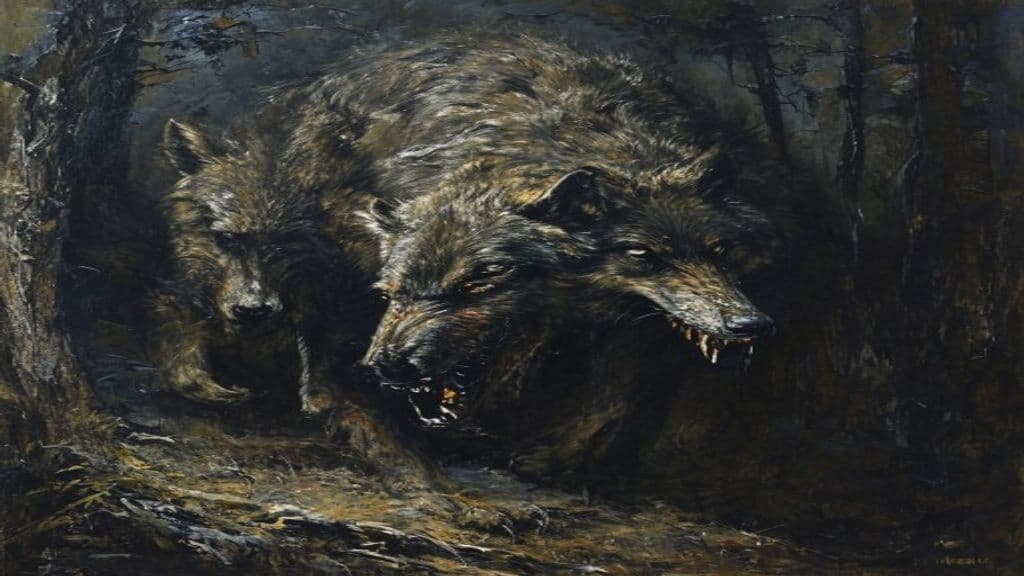
The dominant description across sources presents the pricolici as always resembling a wolf or dog: unusually large, fierce, and predatory canids that attack silently and unexpectedly. Modern rural reports cited in secondary accounts describe attacks by abnormally large wolves identified by villagers as pricolici. A minority, uncertain variant describes a bi-morphic werewolf-like form that can walk upright on two legs, but that description is not consistently attested in the sources and is marked as less certain.
Sources describe pricolici as nocturnal, violent revenants that continue predatory behaviour after death; they are associated with wolves, dogs and other nocturnal hunters (owls, bats) and linked conceptually to vampire-like activity. Some accounts state they have the ability to transform into animals or ordinary people, while other material emphasizes that when manifest as a revenant they are characteristically lupine. Folkloric treatments therefore present a degree of variability: pricolici may be counted among shapeshifters in some narratives, yet in common identification they are noted foremost for their wolf- or dog-like attacks and post-mortem hostility.
Weaknesses
- otherNo clear traditional weaknesses recorded in supplied sources
Wards
- otherThe supplied sources do not specify particular wards or protective rites for pricolici
Aradia
Aradia is a name and motif appearing in late-19th-century folklorist literature (notably Charles G. Leland's Aradia, or the Gospel of the Witches) and in Italian, Sardinian, and adjacent regional folklore where cognate names (Arada, Araja, Erodiade/Irodiada) are attached to a nocturnal female host associated with Diana/Herodias. Sources portray Aradia variously as a messianic teacher of witchcraft (Leland) and as part of a tradition of night-flying female spirits and regional fairy-queen figures (folklore surveys).
Vampire (tradition)
A class of revenant beings in southeastern and eastern European folk belief that subsist by feeding on the vital essence (generally blood) of the living. Recorded chiefly in early modern to modern oral traditions, these vampires are typically described as reanimated corpses whose presence explains unexplained illness, death, and post-mortem disturbances in their communities.
Prenomen (Ancient Egypt)
The Prenomen is one of the five royal names of ancient Egyptian pharaohs, used to signify their divine authority and power. (Note: 1. Power tier: Lower to Greater (as it's tied to the pharaoh's identity and power, but not explicitly stated as deity-level). 2. Abilities: Remove claim that Prenomen has no supernatural abilities or )
Preta (Bhūt)
A bhoota (bhūt) is a supernatural being in Indian popular culture and some ancient texts, typically understood as the restless or perturbed spirit of a deceased person that has not properly moved on after death. Their existence is linked to failures in funerary practice, violent death, or unresolved matters in life.
Preta (Hungry Ghost)
A post-mortem supernatural being associated with extreme, unremitting hunger and thirst. In Hindu usage the Sanskrit term can mean a deceased person, while Buddhist traditions develop the category into a distinct realm of hungry spirits whose condition illustrates karmic consequences for demeritorious action.
Preto / Preta (Bhuta) — Rajasthani folk tradition (absence of sourced evidence)
Requested research on a Rajasthani entity called "Preto/Preta (Bhuta)" cannot be supported by the supplied sources. The provided materials consist of a Portuguese disambiguation for 'Preto', a Wikidata entry for Pretoria, and three municipal/archival documents from Ribeirão Preto; none contain information on Rajasthani folklore, Bhuta, or preta spirits.
Priam
Priam is the legendary king of Troy in Greek and Roman epic tradition, an aged sovereign and father figure whose grief, supplication, and death are central episodes in the narratives of the Trojan War. He is portrayed as a mortal ruler embedded in a cosmos of gods and fate rather than as a supernatural being.
Prince Charming
A European-derived fairy-tale stock character archetype: an idealized princely rescuer who appears at the narrative moment of resolution to liberate a heroine (by kiss, recognition, marriage, or quest-completion) and thereby complete the tale's social or romantic reward.
Prince Marko
Historical figure and major character in South Slavic oral tradition, de jure Serbian king from 1371 to 1395. (Note: - Power tier: Primordial is too high; Ancient (deity-level) is more plausible given the context. - Abilities: The draft implies supernatural abilities, but the source material only describes Prince Ma)
Prince Rabadash
Prince Rabadash is a fictional human royal antagonist from C. S. Lewis's novel The Horse and His Boy. He is a Calormene prince who plans and attempts an invasion of Archenland during the Pevensie reign of Narnia, and is later depicted unfavorably in the narrative.
Prince Rilian
Prince Rilian is a human royal character in C. S. Lewis's secondary-world of Narnia: the son of King Caspian and grandson of Ramandu the star. In The Silver Chair he has mysteriously disappeared and is held under enchantment in an underground realm by an evil enchantress, prompting a quest by children sent by Aslan to rescue and restore him.
Princess Liễu Hạnh
Liễu Hạnh is a governing figure in the Đạo Mẫu tradition, representing the Heaven realm and overseeing the Earth realm. She is one of The Four Immortals, embodying balance between earthly and divine realms. (Note: - Power tier: Lower to Greater (given the governing role but not cosmic primordial-level abilities explicitly stated) - Abilities: Provide a more specific description or eliminate this section, as no )
Community Record
- [1]Pricolici. Wikipedia: 'Pricolici' article (accessed sources supplied)wiki
- [2]Pricolici (Wikidata). Wikidata entry for Pricoliciwiki
- [3]The Curse of the Pricolici: The True Horror of a Family Under Supernatural Attack | Documentary (description). Documentary summary referencing a 1958 case in Poieni and local attributions to pricoliciother
- [4]The werewolf hunter's guide (listing). Book listing noting 'Pricolici of Romania' among comparative werebeings (text not supplied in notes)other