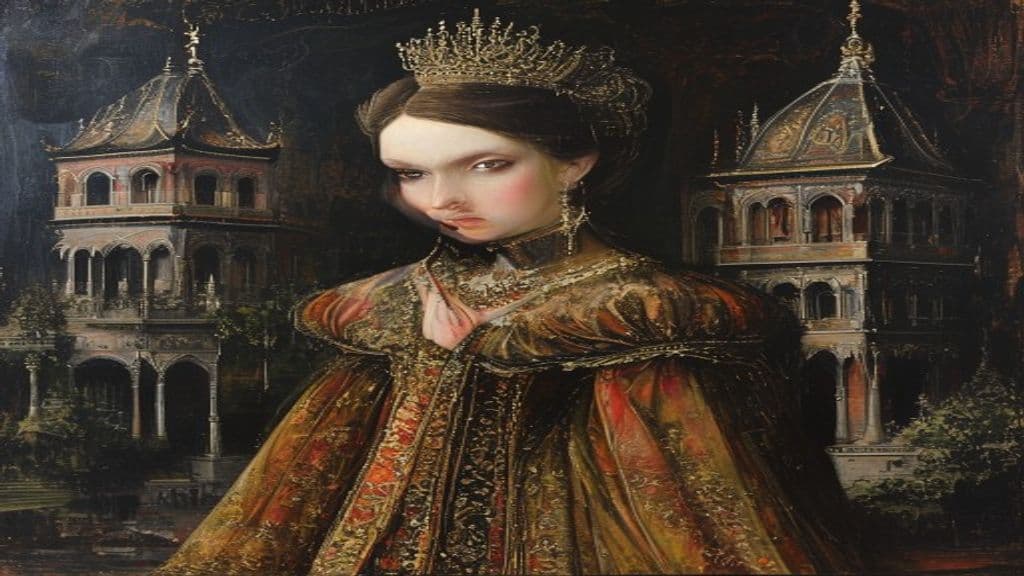
In the Vietnamese folk religion, Liễu Hạnh's position as a governing figure is rooted in her role within the Đạo Mẫu tradition and the Four Immortals cosmology.
There is no description of Liễu Hạnh's physical appearance in the source material.
As a governing figure, Liễu Hạnh may possess spiritual or mystical powers to govern and represent the Earth and Heaven realms. However, specific abilities are not explicitly described in the source material.
Priam
Priam is the legendary king of Troy in Greek and Roman epic tradition, an aged sovereign and father figure whose grief, supplication, and death are central episodes in the narratives of the Trojan War. He is portrayed as a mortal ruler embedded in a cosmos of gods and fate rather than as a supernatural being.
Pricolici
A Romanian folkloric revenant that combines lupine characteristics with vampiric, post-mortem hostility; typically represented as a wolf- or dog-like attacker associated with violent deaths, werewolves, and other harmful undead in rural tradition.
Prince Charming
A European-derived fairy-tale stock character archetype: an idealized princely rescuer who appears at the narrative moment of resolution to liberate a heroine (by kiss, recognition, marriage, or quest-completion) and thereby complete the tale's social or romantic reward.
Prince Marko
Historical figure and major character in South Slavic oral tradition, de jure Serbian king from 1371 to 1395. (Note: - Power tier: Primordial is too high; Ancient (deity-level) is more plausible given the context. - Abilities: The draft implies supernatural abilities, but the source material only describes Prince Ma)
Prince Rabadash
Prince Rabadash is a fictional human royal antagonist from C. S. Lewis's novel The Horse and His Boy. He is a Calormene prince who plans and attempts an invasion of Archenland during the Pevensie reign of Narnia, and is later depicted unfavorably in the narrative.
Prince Rilian
Prince Rilian is a human royal character in C. S. Lewis's secondary-world of Narnia: the son of King Caspian and grandson of Ramandu the star. In The Silver Chair he has mysteriously disappeared and is held under enchantment in an underground realm by an evil enchantress, prompting a quest by children sent by Aslan to rescue and restore him.
Printer's devil
An occupational term and folkloric scapegoat arising in printshop culture: literally a printing apprentice whose ink-stained hands earned the jocular epithet, and folklorically a mischievous devil (often conflated with Titivillus) blamed for typographical errors and textual corruption.
Prithvi
Prithvi (Sanskrit: पृथ्वी, Pṛthvī) is the Vedic personification of the Earth, a maternal cosmic principle who is simultaneously the physical ground, the universal Mother who nourishes life, and manifest matter participating in cosmogony. She is commonly paired with the sky (Dyaus) as the dyadic parents Dyavaprithivi and later becomes identified or merged with Bhūmi in classical Hindu and Buddhist contexts.
Procession of the Dead
A widely attested folkloric motif (Stith Thompson Motif E491) describing a marching retinue of ghosts, phantoms, or souls that travels through the living world. Local forms (e.g., Santa Compaña, Nightmarchers, panchabhāya) vary in appearance and meaning and are often tied to liminal times, funerary ritual, or moral repercussion.
Processional giant
Large hollow costumed figures carried and animated by people in civic and liturgical processions across parts of Europe (notably Belgium, France, Spain, Portugal, Italy and England). Rooted in medieval rites, they function as performative embodiments of town archetypes, biblical and legendary characters and are part of festival pageantry rather than autonomous supernatural beings.
Proctor Valley Monster
A local cryptid of Proctor Valley and Proctor Valley Road in southwestern San Diego County, California, reported in variable forms (commonly a Bigfoot-like humanoid or a bovine-like creature). The figure functions in local lore as an explanatory monster for disappearances, strange animal activity, and unexplained footprints and has been incorporated into regional popular culture.
Proetus
Proetus (Ancient Greek: Προῖτος, Proitos) is a personal name borne by several legendary mortal figures in Greek mythic genealogies and local traditions—principally kings or princes associated with Argos/Tiryns, Corinth, Thebes, and Nauplia—rather than a single supernatural being.
Community Record
- [1]Wikipediawiki