
The name Pylenor appears in the classical/mythic register as an individual centaur identified in a mythic index and summarized as a centaur 'wounded by Heracles' (Wikidata entry). This situates that attestation within the broad cycle of Greek heroic narratives in which Heracles combats various liminal or monstrous figures. Separately, Pylenor is used in a modern narrative context as the name of a human priest who appears in an Assassin's Creed memory sequence; in that scene the priest requests help dealing with snakes at a bathhouse. The available sources do not supply a unified genealogy, mythic origin, or ritual tradition linking these usages, nor do they present Pylenor as a recurring class of spirit or monster with a consistent origin myth.
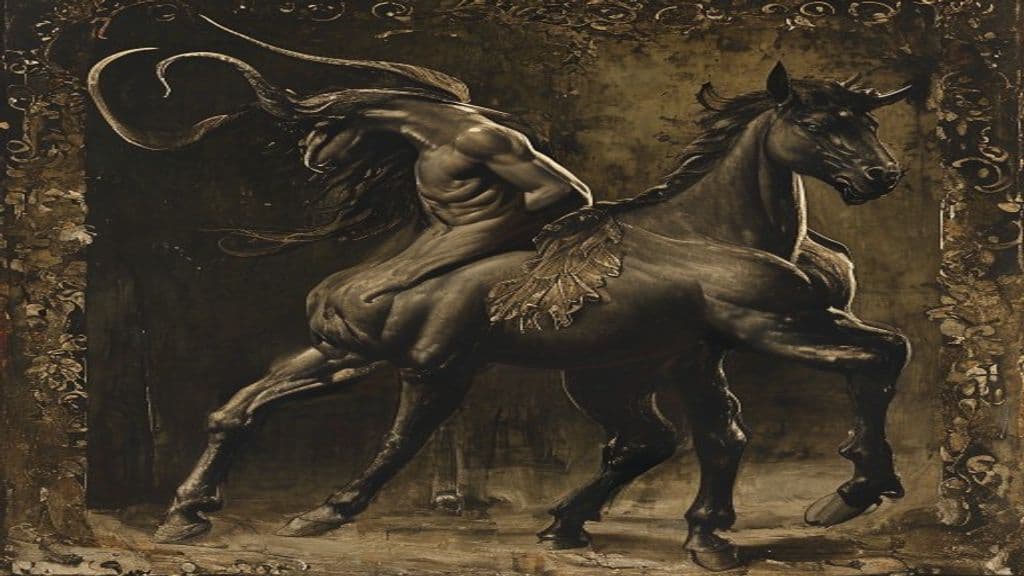
In the classical context, if Pylenor refers to the centaur listed in mythic indexes, his appearance conforms to the standard centaur morphology: the upper body of a human combined with the lower body and legs of a horse (Wikipedia: Centaur description). The source noting Pylenor as a centaur does not provide individualized physical detail beyond class membership. In the modern videogame excerpt Pylenor appears as a human priest in a bathhouse scene; the supplied text identifies him by role and situational context (priest at a bathhouse with a snake problem) but gives no further physical description.
No specific supernatural abilities are attributed to Pylenor in the supplied sources. The classical indexing only records him as a centaur wounded by Heracles without describing particular powers or actions; any generic centaur traits (strength, mounted mobility, martial behavior) are class-level descriptions from centaur summaries rather than source-specific claims about Pylenor. In the videogame excerpt Pylenor is a mundane human priest who asks the protagonist for assistance dealing with a snake infestation at a bathhouse; his actions in the excerpt are conversational and managerial rather than supernatural.
Weaknesses
- othernone attested in sources
Wards
- othernone attested in sources
Purson
Purson is a named supernatural being attested in goetic grimoire tradition references (the Ars Goetia / Pseudomonarchia Daemonum corpus as cited in secondary summaries). In the supplied materials he appears primarily as a catalogued, addressable entity in Western occult lists and as a modern cultural reference (band name, amulet reproduction), but no primary ritual entry or full grimoire description is included among the provided sources.
Puzzle the Donkey
Puzzle is a fictional donkey character in C. S. Lewis's The Chronicles of Narnia, prominently appearing in The Last Battle. In the novel he is a simple, credulous beast manipulated by the ape Shift and presented to others as the deity Aslan as part of a deception plot.
Puṣpadanta
Puṣpadanta is a name attested in South Asian religious literatures with at least two distinct roles in the supplied sources: (1) in Digambara Jain tradition as Ācārya Puṣpadanta, credited (with Bhūtabali) for committing the oral teachings of Mahāvīra to writing in the Ṣaṭkhaṇḍāgama; and (2) in Vaishnava/Śrīmad-Bhāgavatam-type devotional lists as one named attendant/associate among a retinue of divine or semi-divine companions.
Pylades
Pylades (Ancient Greek: Πυλάδης) is a mortal Phocian prince in Greek myth, best known as the steadfast companion, counsellor, and co-actor of Orestes across the Orestes cycle (revenge on Clytemnestra and Aegisthus, the Tauris episode, and related episodes). He functions as a loyal attendant, caregiver, and occasional combatant, and later traditions emphasize the depth of his devotion to Orestes.
Pylaemenes
Pylaemenes is a proper name attested in ancient Greek literary traditions for at least two mortal characters — a Paphlagonian king allied with Troy and a suitor of Penelope — and is also used in modern zoological taxonomy as the genus name for a group of stick and leaf insects (Phasmatodea). The name is not presented as a supernatural entity in the supplied sources.
Pylaeus
Pylaeus (Ancient Greek: Πύλαιος) is a mortal figure in Greek mythic-historical tradition presented as a descendant of Pelasgus and a commander allied to King Priam in the Trojan War. He is recorded as commanding the Pelasgian contingent together with his brother Hippothous and is noted in local Lesbos tradition as having commanded the Lesbian army and giving his name to a mountain on the island.
Pyre of Heracles
A sacred site in ancient Greek mythology, marking the self-immolation of hero Heracles and symbolizing his heroic nature and relationship with death. (Note: 1. Power tier should be Lesser (local spirit) as it's a site and not a living entity with primordial power. 2. Abilities need to be rewritten or removed, as they're more related to cultural significan)
Pyrene (Celtic Tradition)
Figure from Greek and Roman mythology with possible associations to Celtic tradition, associated with the Iberian region. (Note: - The article states that Pyrene's myth is "largely based on Greek and Roman sources", which contradicts the source material stating that her myth survives in Greek and Roman writings. - Power tier: B)
Pyrgo
Pyrgo (Greek: Πυργώ) is a mortal woman named in Greek and Roman mythic genealogies and narratives. She appears chiefly as the first wife or consort of Alcathous in Pelops-cycle genealogies and, in other attestations, as a nurse of Priam's children who accompanies Aeneas to Sicily. Sources present Pyrgo as a named human household figure rather than a supernatural being.
Pyrrha
Pyrrha (Πύῤῥα, "flame-coloured" or "red") is a mortal heroine in Greek myth: wife of Deucalion and one of the two human survivors of Zeus's deluge. Following an oracle from Themis, she and Deucalion repopulate the earth by casting stones over their shoulders that transform into people; she is therefore an ancestral/matriarchal figure in post‑diluvian genealogies.
Python
Python is listed in the supplied sources as a mythical serpent. The available material is a disambiguation-style attestation and does not supply narrative, descriptive, or ritual detail beyond the label "mythical serpent."
Pyttius
Pyttius is attested in the provided sources solely as a human genealogical figure in Greek mytho-historical tradition, named as the father of Amarynceus, a chief of the Eleans. The sources do not present Pyttius as supernatural, nor do they record deeds, cult, appearance, or rituals associated with him.
Community Record
- [1]List of centaurs. Wikipedia, 'List of centaurs' (centaur morphology and general description)wiki
- [2]Pylenor (Wikidata). Wikidata entry for Pylenor summarizing him as a 'centaur wounded by Heracles'other
- [3]Enough is Enough | Assassin's Creed Wiki | Fandom. Assassin's Creed fandom entry describing the memory scene in which 'Kassandra agreed to help the priest Pylenor to deal with the snake problem at the bathhouse.'wiki
- [4]Pylenor (mirror / excerpt). Archived/scripted excerpt referencing Pylenor in a narrative context (provided among research notes)other