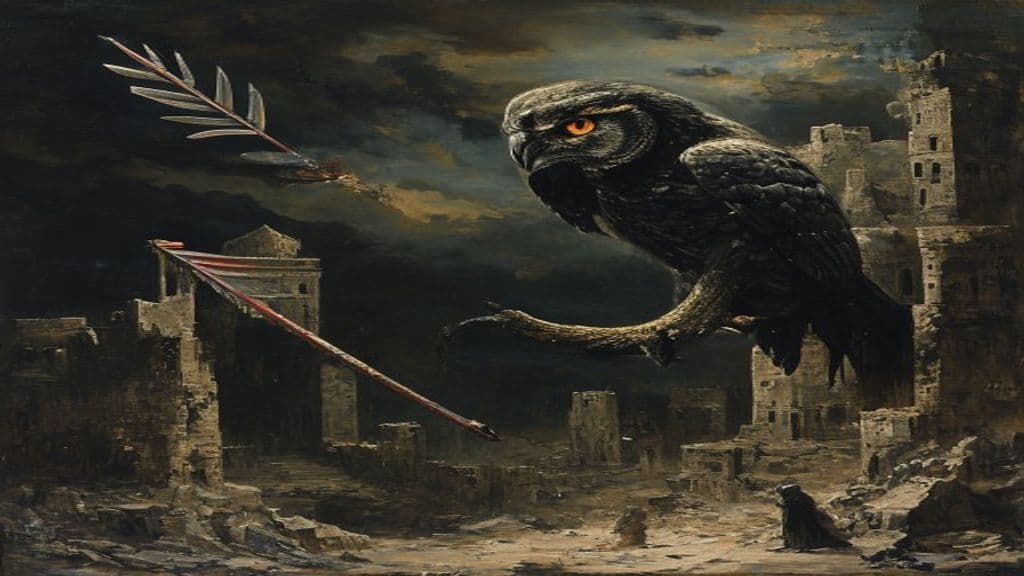
The Qippoz is described as either an arrow snake or an owl, with differing translations in the Hebrew Bible.
Specific powers and behaviors of the Qippoz are unknown beyond its association with desolation and ruined cities in Edom.
Cain (Jewish Tradition)
Biblical figure and symbol of sin and violence, human being with no supernatural abilities. (Note: 1. Power tier: Change to "Human" is correct. 2. Abilities: Specify that the abilities mentioned are a result of Cain's actions and decisions, not supernatural powers. 3. Weaknesses: Mention God's curs)
Fiery Flying Serpent
A metaphorical creature representing the Assyrian kingdom's power and destruction, used in Jewish tradition. (Note: * Power tier should be Greater, not Primordial, as it's a symbolic representation of a powerful regional entity (the Assyrian kingdom) rather than a cosmic or primordial force. * Abilities section nee)
Succubus (Jewish Tradition)
Female demon that seduces male humans through dreams, potentially leading to a hybrid child and the man's decline. (Note: 1. Power tier should be Ancient, not Primordial (Primordial powers are cosmic, while Ancient powers are deity-level). 2. No information on physical appearance is missing because it's simply not mentio)
Qed-Her
Qed-Her is described in the cited reference material as an ancient Egyptian minor warrior and gate goddess of the underworld, functioning as a guardian placed at an entrance or threshold within the realm of the dead. The surviving record in the provided sources is minimal and consists chiefly of a brief encyclopedia-style entry and a linked data label.
Qi
Qi (氣/气) is a foundational concept in Chinese thought referring to a ubiquitous vital substance or vapor-like principle—commonly glossed as 'vital energy' or 'breath'—thought to underlie living beings, health, and cosmological processes. It is treated as an impersonal, polysemous principle rather than an individualized spirit or deity, and is central to practices that aim to cultivate or balance it (e.g., qigong, traditional Chinese medicine).
Qilin
A legendary hooved chimerical creature of Chinese literary tradition (麒麟, qílín) whose appearances in classical accounts function as auspicious omens tied to the birth, arrival, or death of sages and illustrious rulers. The creature is part of a broader East Asian set of correspondents (Japanese kirin, Korean girin) and was historically conflated with the real giraffe in Ming-dynasty court encounters.
Qin (Mandaeism)
Qin is attested in a modern English-language reference as a named inhabitant of the Mandaean underworld. The available source provides only a brief listing that calls Qin "a demon of the Mandaean underworld," without further description or context.
Qingu
Qingu is a Mesopotamian figure attested chiefly in the Babylonian creation epic Enūma Eliš, where he is the consort of the primordial sea-goddess Tiamat, appointed leader of her monstrous host by the Tablet of Destinies, and defeated by the storm-god Marduk; after his execution his blood is used in the mythic creation of humankind. Later ritual and fragmentary texts group or equate him with other vanquished chthonic opponents of the gods.
Qiqirn
Qiqirn is an Inuit non-human spirit from around Baffin Island depicted as a large, hairless dog‑spirit whose mere presence causes men and dogs to suffer convulsions — sometimes fatal — that cease only when the qiqirn departs. It is feared for these effects yet is said to be frightened of humans and will flee if an angakkuq (Inuit shaman) sees it.
Qiuniu
Qiuniu is one of the traditional "nine sons of the Dragon" in Chinese popular and devotional imagery, represented as the patron of music whose head is used as an ornamental motif on musical instruments. Sources present Qiuniu principally as a symbolic figure used in material culture rather than as an independently narrated deity with stories or ritual prescriptions.
Qliphah (Qlippoth)
In Kabbalistic and later Western esoteric frameworks the qliphoth (singular qliphah) are the impure or oppositional spiritual forces that mirror and invert the sefirot; they belong to the metaphysical realm called the Sitra Achra and are later personified and mapped by Hermetic Qabalah traditions.
Qlippoth
Qlippoth (Hebrew קְלִיפּוֹת, qəlippōṯ, singular qəlippā) are the "husks" or "shells" in Jewish mystical literature that constitute the impure, obscuring counterpart to the sefirot. Originating in Zoharic mythic cosmology as coverings or forces of darkness (the Sitra Achra), the concept was later reinterpreted and systematized in Western occultism as infernal realms, orders of demonic beings, and mappings opposite the Tree of Life.
Community Record
- [1]Wikipediawiki