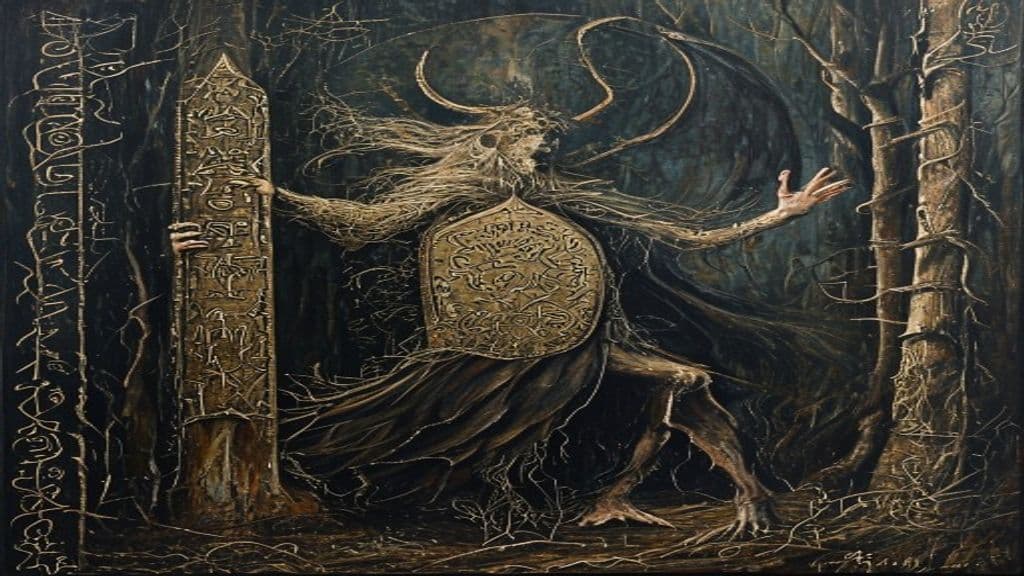
Runic songs originated in the oral traditions of Baltic Finnic peoples, passed down through generations as a form of cultural expression and national epic.
Conveys collective cultural heritage and national epic narratives through oral poetry, representing traditional stories and values of the Baltic Finnic peoples.
Rudaba
Mythological figure in Persian tradition, princess from Kabul and mother to Rostam. (Note: 1. Remove "Primordial" power tier as there is no information in the source material that would suggest Rudaba has cosmic-level abilities. 2. Add a note about her appearance, stating "no explicit descr)
Rudiobus
Rudiobus is an otherwise-unknown deity from Celtic paganism attested only by a single inscribed dedication on a bronze prancing-horse figurine recovered at Neuvy-En-Sullias (Loiret), France, dating to the 1st century BC. Modern sources note the possibility that Rudiobus may represent an aspect of a Gaulish Mars under interpretatio Romana, but no functions or myths are preserved.
Rudras
A plural class of Vedic divine beings regarded as manifestations or attendants of the god Rudra (later identified with Śiva). They function as atmospheric/wind deities, vital forces within the human body, and ritually important gods occupying an intermediate place among the Vedic divinities.
Ruhurater
Ruhurater (also attested as Lahuratil) is an Elamite city-god of Huhnur attested from the Third Dynasty of Ur through Neo-Elamite and Mesopotamian scholarly texts. He functions primarily as a patron deity invoked as a divine witness in legal and administrative contexts and is described in Elamite sources as capable of bestowing kiten (divine protection).
Rukmavati
A minor mythological figure in Hindu tradition, connected to Krishna's lineage as the daughter and wife of Pradyumna. (Note: 1. Power tier: Given that Pradyumna's mother (Rukmini) is mentioned as Krishna's chief wife and an important figure in Hindu mythology, it suggests that Rukmavati may be a more significant character t)
Rukmini
Rukmini is a Hindu goddess and the chief/primary consort of Krishna, revered as an avatar of Lakshmi. She appears in Puranic and epic narratives as a princess of Vidarbha who arranges her marriage to Krishna, later becoming queen of Dvaraka and mother of Pradyumna; she is venerated across multiple Indian devotional traditions and regional cults.
Runtiya
Runtiya is a Luwian deity of the hunt and of deer, venerated in Anatolia from the Bronze Age into the Iron Age and later local contexts. He functions as a protective and hunting patron, depicted anthropomorphically in association with a stag or antlers and receiving offerings (notably gazelles) to secure success in the hunt.
Rusalka
Water spirits in Slavic folklore — the spirits of young women who died by drowning or suicide, bound to rivers and lakes. Beautiful and dangerous, they can bewitch men to their deaths.
Ruti
No supplied sources document a supernatural or folkloric being named 'Ruti'. The term appears in the provided materials only as a modern given name, a surname, a place-name variant, an alternative spelling of the flatbread 'roti', and other non-mythic uses; therefore there is no evidence in these sources to describe a mythic entity called Ruti.
Ryūjin
Ryūjin (龍神, 'Dragon God') is a dragon-shaped water kami in Japanese myth who functions as a tutelary deity of the sea. Worshipped in strands of Shinto belief (Ryūjin shinkō), he is credited with control of tides, influence over rain and fisheries, and intervenes in human affairs from his undersea palace Ryūgū-jō.
Rán
Rán is an Old Norse sea-goddess who personifies the dangerous, engulfing aspect of the ocean; wife of the sea-jötunn Ægir and mother of nine wave-daughters, she is chiefly known for possessing a net with which she seizes those who go down to the sea.
Rõugutaja
Rõugutaja is a term referenced in some modern mentions of Estonian folklore contexts but is not attested or described in the provided source excerpt; the available excerpt on Estonian mythology does not mention or document any entity named Rõugutaja. The entity must therefore be treated as insufficiently attested in the cited material and requires consultation of primary Estonian folklore collections for verification.
Community Record
- [1]