
Texts vary. In Vedic and Purāṇic genealogies the Rudras are born as a group associated with Rudra (with traditions listing them among the thirty‑three gods alongside Adityas, Vasus, and Aśvins). Some accounts name eleven Rudras (and list Rudrāṇīs as their female counterparts), while other passages expand their number in different mythic contexts; the sources present multiple overlapping genealogies rather than a single fixed origin.
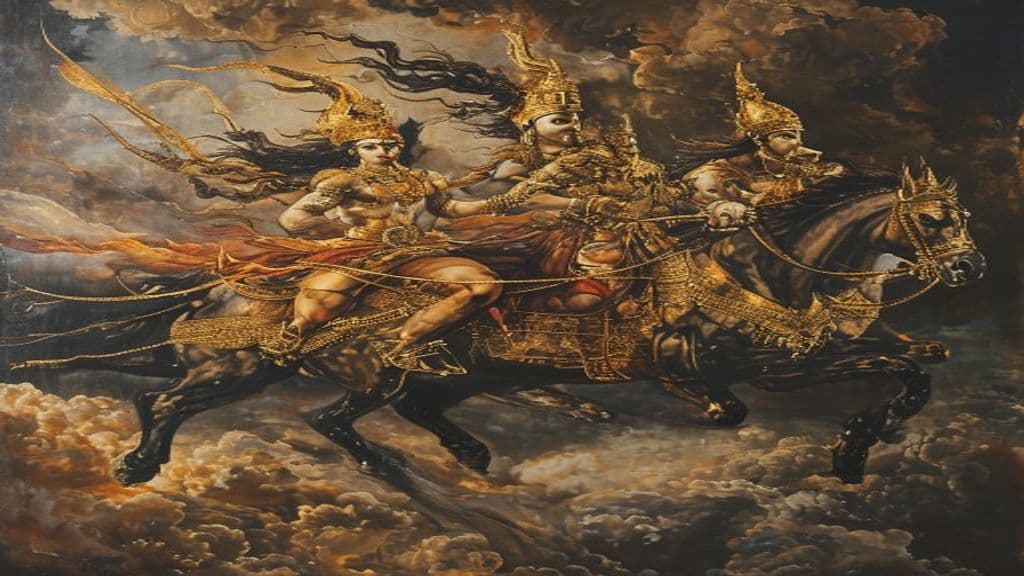
Descriptions differ by source rather than forming a single canonical appearance. Purāṇic summaries (e.g., Matsya Purāṇa summaries) describe Rudras wearing lion‑skins, with matted hair, serpents about their necks, yellow throats, carrying tridents and skulls, and bearing crescent moons; Mahābhārata imagery paints them as fierce, wearing golden necklaces and looking 'like lightning‑illuminated clouds.' Individual Rudra names and epithets (e.g., Kapālin, Pinākin) imply specific accoutrements in some lists.
Across Vedic, Upaniṣadic, epic, and Purāṇic materials the Rudras function as attendants or agents of Rudra/Śiva, are associated with storm and wind‑powers (prāṇa/vital breath), and occupy an intermediary cosmic role (the atmospheric middle world). Upaniṣads map them to internal vital forces and assign them oversight of an intermediary stage of creation and the 'second' stage of life and ritual (including the mid‑day/second sacrificial offering). In Purāṇic and epic episodes they can act as fierce martial forces (e.g., assisting Viṣṇu against demons in a Matsya Purāṇa episode) and are ambivalently beneficent—worshipped for virile power in the Bhagavata Purāṇa but linked in Upaniṣadic passages to causing sorrow and tears when they depart the body at death.
Weaknesses
- conditioncan be placated by propitiation when cause sickness or affliction (Chandogya Upaniṣad prescription)
- conditiontheir departure causes sorrow at death (Brihadāraṇyaka Upaniṣad identification of Rudras with the making of people cry)
Wards
- ritualPropitiation in sickness (Chandogya Upaniṣad) — prescribe propitiating the Rudras when one in the pertinent life stage is sick
- ritualWorship for favor/virile power (Bhagavata Purāṇa) — worship of the Rudras is prescribed to gain virile power and cultivate a favorable relation
Agneya / Āgneyī
Āgneyī (feminine) or Āgneya (masculine adjective) is a Vedic–Puranic divine figure and ritual principle tied to the fire-god Agni and the southeastern direction. In textual traditions she appears both as a personified daughter/shakti of Agni and as an adjectival/technical term applied to fire-consecrated things (direction, astra, etc.). She also occurs as the name Agneya (or Anala) among items revealed in a Shaiva-Agamic list associated with the Aghora face of Sadashiva.
Angiras
Angiras (Sanskrit Aṅgiras/Aṅgirāḥ) is primarily a Vedic rishi (sage) and eponymous lineage (Angirasa) associated with authorship of Vedic hymns, priestly/fire functions, and transmission of mantras; later Puranic accounts multiply his identities in genealogies and lists of sages.
Ap (the Waters)
Ap (Vedic áp-, Classical Sanskrit āpas/āpa-) denotes the sacred category of 'the waters' in Vedic/Hindu thought: a physical element (water), an animate cosmic principle addressed in Rigvedic hymns, and an elemental category later counted among the Panchamahabhuta. The term names collective waters invoked in ritual, is linked to deities such as Varuna and the epithet Apām Napāt, and survives in related Indo-Iranian vocabularies (Avestan āpō/Aban, Persian āb).
Asuras
In Vedic mythology, the Asuras are a group of beings described as the 'enemies' or 'opponents' of the Devas (gods), often associated with chaos and disorder. (Note: 1. Power tier should be Ancient (or Deity-level), as they are described as eternal enemies of the gods. 2. Sensory cues and wards/weaknesses sections should be filled in, as there's no information to )
Atri
Atri is a principal Vedic rṣi (seer) and eponymous founder of the Atreya lineage credited with composing hymns in the Rigveda (notably Mandala 5). He is portrayed in epic and puranic narratives as a mānasputra of Brahma, a practitioner of tapas whose austerities attract the Trimurti, and as the hospitable hermit-counselor in Ramayana episodes.
Bharadvaja
Bharadvaja is a canonical Vedic maharṣi (sage) and eponymous progenitor of a lineage and multiple textual corpora in ancient Indian tradition. Treated as an authoritative seer, teacher, and recipient/attributor of ritual, technical, and ethical knowledge, his name appears across Vedic, epic, Purāṇic, and Buddhist literature as an individual sage and as a clan/author label.
Dragon (Long)
Long (龍, "dragon") is a pervasive cultural and artistic motif that appears in Taoist sacred-geographical contexts, Chinese literature, and modern exhibitions; the provided sources treat it as part of the broader mythic imagery present around Taoist sites and ritual scenes rather than as a single, consistently described doctrinal entity.
Gāyatrī
Gāyatrī is the personified form of the Gāyatrī Mantra in Vedic–Puranic Hindu tradition: simultaneously a 24‑syllable Vedic metre, the hymn composed in that metre, and a goddess—often titled Vedamātā, the mother of the Vedas—who embodies sacred Vedic speech and knowledge.
Hiraṇyagarbha
Hiraṇyagarbha (Sanskrit: हिरण्यगर्भ, 'golden womb') is a Vedic and later Hindu cosmological concept: a primordial golden seed or 'cosmic egg/womb' from which the manifested universe is said to originate. It is presented variously as an impersonal formative principle, the 'Soul of the Universe' in Upanishadic language, and in Purāṇic and exegetical contexts as the first-born or creator (identified with Prajāpati or Brahmā).
Parīkṣit
Parīkṣit is a legendary-historical Kuru king of classical north Indian tradition attested in Vedic, epic and Purāṇic materials. He is portrayed as a sacrificial sponsor and righteous ruler whose life intersects with sages, Nāgas, and divine protection; his death by the Nāga Takṣaka and the subsequent snake-sacrifice of his son Janamejaya form central narrative episodes.
Pishach
Among the oldest classified demon-types in Hindu tradition — flesh-eating entities of the cremation ground first named in the Atharva Veda. The Pishach inhabits fresh corpses and possesses the living, causing the specific Ayurvedic condition of 'pishachabadha': madness, speaking in unknown languages, consuming impure things.
Sea serpent
A large serpentine marine creature attested across many mythologies and sailors' reports. It functions both as a cosmological adversary of storm/sky deities in ancient myth cycles and as a localized monstrous threat in coastal and seafaring folklore and eyewitness accounts.
Community Record
- [1]Rudras — Wikipedia. Wikipedia article 'Rudras' (summarizing Vedic, Upaniṣadic, epic, and Purāṇic material).wiki
- [2]Chandogya Upaniṣad (summary reference). Chandogya Upaniṣad — prescription to propitiate the Rudras in case of sickness (as reported in the research notes).literary
- [3]Brihadāraṇyaka Upaniṣad (summary reference). Brihadāraṇyaka Upaniṣad — identification of Rudras with 'ones who make cry' because their departure causes tears (as reported in the research notes).literary
- [4]Matsya Purāṇa (summary cited in secondary sources). Matsya Purāṇa description of Rudras wearing lion‑skins, matted hair, serpents, yellow throats, bearing tridents and skulls, and crescent moons (as summarized in the research notes/Wikipedia).literary
- [5]Mahābhārata (summarized passages). Mahābhārata passages describing Rudras as fierce, wearing golden necklaces and 'like lightning‑illuminated clouds' and as companions/servants in various episodes (as reported in the research notes).literary
- [6]Bhagavata Purāṇa (summary reference). Bhagavata Purāṇa prescription that worship of the Rudras yields virile power (as reported in the research notes).literary
- [7]nArAyaNAd brahmA jAyatE - GovindA madhavA Bhajan (archive). Devotional‑lyric excerpt archived and cited in the research notes; quoted genealogical line referencing Rudras among born divine groups.folk