
In Puranic narratives summarized in the supplied sources, Rukmini is a princess of Vidarbha (capital Kundina), daughter of Bhishmaka and sister of Rukmi. She falls deeply in love with Krishna and, to avoid an arranged marriage to Shishupala, secretly sends Krishna a message asking him to abduct her. Krishna carries out the plan and marries her; thereafter she becomes his chief consort and queen of Dvaraka. In the lineage narratives, Krishna petitions Shiva on Rukmini's behalf for progeny, and Shiva blesses her to bear Pradyumna, who is identified as an incarnation of Kamadeva. She is also revered as an avatar of Lakshmi and is integrated into regional cults and annual observances such as Rukmini Ashtami.
Narrative descriptions emphasize radiance and rich ornamentation consistent with her name derivation from Rukma ('radiant', 'decorated with gold'). In the marriage episode she is described taking a bejewelled whisk to fan Krishna, wearing an expensive girdle and a dazzling necklace; her eyes are darkened with collyrium. Emotional states are depicted physically (her face growing pale, red nails scratching the floor, hair dishevelled) rather than fixing a single iconographic formula.
Sources present Rukmini primarily through her divine identity as an avatar of Lakshmi and through relational roles: devoted lover and spouse of Krishna, queen of Dvaraka, and mother of Pradyumna. Her narrative agency includes initiating the marriage plan (sending a secret message to Krishna), intense devotional practices (refusing food or diversion while awaiting Krishna, praying at Ambika's temple), and interceding mercifully for her brother. The supplied materials do not enumerate specific miraculous feats attributed to her beyond her status within the divine genealogy and devotional theology.
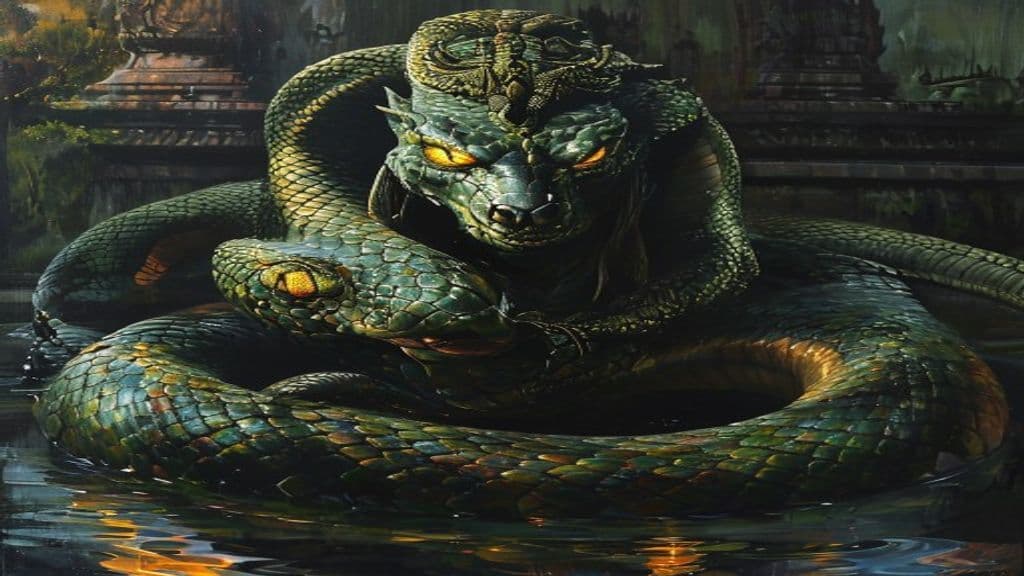
Naga
Divine serpent beings of Hindu, Buddhist, and Jain cosmology — powerful guardians of water, earth, and underground treasures. Revered as deities in South and Southeast Asia.
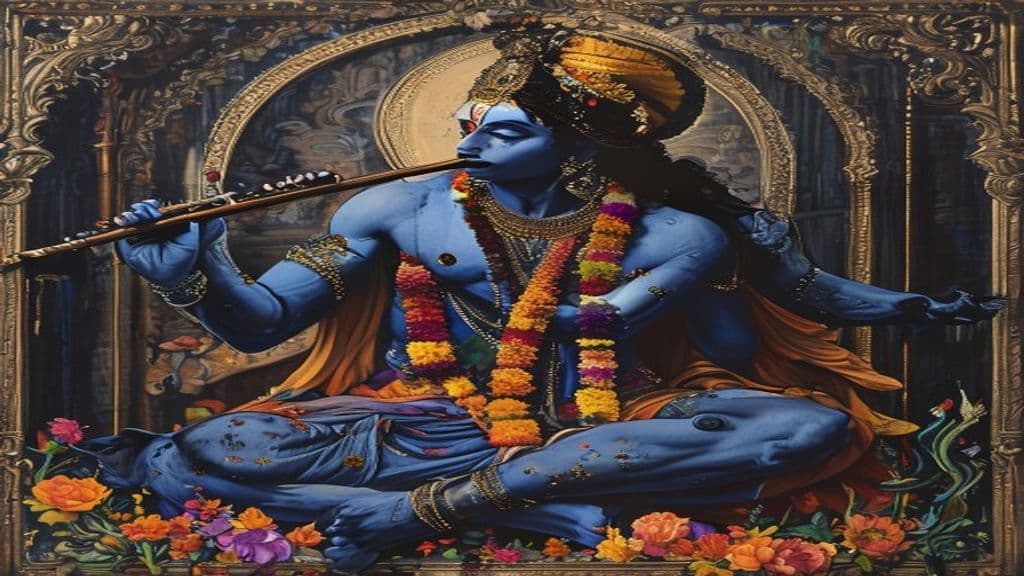
Krishna
Krishna (Sanskrit: Kṛṣṇa) is a major Hindu deity presented in the supplied sources both as the eighth avatāra of Vishnu and, in many traditions, as the Supreme Being (Svayam Bhagavān). He appears in a range of roles—child, cowherd, lover, charioteer, teacher and divine hero—and his life episodes (Krishna-līlā) are central to bhakti devotion, performance arts, and pilgrimage traditions.
Ashta Lakshmi
Ashta Lakshmi (Aṣṭalakṣmī) is a grouped set of eight manifestations of the Hindu goddess Lakshmi, each presiding over a distinct source or form of wealth and together worshipped as an octet, especially in South Indian and Sri Vaishnava devotional contexts. The specific formulation of these eight forms as a fixed octet has become especially prominent in modern devotional media and temple installations since the mid-20th century.
Lakshmi
Lakshmi is a principal Hindu goddess who personifies śrī (auspiciousness) and is revered as the giver of fortune, wealth, prosperity, beauty, fertility, sovereignty, and abundance. She is the consort and shakti of Vishnu in Vaishnavism, part of the Tridevi with Parvati and Sarasvati, and is the focus of popular devotional and festival practices such as Lakshmi Puja during Deepavali and Navaratri.
Rudaba
Mythological figure in Persian tradition, princess from Kabul and mother to Rostam. (Note: 1. Remove "Primordial" power tier as there is no information in the source material that would suggest Rudaba has cosmic-level abilities. 2. Add a note about her appearance, stating "no explicit descr)
Rudiobus
Rudiobus is an otherwise-unknown deity from Celtic paganism attested only by a single inscribed dedication on a bronze prancing-horse figurine recovered at Neuvy-En-Sullias (Loiret), France, dating to the 1st century BC. Modern sources note the possibility that Rudiobus may represent an aspect of a Gaulish Mars under interpretatio Romana, but no functions or myths are preserved.
Rudras
A plural class of Vedic divine beings regarded as manifestations or attendants of the god Rudra (later identified with Śiva). They function as atmospheric/wind deities, vital forces within the human body, and ritually important gods occupying an intermediate place among the Vedic divinities.
Ruhurater
Ruhurater (also attested as Lahuratil) is an Elamite city-god of Huhnur attested from the Third Dynasty of Ur through Neo-Elamite and Mesopotamian scholarly texts. He functions primarily as a patron deity invoked as a divine witness in legal and administrative contexts and is described in Elamite sources as capable of bestowing kiten (divine protection).
Rukmavati
A minor mythological figure in Hindu tradition, connected to Krishna's lineage as the daughter and wife of Pradyumna. (Note: 1. Power tier: Given that Pradyumna's mother (Rukmini) is mentioned as Krishna's chief wife and an important figure in Hindu mythology, it suggests that Rukmavati may be a more significant character t)
Runic Song (Finnish Tradition)
Oral poetry and national epic representing the collective cultural heritage of Baltic Finnic peoples. (Note: - Power tier: Primordial (it's a national epic representing collective cultural heritage, implying a significant impact on the culture and identity of the Baltic Finnic peoples) - Appearance: missing )
Runtiya
Runtiya is a Luwian deity of the hunt and of deer, venerated in Anatolia from the Bronze Age into the Iron Age and later local contexts. He functions as a protective and hunting patron, depicted anthropomorphically in association with a stag or antlers and receiving offerings (notably gazelles) to secure success in the hunt.
Rusalka
Water spirits in Slavic folklore — the spirits of young women who died by drowning or suicide, bound to rivers and lakes. Beautiful and dangerous, they can bewitch men to their deaths.
Ruti
No supplied sources document a supernatural or folkloric being named 'Ruti'. The term appears in the provided materials only as a modern given name, a surname, a place-name variant, an alternative spelling of the flatbread 'roti', and other non-mythic uses; therefore there is no evidence in these sources to describe a mythic entity called Ruti.
Ryūjin
Ryūjin (龍神, 'Dragon God') is a dragon-shaped water kami in Japanese myth who functions as a tutelary deity of the sea. Worshipped in strands of Shinto belief (Ryūjin shinkō), he is credited with control of tides, influence over rain and fisheries, and intervenes in human affairs from his undersea palace Ryūgū-jō.
Community Record
- [1]Rukmini — Wikipedia. Rukmini. Wikipedia. Retrieved from https://en.wikipedia.org/wiki/Rukminiwiki
- [2]Rukmini — Wikidata item Q107365750. Wikidata: Q107365750other
- [3]Archive: Episode 129: Rukmini Callimachi (Part 2). Archive.org audio description referencing a contemporary person named Rukmini Callimachi (not the mythic figure)other
- [4]Archive: #33 @ISIS. Archive.org audio description referencing modern personal-name usage (not the goddess)other