
The source frames Samantabhadri not as a created or narrative figure with an episodic origin but as an ontological aspect of Buddhahood: the primordial Mother Buddha and the feminine counterpart of Samantabhadra. She belongs to the doctrinal schema of the Trikaya (three bodies of a Buddha) as the dharmakaya dakini aspect, and thus her 'origin' is presented as intrinsic to the ever-present, non-conceptual ground of enlightenment rather than as a temporal emergence.
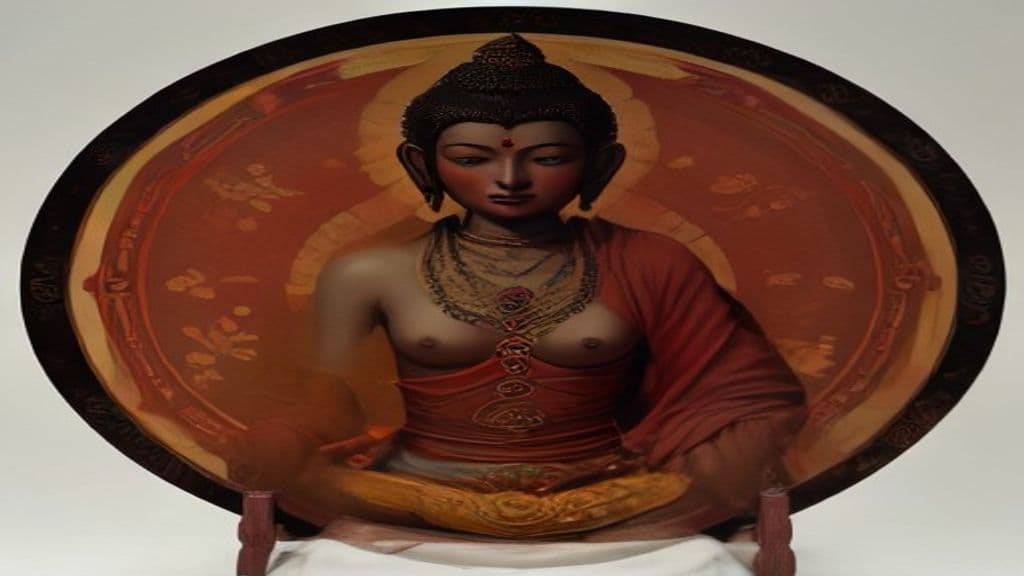
The available source does not supply a detailed iconographic description (color, posture, implements, or specific attributes). It does, however, present Samantabhadri conceptually as a dakini and as the primordial Mother Buddha — a feminine, dakini manifestation of the dharmakaya — and indicates she may be understood as an aspect of Prajnaparamita or the Great Mother. From the source material this positions her iconographically and conceptually among enlightened female figures and dakini representations in Vajrayana while noting that no specific visual traits are reported in the supplied excerpt.
The source does not list narrative or miraculous acts. Instead Samantabhadri's 'ability' is doctrinal: she embodies the dharmakaya aspect of Buddhahood in feminine/dakini form and thereby represents the uncontrived, non-conceptual ground of awakening — "the aspect of Buddhahood in whom delusion and conceptual thought have never arisen." Functionally this makes her the font or wellspring of the divine feminine aspects of enlightenment and aligns her with Prajnaparamita in role, not as an agent of discrete magical acts but as an ontological principle central to soteriology.
Weaknesses
- otherSource provides no weaknesses
Wards
- otherSource provides no wards or protective countermeasures
Samantabhadra
Samantabhadra is a sacred name used across Indian-origin traditions. In Mahāyāna Buddhism it denotes a major bodhisattva associated with practice, vows, and the transfer of merit; in Tibetan Buddhism the name (Tibetan: Kuntu Zangpo) is also used for an Adi‑Buddha or primordial principle in Dzogchen contexts; separately, Samantabhadra is the name of a historical second‑century Digambara Jain monk and author of works such as the Ratnakaranda Gaurav.

Dakinī
A dakini is a feminine spiritual figure attested in Hindu and Buddhist literature and in Himalayan Vajrayāna cultural contexts; sources in this set characterize the dakini as a type or class of goddess and as a figure embedded in tantric and Himalayan religious landscapes. Specific iconography, powers, and ritual formulas are not documented in the supplied sources.
Acala
Acala (Sanskrit: अचल, 'The Immovable') is a wrathful protective deity (dharmapala) in Vajrayāna and East Asian esoteric Buddhism, classed among the Wisdom Kings (Vidyārāja). He functions as a ritual focus for visualization and mantra practice intended to remove obstacles and bind or destroy hostile forces.
Acalanātha (Acala / Achala)
Acalanātha (also Acala or Achala) is a wrathful deity and dharmapāla — a protector of the Dharma — prominent in Vajrayana and East Asian Mahayana Buddhist contexts. Presented as a fierce, non‑human or semi‑divine protector-figure, Acalanātha functions to defend the teaching and practitioners by removing obstacles and confronting threats to the transmission and practice of Buddhism.
Amitābha
Amitābha is a central celestial Buddha of Mahayana Buddhism who presides over the western Pure Land called Sukhāvatī. Devotional practices invoking his 'measureless' light and life (nianfo/nembutsu) are presented in Pure Land traditions as a path by which beings may be reborn in his buddhafield and quickly attain Buddhahood.
Amoghasiddhi
Amoghasiddhi is one of the Five Tathāgatas (Five Wisdom Buddhas) in Mahayana and Vajrayana/Esoteric Buddhism, representing the Karma family and the quality of "unfailing accomplishment". He functions as an archetypal, protective, and contemplative buddha-body within tantric mandalas, presiding over the northern quarter and invoked in mantras and ritual iconography.
Bhrikuti
Bhrikuti is a historic-legendary 7th-century Nepali princess of the Licchavi line who became queen-consort to the Tibetan king Songtsen Gampo and, in Tibetan religious imagination, is represented iconographically and devotionally as an emanation or incarnation of Green Tara. Sources credit her with bringing sacred Buddhist images, skilled Newar craftsmen, and patronage that aided the establishment of Buddhism in Tibet; she is not presented in the sources as a harmful folk spirit.
Bodhisattva
A bodhisattva is a being or practitioner in Buddhist thought who has generated bodhicitta — the wish and compassionate intention to attain awakening (bodhi) for the benefit of all sentient beings. In Early/Theravāda contexts the term often denotes the Buddha in his pre‑awakening lives, while Mahāyāna expands it into an ideal and category of spiritually advanced, active helpers and devotees.
Bönpo Lu (local mountain spirits)
A research label for local mountain-associated spirits situated in Himalayan/Tibetan ritual worlds; the term as presented is not documented in detail in the supplied sources. The available materials place such landscape spirits within a broader Bön and Tibetan Buddhist milieu where mountains and local non-human agents are engaged through offerings and ritual specialists.
Dakinī
A dakini is a feminine spiritual figure attested in Hindu and Buddhist literature and in Himalayan Vajrayāna cultural contexts; sources in this set characterize the dakini as a type or class of goddess and as a figure embedded in tantric and Himalayan religious landscapes. Specific iconography, powers, and ritual formulas are not documented in the supplied sources.
Dharmapāla
In Buddhist traditions, a dharmapāla is a protective deity or guardian whose role is to defend the Dharma (the Buddha's teaching) and to avert obstacles to spiritual practice. Appearing across Mahāyāna and Vajrayāna contexts (notably Tibetan, Chinese, and Japanese), dharmapālas range from local worldly guardians to wrathful enlightened emanations invoked in tantric ritual.
Dīpankara Buddha
A Buddha of the past in Buddhist sacred history who, according to traditional narratives, recognized and predicted the future Buddhahood of the bodhisattva Sumedha (a previous life of Gautama/Śākyamuni). He is venerated in ritual contexts, represented in Asian Buddhist art, and commemorated in contemporary temple and festival practices.
Goddess
A goddess is a female deity — a sacred female divine figure found across many polytheistic and religious traditions. The term functions as a classificatory label for diverse culturally specific female divinities and metaphysical female principles, ranging from local patronesses to supreme cosmic realities.
Lha
Lha is a Tibetan term used in Buddhist and related Himalayan contexts to denote local or regional deities and divine presences that have been incorporated into the ritual and popular religion of Tibet and neighbouring areas. The category overlaps with indigenous spirits and classical Buddhist beings (devas, yakshas) and functions within ritual life as objects of veneration, territorial sacralization, and protective or beneficent cult practice.
Community Record
- [1]Samantabhadri (tutelary) - Wikipedia. Wikipedia, Samantabhadri (tutelary)wiki