
Sources identify shiqq as part of a pre-Islamic layer of Arabian supernatural beings that continued into Bedouin oral tradition after the advent of Islam. The cited summaries classify the shiqq within the broader taxonomy of jinn-types and describe it as a lower-ranked or lesser member of that unseen population. Beyond this placement in older Arabian cosmologies and continuity into Bedouin folklore, the available sources do not provide a detailed creation myth, genealogy, or cosmological origin specific to shiqq.
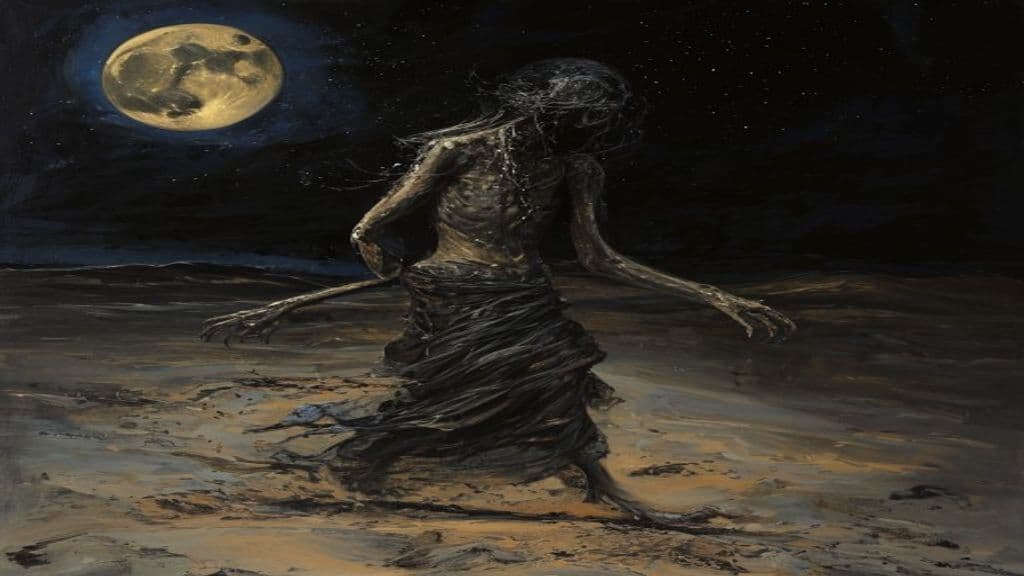
Available descriptions are brief and characterize the shiqq primarily as 'only half-formed,' producing a monstrous appearance. This half-formed descriptor links the shiqq conceptually to other half-bodied motifs in Arabian folklore (for example, the nasnas) but the sources do not supply precise anatomical details for shiqq, so assertions about exact morphology beyond the general 'half-formed' or malformed quality are not attested in the provided material. Modern media usages (animated episodes) reuse the name 'Shiqq' as a character but do not function as traditional descriptive sources.
The supplied sources do not enumerate specific powers, capabilities, or standard behaviors for shiqq beyond their classification as lower-ranked jinn-like or monstrous beings and a noted overlap with the ghoul category in folk summaries. That overlap suggests a conceptual affinity with monstrous or predatory beings in Arabian lore, but the sources do not document particular abilities, modes of attack, or interactions with humans for shiqq. Modern fictional portrayals in the cited animated episodes show narrative actions by a character called Shiqq, but these are not presented as ethnographic evidence of traditional powers.
Nasnas
A half-human djinn creature of Arab folklore — possessing only half a face, one arm, one leg, and half a torso — descended from the union of a shaitan and a human, moving by leaping and highly dangerous to encounter.

Jinn
A class of supernatural beings from pre-Islamic Arabian religion later integrated into Islamic theology; jinn are created, morally accountable entities distinct from humans and angels, often unseen but capable of taking visible forms and interacting with people in varied ways.

Ghoul
A ghoul is a demon-like or monstrous humanoid originating in pre-Islamic Arabian religion, traditionally associated with graveyards and the consumption of human flesh. The concept later entered broader folklore and has been widely reused and transformed in modern fiction and popular culture.
Al-Jānn
Al-Jānn (jann) is a pre-Adamite, ancestral category invoked in Arabic-Islamic exegetical, hadithic, mystical, and folkloric materials to designate an earlier class of sentient beings—progenitors of later jinn—said to be created of fire, to have once inhabited and sometimes ruled the earth, and to stand in a liminal ontological position between angels and humans.
Al-Mi'raj
A mythical creature from medieval Arabic literature, described as a one-horned hare or rabbit. (Note: * Power tier: Given the lack of information on abilities and powers, it's too early to assign a power tier. However, considering its classification as a "mythical creature" in medieval Arabic literatu)
Hatif
Hatif (Arabic: هَاتِف, hātif) is an auditory phenomenon in Arabic and Bedouin traditions described as a voice heard without discovering the body that made it. Sources record multiple, sometimes conflicting explanations: an unseen communicator such as a jinn, the voice of the dead near graves, or a psychological hallucination arising from loneliness.
Qutrub
A qutrub (قُطْرُب) in Arabian folklore is described in secondary sources as a type of jinn or demon associated with graveyards and corpse‑eating; it is variously likened to an 'Arabian werewolf' or a ghoul and appears in Arabic literary and manuscript references.
Shidaidaka
A regional yōkai from Japan's Chūgoku region that appears above roads and changes apparent height with an observer's gaze: it grows taller when looked up at and becomes smaller or disappears when looked down upon. Local variants record specific injunctions and narrative resolutions in several prefectures (Tottori, Shimane, Yamaguchi, Hiroshima, Okayama).
Shift
Shift is a talking ape and the primary antagonist of The Last Battle (the final book of C. S. Lewis's Chronicles of Narnia). An intelligent and articulate animal, he organizes deception and political collusion that precipitate the Last Battle and is ultimately killed during the book's climactic events.
Shii (yokai)
The provided source is a short biographical note on manga artist Daijiro Morohoshi and does not mention or describe any yokai named "Shii." Any association of a yokai called Shii with Morohoshi’s work is speculative based on this single excerpt and is not supported by the material provided.
Shipibo-Conibo ayahuasca medicine work
A culturally embedded system of healing, ritual, and artistic expression among the Shipibo-Conibo people of the Peruvian Amazon centered on ayahuasca ceremonies and medicine songs. It functions as a mode of diagnosis, healing, and transmission of unseen knowledge rather than as a single personified spirit or being.
Shishiga
Shishiga (Russian: шиши́га), also called leshenka in one account, is a female swamp or forest spirit in Russian and Komi traditional belief. Presented as a place-bound nature-being, she is associated with marshes, riverbanks and wooded margins and is said to harass people (particularly intoxicated persons) and, in Komi tradition, to be an omen or cause of drowning and death for those who see her.
Shitalanatha
Shitalanatha is the tenth Tirthankara (spiritual ford-maker) of the present Jain cosmic age (avasarpini). Venerated as an exemplar who attained omniscience (Kevala Jnana) and liberation (moksha), he is worshipped in temples and at pilgrimage shrines including a footprints shrine on Mount Shikharji.
Shiva
Shiva (Sanskrit: Śiva) is one of the principal deities of Hinduism, central to Shaivism and pan-Hindu worship. Portrayed as a paradoxical figure—ascetic yogi, householder, warrior and cosmic agent—he is described as the auspicious One who creates, protects and transforms the universe and is commonly associated with dissolution within the Trimurti framework.
Shobijin
Tiny twin fairies who serve as the priestesses and emissaries of the giant guardian Mothra (Mosura), acting as ritual singers and spokeswomen for Infant Island and its protector across multiple films and media appearances.
Community Record
- [1]Shiqq. Wikipedia contributors, 'Shiqq,' Wikipedia, The Free Encyclopedia.wiki
- [2]Shiqq (Wikidata). Wikidata entry Q131277817, 'Shiqq'.wiki
- [3]Nasnas. Wikipedia contributors, 'Nasnas,' Wikipedia, The Free Encyclopedia (used for comparative motif of 'half-formed' beings).wiki
- [4]Imago | Shiqq le divin (Épisode 10) | Épisode Complet FR. Archived episode of the animated series Imago featuring a character named 'Shiqq' (modern media usage).other
- [5]Imago | Salamantra (Épisode 9) | Épisode Complet FR. Archived episode of the animated series Imago (modern media usage referencing 'Shiqq').other
- [6]Imago | L'Imago de la lampe - Partie 2 (Épisode 2) | Épisode Complet FR. Archived episode of the animated series Imago (modern media usage referencing 'Shiqq').other
- [7]List of Jinn Types | Cryptid Wiki | Fandom. Cryptid Wiki list of jinn types (includes shiqq among various jinn categories).other