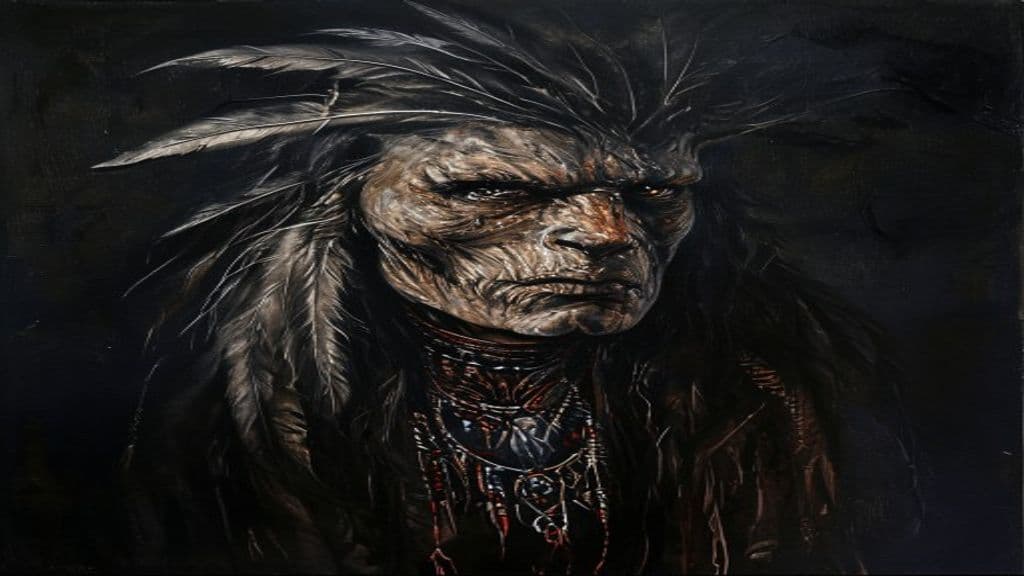
Its appearance varies depending on its form, and when it disguises itself as another person, its physical appearance is indistinguishable from that of a human.
A key characteristic of skin-walkers is their ability to transform into animals or humans, using this power to cause harm to others. They can also possess someone's body or disguise themselves as another person.
Asdzá́ą́ Nádleehé
A creation spirit in Navajo tradition, involved in the formation of the world and creation of the Navajo people. (Note: - Power tier should be Primordial (no issue) - Origin story is accurate - Appearance needs to be added, stating that no physical description is available - Abilities are mostly accurate, but more deta)
Sjtuf
Sjtuf is a Roermond processional giant — a 6‑metre-high anthropomorphic effigy (also called Christoffel) used in Dutch/Flemish giants' processions. It functions as a civic and religious pageant figure personifying Saint Christopher and is documented in archival descriptions and a Wikidata entry as a constructed parade giant rather than an autonomous supernatural being.
Sjörå
A female humanoid water spirit of Swedish folklore classed among the rå (place-keepers). Bound to a particular lake, pool, or freshwater site, the sjörå protects the waters and its fish, rewards respectful users with good catches and safety, and may seduce or drown those who are disrespectful.
Skald (Norse Poet)
In Norse tradition, a skald is a poet who composes poetry in the form of skaldic verse, often honoring kings and mythological figures. (Note: - Power tier: Downgrade to Ancient (deity-level), as the abilities described do not match Primordial level. - Appearance: Clarify that formal attire was worn during performances, but provide more spec)
Skanda
Skanda is a prominent South Asian divine figure: in Hinduism he is the war-god son of Śiva and Pārvatī (also worshipped regionally as Murugan, Kartikeya, Subramanya) and the eponym of the large Skanda Purāṇa; in East Asian Mahāyāna Buddhism he appears as a monastery guardian known as Weituo (韋馱) or Idaten (韋駄天).
Skaði
Skaði is an Old Norse mythic figure, daughter of the jötunn Þjazi who is also treated as a goddess. Associated with mountains, winter, skiing and bowhunting, she becomes the wife of the sea-god Njörðr as part of compensation for her father's death and appears among the Æsir in mythic narratives (including the binding of Loki).
Skeleton (undead)
An articulated, physically manifested collection of bones animated as an undead agent. Appears across folklore, visual art, literature, and modern popular media where it functions variously as a personification of death, a symbol in cultural practices, and a commonly used hostile creature in games and fiction.
Skinwalker
In Navajo cultural framing, the skinwalker (English label) denotes a harmful witch who can turn into, possess, or disguise themselves as an animal. The English term has also been appropriated in contemporary U.S. paranormal and media contexts (notably the named Skinwalker Ranch), where it labels a cluster of anomalous reports distinct from the Navajo witchcraft meaning.
Skjöldr (Skjǫldr / Scyld)
Skjöldr is a legendary ancestral king in Germanic/Norse tradition, commonly presented as the eponymous founder of the Danish royal line (the Skjöldungs/Skjöldungar). Attestations vary: in Old Norse sources he appears as a son of Odin who receives Denmark, while in Old English (Beowulf) he appears as a foundling (Scyld Scefing) who rises to become a powerful king.
Skogsrå
A female forest rå in Swedish folklore who rules the woods and its game; she appears as a beautiful woman from the front but reveals non-human features when seen from another angle. She interacts with hunters, woodcutters and charcoal-burners, offering favors (hunting luck, help with work, offspring) or ensnaring men who follow her into the forest.
Skondhokata
The headless ghost of Bengal — spirit of someone who died by decapitation or whose body was not found complete after death. Skondho (shoulder) + kata (cut): it carries its head under its arm, seeking the place where the head was lost and terrifying those who encounter it on rural roads at night.
Skuld (princess)
Skuld is the youngest of the three named Norns in Old Norse sources, a fate-being associated with obligation and what ought to occur; in Snorri's Prose Edda she is also listed among female figures who ride to battle in a valkyrie-like function, taking the slain and deciding fights.
Community Record
- [1]