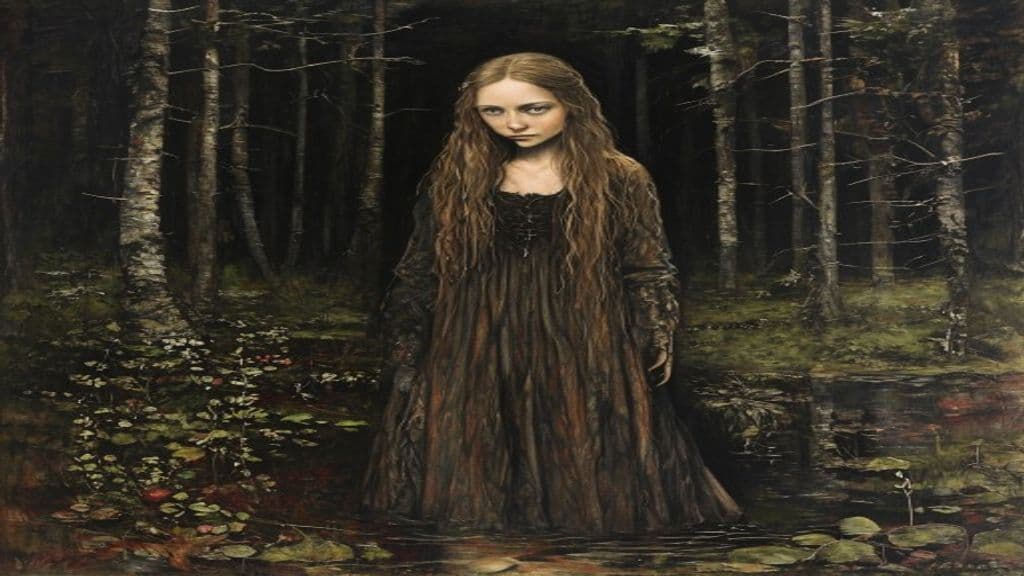
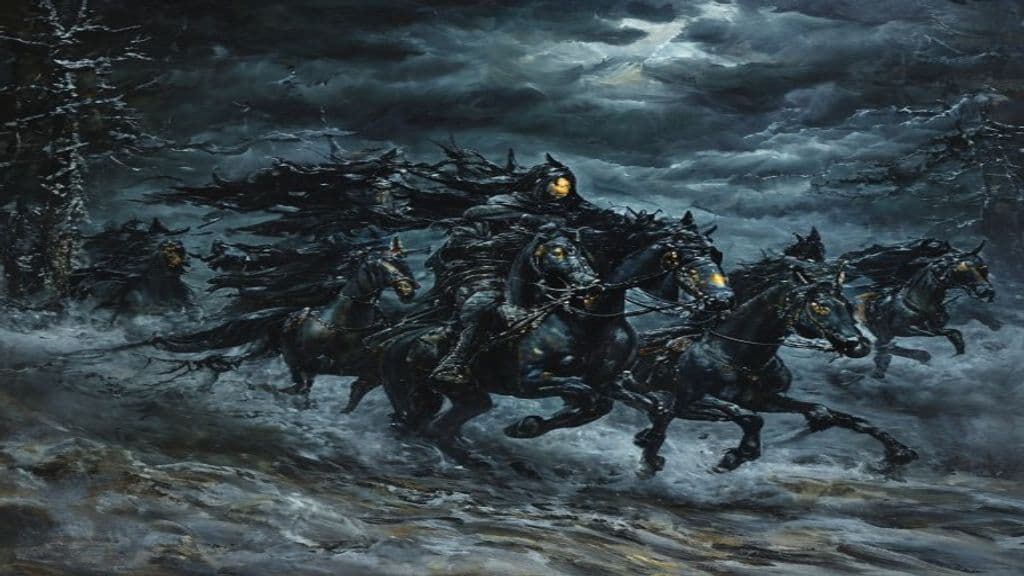
The skogsrå belongs to the Scandinavian class of domain-spirits called rå—beings who hold lordship over particular natural domains. Within this cosmology the skogsrå is the mistress or maiden of the forest, owner of the beasts and grantor of game. She is attested across Swedish sources and in neighboring regional variants (Norwegian 'Skogs-raa'; Finnish names such as metsänneitsyt, haapaneitsyt, metsänemäntä) and appears in the same folkloric layer as other land-spirits (vittra, landa, huldran). Songs and tale fragments link her to broader mythic motifs such as the Wild Hunt in some regional accounts.
From the front she commonly appears as a strikingly beautiful woman with a placid or inviting demeanor. When revealed from another angle or when a trick exposes her she shows non-human traits: a tail or hollow/rotted back (described in one tale as 'hollowed out like a trough for kneading bread'), a mix of human and animal feet (one human foot and one horse foot), or skin like tree bark. These dual aspects—attractive face, otherworldly rear—are recurrent in the collected accounts.
Tales describe her seductive power over men—leading those who follow her astray in the woods—and her capacity to grant favors to favored humans, notably success in hunting and practical help to charcoal-makers. Repeated intimacy with her is represented in some narratives as resulting in a man's decline of health or sanity, or in metaphors that his soul 'remained with her.' She also possesses specialised knowledge in stories (herbal recipes, methods to make a gunshot effective) which humans may obtain by tricking her (a common tale motif, ML 6000). She can punish inconstancy or rebuff by withholding game or inflicting other misfortune.
Weaknesses
- substancetibast (daphne) — named in tales as part of herbal countermeasures
- substancevändelrot (valerian) — named in tales as part of herbal countermeasures
- conditionbeing shot — narrative motif where shooting frees an afflicted man (regional and tale-specific)
- substancesilver bullet — attested in a Finnish Nyland account as capable of killing the skogsjungfrau (regionally recorded, not universal)
Wards
- ritualturn clothing inside-out
- substancetibast (daphne)
- substancevändelrot (valerian)
Askafroa
A female tutelary spirit identified as the localized soul or guardian of an individual ash tree in southern Swedish folk belief (notably Scania). Traditionally propitiated annually on Ash Wednesday to prevent illness or damage that was believed to follow injury to the tree.
Bergsrå
A place-bound mountain spirit (a form of Scandinavian 'rå') thought to inhabit and preside over a mountain, often described as keeping a household or court within the mountain and known for luring or taking humans into the mountain (bergtagning).
Church Grim
A site-bound guardian spirit in English, Scottish and Nordic/Scandinavian folklore that watches over an individual Christian church and its churchyard, defending the consecrated ground from profanation and hostile spirits. Forms and origin accounts vary by region, including a large black dog in English tradition, the bound spirit of an animal (often a lamb) in Scandinavian accounts, and in some Scottish strands the spirit of the most recently buried person acting as a temporary watcher.
Hag
A hag is a folkloric figure typically depicted as an old, wizened woman who appears across European traditions in multiple roles: a nightmare spirit, a witch-like or fairy-type being, a river or household monster, or (in some cases) a form adopted by sovereignty or storm goddesses. The figure functions variously as a cautionary monster, an explanation for sleep paralysis and nightmares, and a liminal test-figure in myth.
Hulder (Huldra)
The hulder (Norwegian huldra) is a class of Scandinavian 'hidden folk' — a forest-associated local spirit traditionally conceived as a race or kind rather than a single individual. They are counted among the rå (wardens/keepers) of particular natural places and are widely attested in Scandinavian toponyms and folk belief.
Sjörå
A female humanoid water spirit of Swedish folklore classed among the rå (place-keepers). Bound to a particular lake, pool, or freshwater site, the sjörå protects the waters and its fish, rewards respectful users with good catches and safety, and may seduce or drown those who are disrespectful.
Ysätters-Kajsa
A localized Swedish wind-being from the province of Närke, presented in late 19th/early 20th-century sources (notably Selma Lagerlöf) as a singular, personified 'wind-troll' who delights in gales and whirlwinds and plays mischievous but sometimes protective roles in local life.
Skin-Walker (Navajo Tradition)
A malevolent entity in Navajo culture that can transform into animals or humans, causing harm to others. (Note: - Power tier should be Greater (powerful regional) instead of Primordial (cosmic). - Remove "A key characteristic" from Abilities and just state the characteristics. - No sensory cues, weaknesses, or )
Skinwalker
In Navajo cultural framing, the skinwalker (English label) denotes a harmful witch who can turn into, possess, or disguise themselves as an animal. The English term has also been appropriated in contemporary U.S. paranormal and media contexts (notably the named Skinwalker Ranch), where it labels a cluster of anomalous reports distinct from the Navajo witchcraft meaning.
Skjöldr (Skjǫldr / Scyld)
Skjöldr is a legendary ancestral king in Germanic/Norse tradition, commonly presented as the eponymous founder of the Danish royal line (the Skjöldungs/Skjöldungar). Attestations vary: in Old Norse sources he appears as a son of Odin who receives Denmark, while in Old English (Beowulf) he appears as a foundling (Scyld Scefing) who rises to become a powerful king.
Skondhokata
The headless ghost of Bengal — spirit of someone who died by decapitation or whose body was not found complete after death. Skondho (shoulder) + kata (cut): it carries its head under its arm, seeking the place where the head was lost and terrifying those who encounter it on rural roads at night.
Skuld (princess)
Skuld is the youngest of the three named Norns in Old Norse sources, a fate-being associated with obligation and what ought to occur; in Snorri's Prose Edda she is also listed among female figures who ride to battle in a valkyrie-like function, taking the slain and deciding fights.
Community Record
- [1]Skogsrå — Wikipedia. Wikipedia: 'Skogsrå' article (descriptive material on names, appearance, behaviors, herbs, and tale motifs).wiki
- [2]Huldrefolk Maker (archive audio and notes). Recorded song fragments and archive notes referencing Wild Hunt motifs and skogsrå flight scenes.folk
- [3]Mjölner - Vilda Jakten (archive). Song recording cited in notes linking skogsrå to Wild Hunt imagery and night-chase lyrics.folk
- [4]Research notes provided by user (compiled folkloric summary). Compiled research notes supplied in the prompt summarizing attested names, rituals, appearance, abilities, regional variants, and tale motifs (including ML 6000 motif references).other