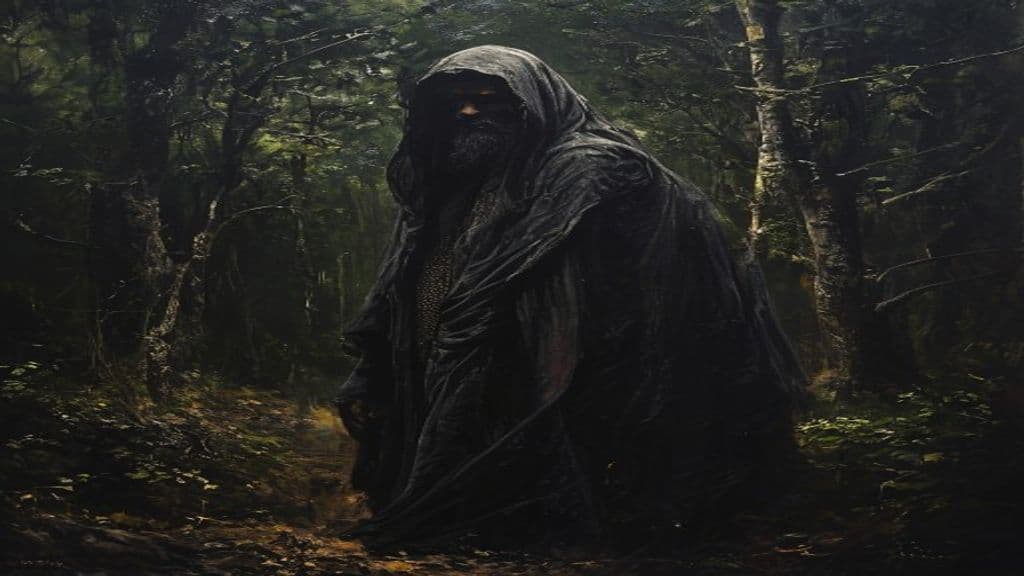
Sohrab is the son of Rostam and Tahmineh, his mother. This makes him the grandson of the king of Samangan.
No physical description is provided in the source material.
As a warrior, Sohrab presumably had martial skills.
Sleih beggey
An umbrella term in Manx tradition for the island's 'little people' or fair folk, covering a range of domestic and wild fairy types who interact with human communities — sometimes helpful or neutral, sometimes hostile, notably in accounts of hunting, music, hearth-occupation, and infant abduction.
Slender Man
The Slender Man is an internet-created fictional supernatural figure (a creepypasta/Internet meme) originating on the Something Awful forum in June 2009. Within online participatory horror culture he functions as a tall, unnaturally thin humanoid associated with liminal spaces, stalking and traumatizing victims—especially children—and whose attributes and motives remain deliberately vague and collaboratively expanded.
Sluagh
The host of the unforgiven dead in Irish and Scottish tradition — a restless swarm who travel from the west, steal souls, and attack the living, whom they carry off into their dark company.
Smallpox demon (hōsōshin / hōsōgami)
In Japanese folk belief the smallpox demon (Japanese: 疱瘡神, hōsōshin / hōsōgami) is a sickness‑spirit or disease‑kami held responsible for outbreaks of smallpox. Communities treated it as an intentional supernatural agent that could be appeased, placated, driven off, or even enshrined through ritual, performance, color symbolism (especially red), and offerings.
Smaug
Smaug is a singular, ancient dragon from J. R. R. Tolkien's legendarium (The Hobbit). He seized and occupied the Dwarf-kingdom of Erebor, guarded a vast hoard for centuries, and is portrayed as a highly intelligent, speech-capable, and vainglorious hoard-guardian whose single exposed belly-spot proves fatal.
Sobek
Sobek is an ancient Egyptian crocodile-associated deity whose roles include a fierce animal patron, protector/apotropaic power, royal/fertility god, and participant in Osirian healing myths. He appears from the Old Kingdom through the Roman period with major cult centers in the Faiyum (Shedet/Crocodilopolis) and at Kom Ombo and exists in multiple local manifestations and syncretisms (e.g., with Horus and Ra).
Soini (Finnish Mythology)
A giant and son of Kaleva in Finnish mythology, known for his mischievous tendencies. (Note: 1. Power tier should be Lesser (not Ancient) based on the description of Soini as a giant and a son of Kaleva, but not necessarily a deity-level figure. 2. Add sensory cues from Christfried Ganander's)
Solar Barque (Egyptian)
Divine vessel associated with the sun god Ra, carrying him through the sky during his daily journey. (Note: * Power tier should be Ancient (deity-level) since it's associated with the sun god Ra. * Appearance should note that no physical description exists in source material, but also acknowledge that Ra us)
Solar deity
A solar deity is a class of sky-associated divine figures whose identity or aspect is the Sun. Across many traditions the solar deity personifies solar phenomena (light, daily motion, power) and is integrated into myths of cosmology, kingship, and the afterlife.
Solomon's Shamir
A mysterious entity with the power to cut through or disintegrate stone, iron, and diamond. (Note: - Power tier should be Ancient (deity-level) instead of Primordial. - Weaknesses should not be listed as non-violent means of achieving goals; this seems unrelated to the source material's description)
Solomonari
Solomonari are weather-controlling magic-workers in Romanian folklore, described as human practitioners trained at a secret school who ride dragons (zmeu or balaur) and cause rain, thunder, or hail. They appear in 19th‑century ethnographic accounts from Transylvania, Bukovina, and adjacent Romanian regions and are associated with an institutionalized craft of magic (Scholomance/Şolomanţă) in several variants.
Solosmasthana (Buddhist tradition)
In the Buddhist tradition of Sri Lanka, Solosmasthana refers to 16 sacred places believed to have been visited by Gautama Buddha. (Note: 1. Power tier should be "Greater" or possibly even "Ancient" considering they are considered important religious locations and associated with deity-level events (Buddha's visits). 2. Origin story is )
Community Record
- [1]