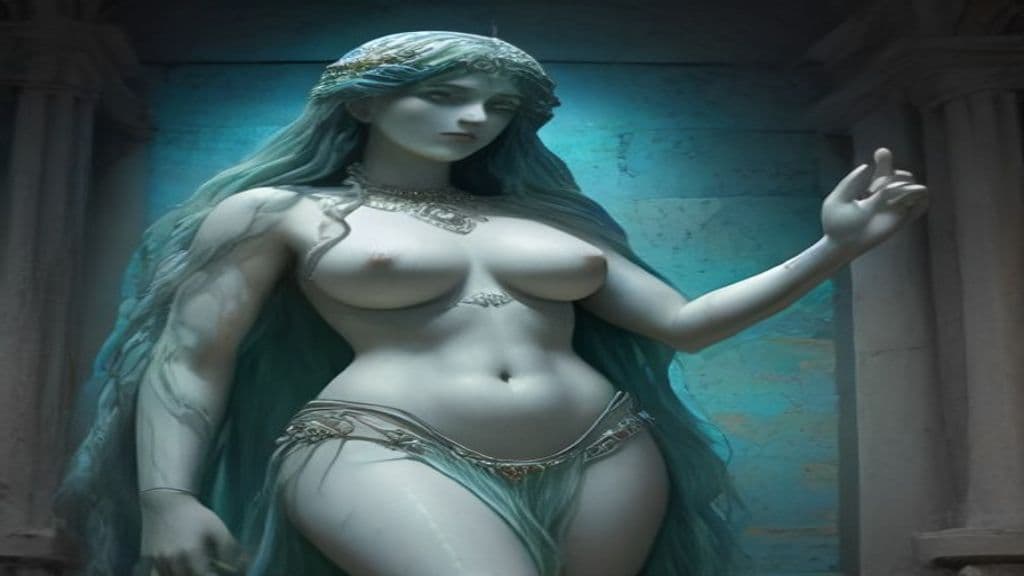
Accounts of Thalassa's place in cosmogony vary among the sources summarized in the modern literature. Hyginus (preface to Fabulae, as summarized in the secondary sources) treats Mare/Thalassa as a daughter of Aether and Dies (Day) and sister to Terra and Caelus; paired with Pontus she produces fish. Other traditions recorded in scholia and later mythographers assign Thalassa a maternal role — Diodorus Siculus is cited as calling 'Thalatta' mother of the Telchines and the sea-nymph Halia, while a scholion on Apollonius of Rhodes records a tradition (attributed to Ion of Chios) naming her mother of Aegaeon/Briareus. The Orphic Hymn to the Sea equates Thalassa with Tethys and, in that hymn, calls her mother of Kypris (Aphrodite). These variant placements indicate flexible genealogical uses of the sea-personification across Greek and Roman sources.
In literary personifications Thalassa commonly appears in the form of a woman when addressing humans (e.g., Babrius' fable-accounts where the sea 'assumes the form of a woman' to speak). In later Roman and eastern Mediterranean mosaic art she is depicted half-submerged and clothed in bands of seaweed; specific ornamental attributes recorded in the survey literature include crab-claw horns (an attribute transferred in iconographic practice from Oceanus), a ship's oar in one hand and a dolphin in the other. These visual elements are attested in the mosaic tradition summarized by modern reference works rather than as exhaustive or exclusive traits across all sources.
Sources represent Thalassa principally as a speaking personification and as a genealogical principle rather than as an agent endowed with enumerated magical feats. In Babrius' fables and other literary traditions she gives reasoned replies (for example blaming winds for storms or advising rivers who complain about salt) and participates in moral or didactic discourse. Mythographers attribute to her parental roles (mothering Telchines, Halia, Aegaeon/Briareus, or — in Orphic schema — Kypris) and literary dialogues (e.g., Lucian) show her interacting with other water-deities in conciliatory or restorative modes. The surviving materials do not record ritual powers, charms, or explicit supernatural abilities beyond those implied by personification and genealogical status.

Pontus
Pontus is attested in the supplied sources primarily as a Greek theonym meaning "sea" (Πόντος, Póntos) and as a geographic/ethnic designation for the region on the southern coast of the Black Sea. The corpus does not provide evidence of Pontus functioning as a discrete, living folkloric spirit with attendant rituals or abilities.

Tethys
Tethys is attested in the provided materials primarily as a Titaness of Greek mythic tradition who in a modern children's retelling is presented as an elderly storyteller and mediator among gods. The name is also widely reused in scientific and cultural contexts (a Saturnian moon, a gastropod genus, the ancient Tethys Ocean, and various institutions), usages which are naming transfers rather than continuations of the mythic figure.
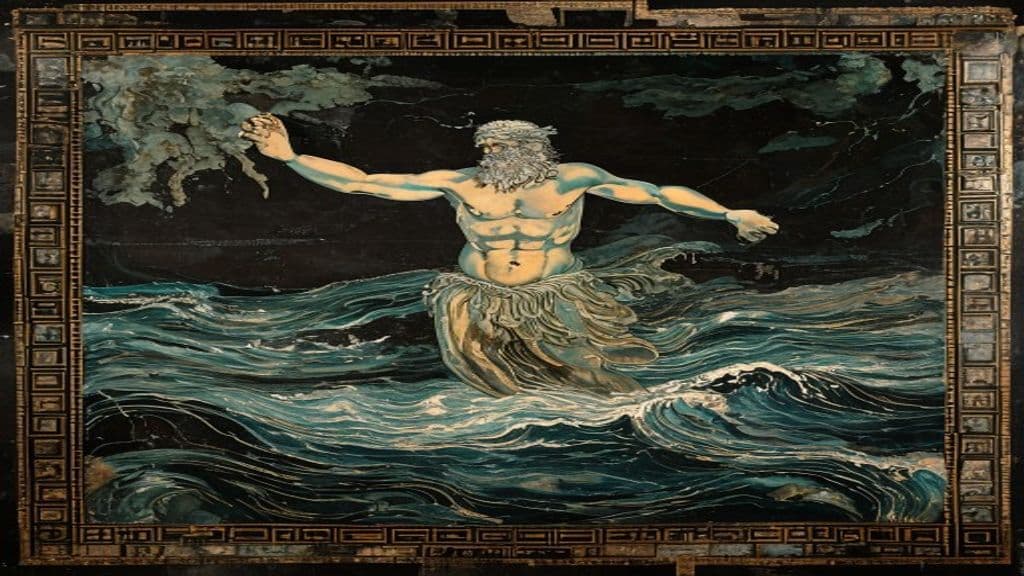
Oceanus
Oceanus (Greek: Ὠκεανός) is a primordial Titan in ancient Greek cosmology who personifies the great river that encircles the world and is named as father of the river gods (potamoi) and the Oceanids. He functions as a cosmological boundary-stream and genealogical progenitor in multiple Greek traditions and appears in literary theogonies and Greco-Roman art.
Aeolus
Aeolus is a name applied to multiple related figures in Greek myth: an eponymous son of Hellen (founder of the Aeolian people), a son of Poseidon who led colonial ventures to Tyrrhenian islands, and a son of Hippotes depicted in epic as a ruler or keeper of the winds. Ancient mythographers note confusion and overlap among these persons.
Alces
Alces is a minor figure in Greek mythographic genealogies: an Egyptian prince counted among the sons of King Aegyptus and named as the husband of the Danaid Glauce. He is attested only in catalog-style lists of Aegyptid sons and not as an independently active or culted supernatural being.
Brettia
Brettia (Ancient Greek: Βρεττίας in the surviving lexicon entry) is an eponymous nymph credited in Greek ethnographic/place-name handbooks as the name-source of the district Abrettene in Mysia. She is attested only in lexicographical/ethnic compendia and is presented as a local, place-personifying divine figure rather than a figure with recorded myths, cult practice, or narrated deeds.
Ecbasus
Ecbasus (Greek: Έκβασος) is a minor figure in Greek mythic genealogies, presented as a son of Argus and an ancestor within the ruling houses of Argos. He functions primarily as a connective ancestral link between better-known mythic figures (Argus, Agenor, Argus Panoptes, Pelasgus) rather than as an active heroic or supernatural agent.
Iphiboe
Iphiboe (Greek: Ἰφιβώη) is a named maternal figure in Greek mythographic genealogies, attested in some traditions as the mother of Augeas. She appears in scholia and later mythographic compilations as one variant among several given for Augeas’s mother, and in at least one tradition (Tzetzes on Lycophron) is linked to Crete.
Tethys
Tethys is attested in the provided materials primarily as a Titaness of Greek mythic tradition who in a modern children's retelling is presented as an elderly storyteller and mediator among gods. The name is also widely reused in scientific and cultural contexts (a Saturnian moon, a gastropod genus, the ancient Tethys Ocean, and various institutions), usages which are naming transfers rather than continuations of the mythic figure.
Teucer
Teucer (Greek: Τεῦκρος, Latinized Teucer/Teucrus) is a mythic human hero of the Homeric age: an accomplished archer, son of King Telamon and Hesione, half‑brother of Ajax, a participant in the Trojan War and later an eponymous founder (most commonly credited with founding Salamis on Cyprus). He appears in epic (Homer) and tragic (Sophocles, Euripides) traditions and functions as a legendary warrior‑founder in Greek mythic genealogies.
Teutamides
Teutamides (Ancient Greek: Τευταμίδης), also attested as Teutamus (Τεύταμος), is a mytho-historical king of Larissa in Thessaly known from classical genealogical accounts. He appears in Greek mythographic traditions as son of Amyntor, father of Nanas and Lethus, and as a great-grandson of Pelasgus, linking autochthonous ancestry to later heroic generations.
Teuthras
Teuthras (Ancient Greek: Τεύθρας) is a legendary king of Mysia in the Greek mythic-historical tradition, eponymous for the district or town Teuthrania/Teuthraea. He appears in genealogical and epic-cycle narratives as a local ruler who hosts Auge and provides refuge and succession to the hero Telephus, with variant accounts of familial relations across sources.
Thalia
Thalia is not a single supernatural being in the supplied sources but a personal name applied to multiple distinct figures in Greek myth (a Muse, a Grace, a Nereid, and a nymph/minor vegetation goddess) and to various modern secular persons, places, and institutions. The provided materials are disambiguation and archival records and do not present a unified cosmology or ritual system for a single entity named Thalia.
Thalpius
Thalpius is a human heroic figure of Greek myth, an Epeian leader from Elis and son of Eurytus of the Molionid line. He is listed among the leaders who sailed to Troy in the Catalogue of Ships and appears in later mythographical and local genealogical tradition as part of the ruling network of Elis.
Thanatos
Thanatos (Greek: Θάνατος) is the personified figure of Death in ancient Greek myth — a divine, chthonic agent who escorts or takes the dead. He appears across literature and art as an operative presence of mortality, frequently paired with his twin Hypnos (Sleep) and counted among the children of Night (Nyx).
Community Record
- [1]Thalassa (Wikipedia). Wikipedia contributors, 'Thalassa,' Wikipedia, The Free Encyclopediawiki
- [2]Thalassa (moon) (Wikipedia). Wikipedia contributors, 'Thalassa (moon),' Wikipedia, The Free Encyclopediawiki
- [3]Wikidata: Thalassa. Wikidata entry for Thalassaother
- [4]Babrius (fable tradition), Lucian, Diodorus Siculus, Hyginus, Orphic Hymns (as summarized). Classical authors cited in the modern summary: Babrius; Lucian; Diodorus Siculus; Hyginus; Orphic Hymns (see consolidated references in the Wikipedia article)literary