
Sources do not record a unified cosmogonic origin or narrative birth for Werethekau. Rather, she emerges in texts and material culture as the personified quality of hekau (magical power); her identity functions both as an independent goddess in some inscriptions and as an epithet or attribute attached to other deities and to royal and protective objects.
Iconography varies and appears to be uncommon; sources describe Werethekau sometimes as a snake or as a lion-headed woman and, when associated with Ra-Horakhty, depicted with his solar disk on her head. At the same time at least one source notes she was seldom depicted in reliefs or papyri, indicating that visual representations are inconsistent and relatively rare.
Werethekau embodies the efficacy of magic (heka) and serves a chiefly protective function. Her name and image are placed on funerary objects and weapons so the deceased can defend themselves in the underworld, on ivory knives as charms to protect pregnant and nursing mothers, and she is described as an inherent power of the Crowns of Egypt and as dwelling in the state sanctuary. She is frequently used as an epithet for goddesses such as Isis, Sekhmet, and Mut, signaling that her power is both an independent divine force and an attribute conferred through other deities.
Weaknesses
- otherSources do not record specific weaknesses or vulnerabilities for Werethekau
Wards
- symbolDepiction/inscription of Werethekau on objects (funerary weapons, ivory knives, crowns) used as talismanic protection
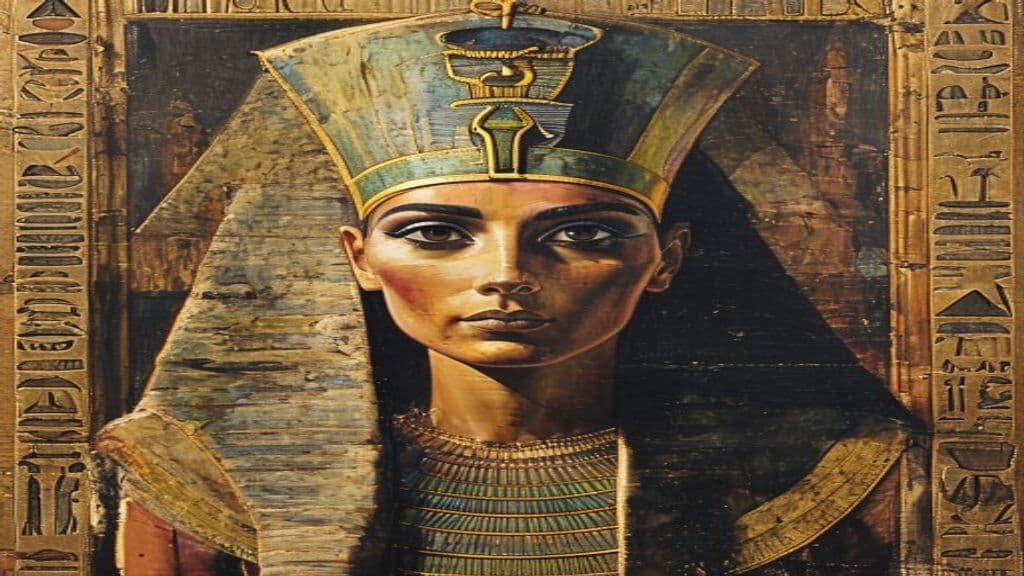
Isis
Isis is a major goddess of ancient Egyptian religion, a member of the Heliopolitan Ennead who functions as sister and consort of Osiris, mother and protector of Horus, a funerary and royal protector, and a locus of potent magic whose cult spread through the Hellenistic and Roman Mediterranean.

Sekhmet
Sekhmet is an ancient Egyptian lioness-headed goddess who functions as the vengeful 'Eye of Ra', a solar agent of divine punishment, and simultaneously as a powerful healing and protective deity invoked against disease. Her mythology and cult deploy the same ambivalent force for destruction and restoration, with ritual practices developed to both propitiate and emulate her pacification.
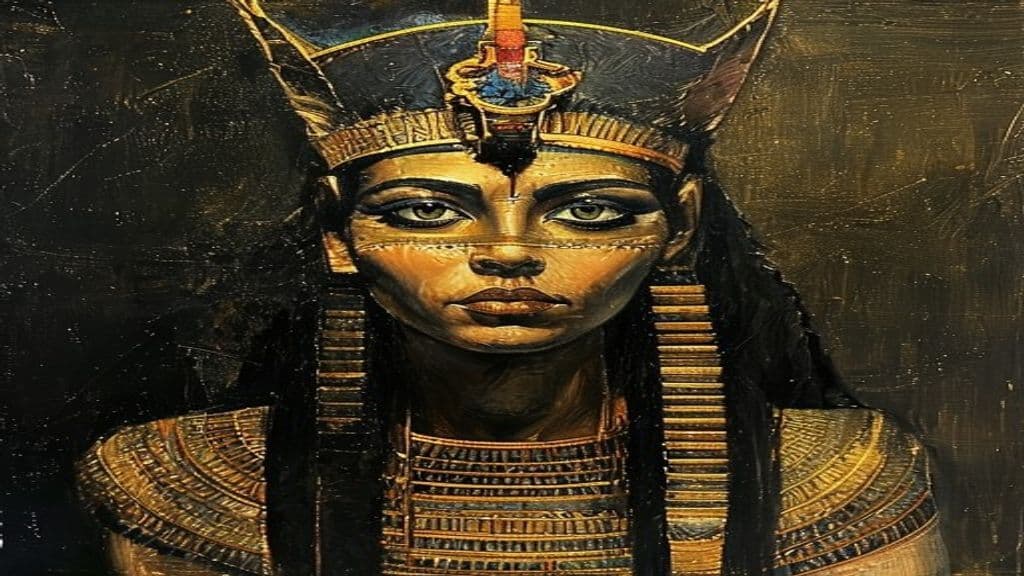
Mut
Mut is an ancient Egyptian mother goddess associated with the primordial waters (Nu), the Theban Triad, and the Eye of Ra corpus. She functions as a cosmic maternal principle, a local patroness of Thebes with temples and priesthood, and a shifting consort/maternal figure within Amun-centered theology.

Ra-Horakhty
Ra-Horakhty is a syncretic ancient Egyptian deity combining Ra (the principal solar god associated with the noonday sun and rulership) and Horus in his horizon-related aspect. The compound, glossed as "Ra who is Horus of the Two Horizons," expresses the sun's journey across the horizons and the fusion of solar sovereignty with royal/sky symbolism in Egyptian theology.
Hathor
Hathor (Ancient Egyptian ḥwt-ḥr, 'House of Horus') is a major polyvalent goddess of ancient Egypt associated with the sky, maternal and royal motherhood, music, joy, fertility, and the Eye of Ra; she appears in multiple local manifestations and assisted the deceased into the afterlife.
Isis
Isis is a major goddess of ancient Egyptian religion, a member of the Heliopolitan Ennead who functions as sister and consort of Osiris, mother and protector of Horus, a funerary and royal protector, and a locus of potent magic whose cult spread through the Hellenistic and Roman Mediterranean.
Petbe
Petbe is attested in modern summaries as a localized deity associated with retributive justice, described as a "god of revenge" worshipped around Akhmim in central Egypt. Sources present competing etymological readings (e.g., "Sky-Ba" vs. a hybrid Pet-(Baʻl)) and offer little surviving detail about cult practice, iconography, or myths.
Qebui
Qebui is an ancient Egyptian deity personifying the north wind. Attested in modern summaries of Egyptian religion, Qebui is identified primarily by his directional role and distinctive iconography.
Wadj-wer
Wadj-wer is an ancient Egyptian deity-personification of large northern waters called the "great green," associated with fertility and the productive richness of the Nile Delta. Modern descriptions often equate him with the Mediterranean Sea, while primary evidence and some scholarly readings emphasize lagoons and lakes of the northernmost Delta; his earliest attestation is on a 5th Dynasty mortuary temple of Sahure.
Werecat
A werecat is a folkloric category of therianthropic beings or people associated with transformation between human and feline forms. The motif appears across Europe, Africa, South and Southeast Asia, and China, with locally specific explanations (witchcraft, hereditary curse, sorcery, ghostly influence, or divine/royal descent).
Werehyena
A supernatural being from Central African tradition and the Arabian Peninsula that can shapeshift between human and hyena forms. (Note: 1. Power tier: Should be "Greater" instead of "Ancient", as the source material does not describe the Werehyena as a deity-level entity. 2. Origin story: Should state that the origin is unknown or not)
Werejaguar
The werejaguar is an Olmec iconographic motif and reconstructed supernatural found throughout the Olmec archaeological record; scholars treat it variously as a recurring visual type, a class of supernaturals, a possible rain-associated deity, or a spirit-helper used in elite ritual contexts.
Wererat
A gaming monster from tabletop role‑playing bestiaries presented as a humanoid shapechanger that can take human, rat‑humanoid hybrid, and giant rat forms. The wererat appears primarily in modern fantasy role‑playing game materials (Dungeons & Dragons, Pathfinder) and associated hobby media such as miniatures and adventure conversions.
Werewolf
A figure of European folklore of a human who can change into a wolf or wolf–human hybrid, variously portrayed as voluntary shapeshifter, cursed afflicted person, or clinical delusion (lycanthropy). Belief in werewolves was entwined with medieval and early modern witchcraft accusations and persisted into Gothic and popular fiction.
Wewe Gombel
Wewe Gombel is a female spirit or vengeful ghost in Javanese/Sundanese Indonesian folklore associated with the abduction and protective custody of children who are mistreated or left out at night; she is used pedagogically to warn children to stay home and to signal parental responsibility.
White Dragon Horse
A dragon prince from the West Sea who, after punishment and Guanyin's intervention, is transformed into and serves as Tang Sanzang's steed in the 16th‑century Chinese novel Journey to the West; by the pilgrimage's end he is ordained as a bodhisattva and resumes dragon status in a temple role.
Community Record
- [1]Werethekau. Wikipedia, 'Werethekau' article (accessed via provided research notes)wiki
- [2]Werethekau & Isis Great of Magic – Isiopolis. Isiopolis blog quoting Ebers Papyrus and discussing the epithet Weret Hekaufolk
- [3]The Goddess Werethekau & Isis – Isiopolis. Isiopolis blog on Werethekau and her usage as an epithetfolk
- [4]Urthekau, Werethekau (nemo.nu). Nemo.nu summary noting lion-headed depiction and rarity of depictionsother
- [5]werethekau | Ancient Egypt Online. Ancient Egypt Online entry on Werethekau (referenced in research notes)other