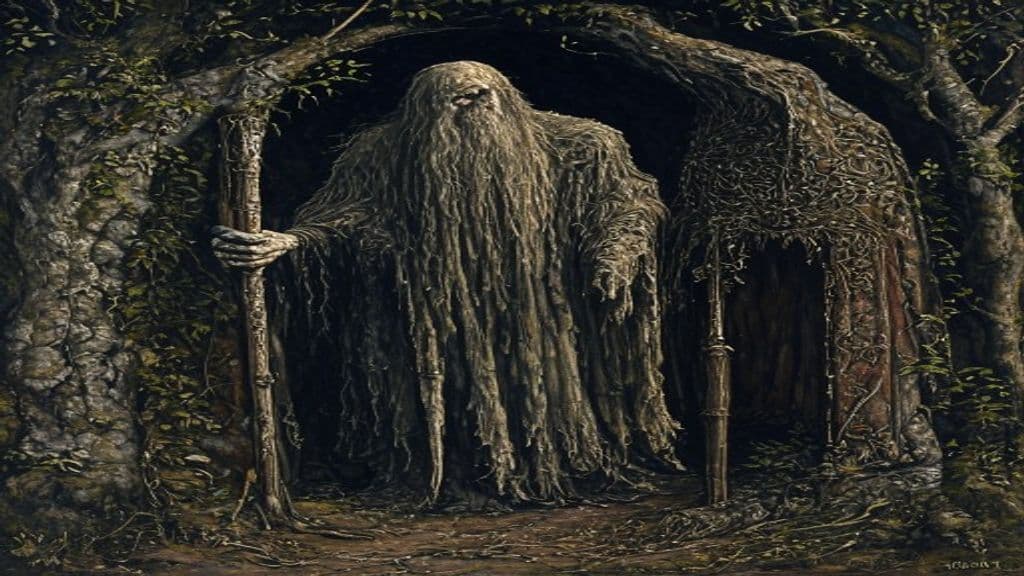
Etymologically the English wight descends from Old English wiht (Middle English wight/wiȝt) and is cognate with Old Norse vættr/ vættir and related North Germanic forms; the lexical family denotes a created being or 'that which exists'. In medieval Christian contexts the term was used within an ontology distinguishing created beings from God and could be applied across a moral range (including saints in some texts). Over time during Middle English and later literary developments the term's semantic range shifted and was reinterpreted in different registers, including a later literary narrowing in modern fantasy to particular undead figures.
No single, consistent physical form is attributed to a 'wight' in the historical material: Old English usages can apply the term to ordinary human figures and to monstrous agents in epic poetry (for example the lexical field includes characters like Grendel or the dragon in Beowulf when translated as 'creature' or 'wight'), while Old Norse and later Scandinavian cognates occur in contexts for local nature and household beings (vætter/vættir, vätte) that are commonly imagined in folklore as small humanlike land- or house-spirits. Thus traditional appearances range from mundane human persons to small nature-spirits to monstrous beings, with the modern fantasy undead depiction arising as a later, genre-specific innovation rather than reflecting the older folkloric range.
Abilities and behaviours vary with the subcategory indicated by the term: as a generic 'created being' no special powers are implied; as Old Norse vættir the term appears in compounds denoting land-vættr (guardian spirits of place), bjargvættr (helping sprite), and mein-vættr (evil wight), indicating roles that include protecting, aiding, or harming depending on type. Medieval uses sometimes extend to sanctified figures, reflecting protective or sanctified capacities in certain registers. Modern fantasy sources attribute undead powers (life-drain, reanimation) to 'wights', but those traits are literary developments distinct from the broad historical semantic field.
Weaknesses
None recorded.
Wards
- otherpropitiation and respectful behaviour toward local vættir (Scandinavian comparative practice; not specifically detailed in supplied sources)
Agnarr Geirröðsson
Agnarr Geirröðsson is a mortal prince attested only in the Poetic Edda poem Grímnismál; he aids Odin (disguised as Grímnir) during Geirröðr's torture and, after Odin reveals himself and King Geirröðr dies, Agnarr succeeds as king.
Anund (Bröt-Anund)
Anund, commonly known by the byname Bröt-Anund ('trail‑blazer' or 'land clearer'), is a semi-legendary Swedish king of the Yngling dynasty attested in early Norse genealogical poetry and saga prose. Sources credit him with avenging his father in Estonia, accumulating wealth, promoting settlement by clearing land and making roads, and dying under ambiguous circumstances (landslide or killing).
Aurvandill
Aurvandill is a figure attested in medieval Germanic onomastics and Norse narrative, most famously remembered in an Old Norse tale where Thor carries him across icy rivers and his frozen toe is cast into the sky as the star called Aurvandils-tá. Comparative linguistic study reconstructs a Common Germanic name associated with dawn or the morning star.
Beaduhild (Böðvildr)
Beaduhild (Old Norse Böðvildr; Old English Beaduhild/Beadohild; also Bodil, Badhild) is a legendary human princess in Germanic heroic tradition whose life is entangled with the smith Wayland (Weland/Vǫlundr). In earlier sources she appears as a tragic victim in the Weland cycle; in later Scandinavian recensions she is recast as Wayland's wife and the mother of a heroic descendant (Viðga).
Billingr
Billingr is a named paternal figure in Old Norse sources, best attested as the father of a maiden whose household prevents Odin from consummating a nocturnal rendezvous (Hávamál stanzas 96–102). Manuscript and kenning evidence leave his taxonomic identity (dwarf or jötunn) ambiguous.
Dark Lord
A literary and media archetype representing the supreme antagonist: a centralized embodiment of evil, darkness, or death who commands lesser agents and opposes heroic protagonists. Treated in sources as a narrative trope rather than a discrete folkloric being.
Domalde (Dómaldi)
Domalde (Old Norse Dómaldi/Dómaldr) is a legendary Swedish king of the Yngling dynasty whose reign is associated with prolonged famine. In Old Norse sources his personal ill‑luck (ósgæssa), said to be caused by a curse from his stepmother, is presented as coterminous with the land's fertility; communal cultic escalation culminates in the king's sacrificial killing and the restoration of good harvests.
Dwarf (folklore)
A type of supernatural, human-shaped being in Germanic tradition associated with subterranean places, craft (notably metalwork), and a liminal role between nature and culture. In Norse mythic sources dwarfs function as artisan-makers of powerful objects for gods and occasionally appear in folktales as magical servants bound to objects.
Eadgils (Aðils / Adils)
Eadgils is a semi-legendary 6th-century Swedish king of the Yngling/Skilfing dynasty attested in Old Norse skaldic poetry and sagas and in the Anglo-Saxon epic Beowulf. Sources present him as a dynastic figure whose exile, restoration, and conflicts (notably with Onela/Áli and later associations with Hrólfr Kraki) explain succession and inter-kingdom violence; he is treated as a mortal ruler rather than a supernatural being.
Fire-breathing monster
A cross-cultural mythic category of monster defined by the ability to expel flame (or fire-like phenomenon) from the mouth or nostrils. Appears in multiple traditions (e.g., Greco-Roman, Hebrew/Biblical, Anglo‑Saxon, Japanese, Philippine, Native American, West African, Mapuche) and in modern fantasy as a recurring trope.
Fjalar and Galar
Fjalar and Galar are two named dwarf brothers in Old Norse myth who murdered the wise being Kvasir and transformed his blood into the mead of poetry; they also killed the jötunn Gilling and his wife, an act that led Suttungr to take possession of the mead. Their actions set in motion the canonical mythic sequence recorded in Skáldskaparmál/Prose Edda linking dwarfs, giants, gods, and the origin of poetic inspiration.
Fulla
Fulla (Old Norse Fulla; Old High German Volla/Folla) is a named goddess (ásynja) in the Germanic tradition, attested as Frigg's trusted attendant and confidante in Old Norse sources and as a named singer in the Old High German Merseburg horse-healing charm.
Community Record
- [1]Wight. Wikipedia: 'Wight' (entry on etymology, historical senses, Old Norse cognate, and modern fantasy usage).wiki