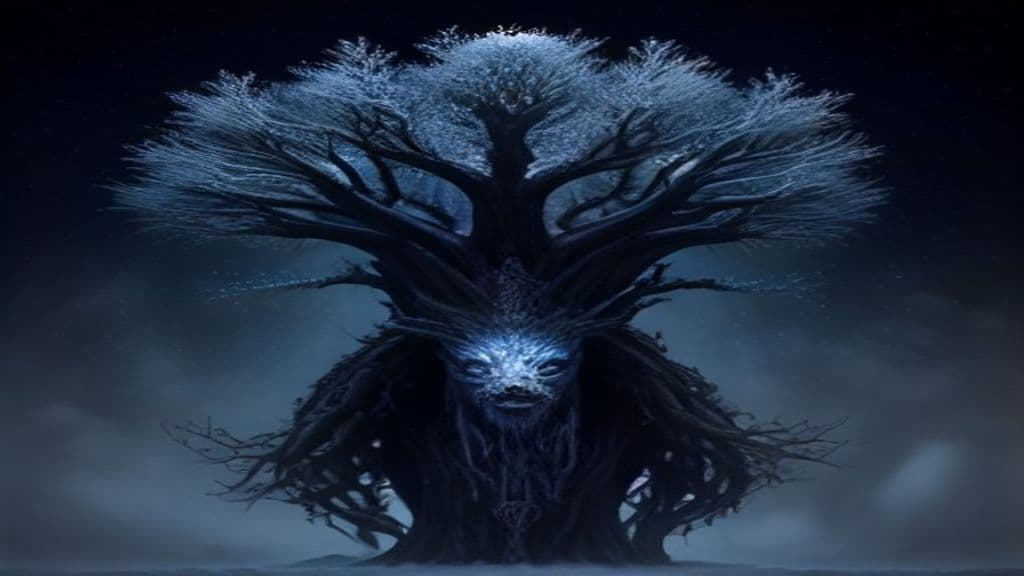
Across the surveyed traditions the World Tree appears in origin and cosmological accounts rather than as a single unified narrative. In Mesoamerican sources the world tree appears in creation accounts and civic-ceremonial cosmography, marking cardinal directions and participating in cosmogony (Source 9). In Siberian shamanic descriptions a great Tree grows upon a mountain at the center of the world and contains multiple planes through which shamans travel; these accounts present the tree as a preexisting cosmic structure that orders existence (Source 12). Norse tradition names the central cosmic tree Yggdrasil and treats it as the pivotal arboreal axis of that cosmology (Source 10). Comparative summaries note the motif's presence in Indo-European and Native American cosmologies and emphasize its role in ordering heaven, earth, and the underworld (Source 1).
The World Tree is depicted as a colossal, singular tree far larger than ordinary trees, whose trunk and crown reach the heavens while its roots extend into the underworld, making it a vertical axis between cosmic levels (Source 1). Siberian descriptions place a great Tree on a central mountain that contains waters and internal planes, with the Waters of Life rising on one side and healing Waters of Death on the other (Source 12). Mesoamerican iconography represents world trees stylized in codices and monuments as central trunks with directional branches that mark the four cardinal directions and cosmological points (Source 9). Norse references invoke Yggdrasil as the central tree of that mythic landscape (Source 10).
Rather than acting as an animate agent, the World Tree functions cosmologically: it supports or upholds the heavens, connects heaven, earth, and the underworld, and thereby mediates passage or relation between realms (Source 1). In some Siberian accounts the tree channels symbolic waters—life on one side and healing/death waters on the other—indicating a mediating role in life, death, and healing symbolism (Source 12). Mesoamerican world trees order space by embodying the four cardinal directions and participate in creation accounts, giving them a role in spatial and civic cosmography (Source 9). The surveyed sources do not describe consistent volition, speech, or direct interpersonal agency for the tree; its functions are structural and symbolic within cosmologies (Sources 1, 9, 12).
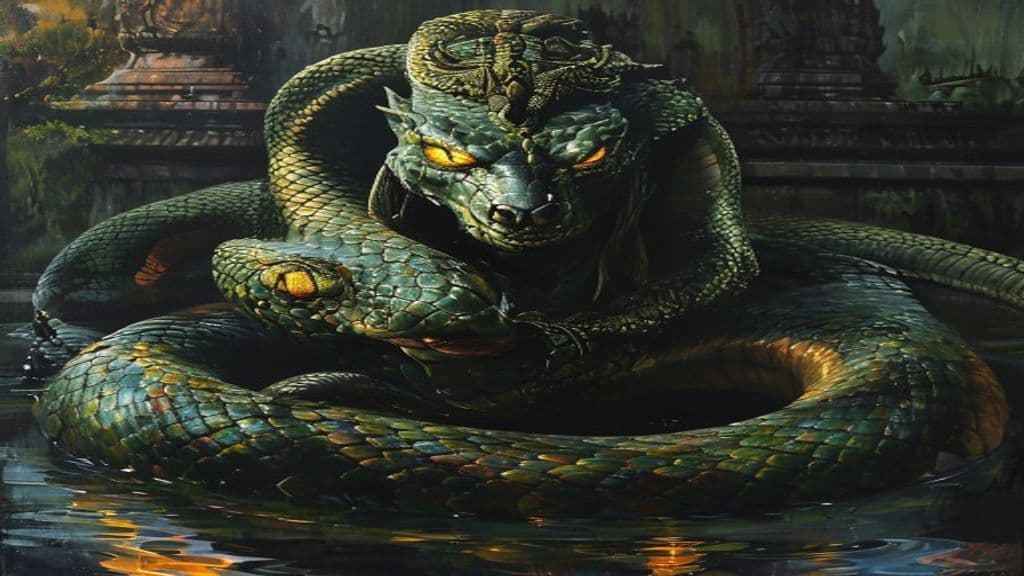
Naga
Divine serpent beings of Hindu, Buddhist, and Jain cosmology — powerful guardians of water, earth, and underground treasures. Revered as deities in South and Southeast Asia.
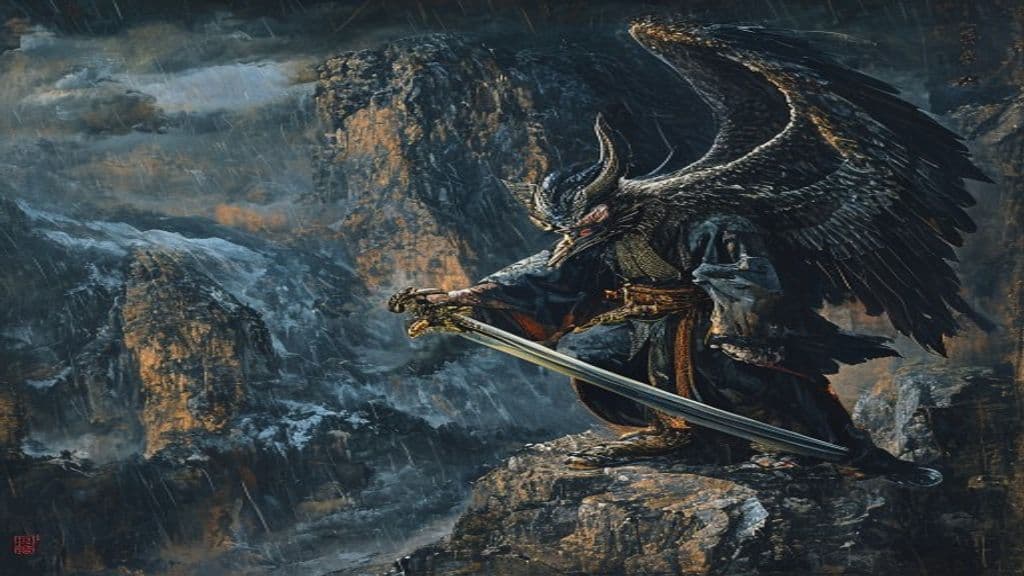
Tengu
Proud, warrior-like mountain spirits of Japan, associated with martial arts, pride, and the wild mountains. Neither fully good nor evil — they test and train warriors and monks, but punish the arrogant.
Baldr
Baldr (Old Norse Baldr; Old English Bældæġ; Old High German Balder/Palter) is a god in Germanic mythology. In the Norse branch he is named as a son of Odin and Frigg and as a member of the Aesir, attested alongside brothers such as Thor and Váli in the supplied sources.
Black Shuck
A spectral black dog of East Anglian legend, with glowing red or green eyes. Its appearance is an omen of death. Its howl has been heard on clifftops during storms for centuries.
Deutsche Mythology
A collection of mythological narratives representing the collective myths, legends, and beliefs of ancient Germanic cultures. (Note: 1. Power tier: Primordial (Deutsche Mythology as a collective mythological narratives does not have supernatural abilities and behaviors attributed to it; rather, it contains those of individual Germa)
Domar (Dómarr)
Domar (Old Norse Dómarr, 'Judge') is a legendary Swedish king of the Yngling dynasty attested in medieval Scandinavian genealogical sources. He is presented as a mytho-historical ancestral ruler whose long and peaceful reign follows the sacrificial death of his father Domalde and whose own death was marked by cremation at Fyrisvellir and erection of a memorial stone at Uppsala.
Dragon (Long)
Long (龍, "dragon") is a pervasive cultural and artistic motif that appears in Taoist sacred-geographical contexts, Chinese literature, and modern exhibitions; the provided sources treat it as part of the broader mythic imagery present around Taoist sites and ritual scenes rather than as a single, consistently described doctrinal entity.
Draugr
In Nordic folklore the draugr (plural draugar; anglicized draug) is an archaic term for a malevolent revenant — a dead person who returns and remains active in the world of the living. Accounts emphasize variability: traits, behaviours, and descriptions change between stories and across regions, especially in early medieval Icelandic sagas and surviving Norwegian folklore.
Dís (dísir)
In Norse/North Germanic tradition, a dís (pl. dísir) is a collective term for female supernatural beings whose roles range from protective ancestral spirits and fertility figures to fate‑linked women comparable to valkyries or norns; they are invoked in both private and public cult (notably the dísablót) and can be benevolent or hostile toward humans.
Eystein Halfdansson
Eystein Halfdansson (Old Norse: Eysteinn Hálfdansson) is presented in Norse king-list and saga tradition as a semi-legendary Norwegian petty king of the House of Yngling who ruled Romerike and acquired Vestfold by marriage. He is depicted as a dynastic ruler and Viking raider whose death is attributed in Snorri's Ynglinga saga to a magical act performed by King Skjöld of Varna.
Fenrir
The monstrous wolf son of Loki, bound by the gods with a magical ribbon until Ragnarök — when he will break free and swallow Odin, and the world.
Fylgja
A supernatural accompanying spirit in Old Norse tradition tied to a person's or family's fate and fortune. The fylgja appears most often as a female human figure or as an animal, commonly in dreams, and functions as an omen-bearing presence connected to destiny rather than an agent that alters fate.
Huldra
A seductive forest spirit of Scandinavian folklore — beautiful from the front but with a cow's tail or hollow back — who lures men into the wilderness, sometimes to their ruin.
Jade
Jade is a material and cultural concept referring to two distinct groups of ornamental rocks—nephrite and jadeite—valued across many societies (not a supernatural being). It has deep historical, ritual, and symbolic significance especially in East Asia and Mesoamerica, and carries folk associations with health and social status.
Community Record
- [1]World Tree (Wikipedia). Wikipedia, 'World tree' article — comparative summary noting motif in Indo-European, Siberian, and Native American religions and functions linking heavens, earth, and underworld.wiki
- [2]Mesoamerican world tree (Wikipedia). Wikipedia, 'Mesoamerican world tree' — notes prevalence of world-tree motif in pre-Columbian Mesoamerican cosmologies, creation accounts, and iconography marking cardinal directions.wiki
- [3]World Tree — shamanic summary (users.lmi.net). Web summary of shamanic/world-tree motifs — describes Siberian cosmology where a great Tree grows on a mountain at the center of the Earth, mentions Waters of Life and healing Waters of Death and that seven planes exist within the Tree.folk
- [4]Heimdall, the World Tree, and All of Us (Norse Mythology Blog). Norse-focused blog invoking Yggdrasil as the World Tree central to Norse mythology; used here to identify Yggdrasil as the Norse instance of the world-tree motif.other