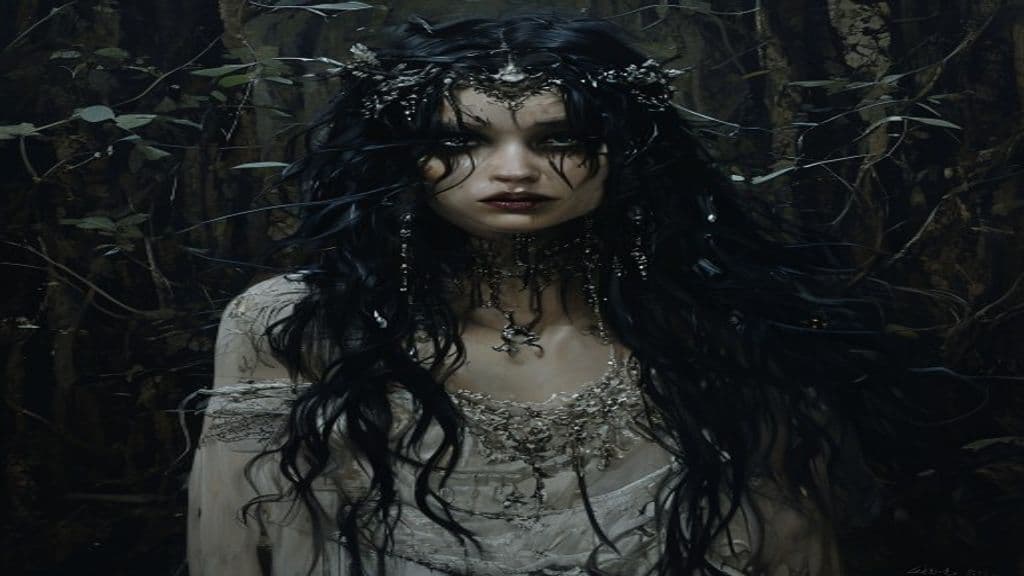
There is no specific origin story mentioned in the source material. It can be inferred that Xtabay may have originated from Maya mythology, but further research is required to understand her full mythological context.
La Xtabay has beautiful, shining black hair that falls down to her ankles and wears a white dress.
She preys upon men in the Yucatán Peninsula, using her beauty to lure them to their deaths.
Weaknesses
- conditionnone mentioned
Wards
- ritual|substance|symbol|mantra|conditionnone specified
Wōden
Wōden (reconstructed Proto‑Germanic Wōðanaz) is the chief figure of Germanic paganism attested across Norse mythological sources and historical records of Northern Europe; scholarship reconstructs his name as linked to frenzy or possession and to poetic inspiration. Surviving information about him comes largely from medieval Norse literature and later historical commentaries of the Germanic world.
Xanthe
Xanthe (Greek: Ξανθή, Xanthē) is primarily a Greek-derived personal name meaning "blond-haired" attested across mythological, toponymic, astronomical, and modern personal-name usages. In the supplied sources it appears as the name borne by multiple distinct figures in Greek myth (an Oceanid, an Amazon, and as an alternate name applied to Epione) and as a modern given name and place/asteroid name, rather than as a single unified supernatural entity with its own cult or powers.
Xanthus (Ξάνθος)
Xanthus (Ancient Greek: Ξάνθος) is a recurring proper name in Greek myth and geography applied to multiple distinct beings and places: a river-personification (the divine name for the Scamander at Troy), one of Achilles' pair of immortal horses, several mortal figures (e.g., a Theban king), and the Lycian city and river Xanthus/Xanthos. The name literally means "yellow" or "blond" and functions as a descriptive epithet transferred across persons, animals, and places.
Xezbeth
Xezbeth (alt. Shezbeth; Arabic: al‑Kadhāb, "The Liar") is attested in Western demonological reference works and modern creative uses as a named demon associated with lies, invented tales, and the propagation of false legends.
Xoanon (Greek)
A wooden cult image used in Archaic Greece, often associated with deities or legendary figures. (Note: - Power tier should be Primordial (since Xoana are described as having spiritual significance and being associated with legendary figures/deities, implying they may have had more fundamental or univer)
Xolotl
Xolotl is an Aztec (Nahuatl) deity and liminal psychopomp associated with death, misfortune, twinship, deformity, and transformation; he functions as the dark/evening twin of Quetzalcōātl and escorts the dead through Mictlān while participating in creation narratives and lightning/fire imagery.
Xuan Wu (Xuanwu Dadi)
Xuan Wu, often titled Xuan Wu Dadi, is a Taoist deity associated with the north and with water who functions as a protective and martial tutelary figure; he was venerated in popular Taoist religion and incorporated into state cult practice (notably honored as a tutelary patron during the Ming dynasty).
Yakka (Yakka Deviyo)
Yakka (Yakka Deviyo) is a name attested in Sri Lankan contexts as a term for spirit-beings or deities in island traditions. The single provided source does not supply description, functions, or rituals for Yakka; it only situates the broader religious landscape of the Kataragama shrine complex where many local deities are venerated.
Yakrub-El
Yakrub-El (also attested Ikrub-El) is a local Old Babylonian–period divine figure attested in the Mari/Terqa corpus. Scholarly treatments present him as a district-level deity of Terqa whose name and cultary role reflect a deified personal-name type (e.g., a clan ancestor or chief) integrated into civic ritual, legal practice, and oracular correspondence.
Yaksha
Nature spirits of Hindu, Buddhist, and Jain cosmology — guardians of forests, treasures, and wilderness. Ambivalent beings, capable of great benevolence to the respectful and terrible harm to the greedy.
Yakshi
A class of female nature-spirits in South Asian religious and folk traditions associated with sacred groves, fertility, and the liminal boundaries of sacred enclosures. Represented in Hindu, Buddhist, and Jain contexts and in regional folklore, with archaeological and artistic attestations dating to antiquity.
Yakshini
Semi-divine female nature spirits of enormous power — guardians of trees, forests, and buried treasure, described in Hindu, Buddhist, and Jain traditions alike. The 36 Yakshinis of the Uddamareshvara Tantra can be propitiated for wealth, beauty, and supernatural alliance — or angered to devastating effect by those who harm their trees.
Community Record
- [1]