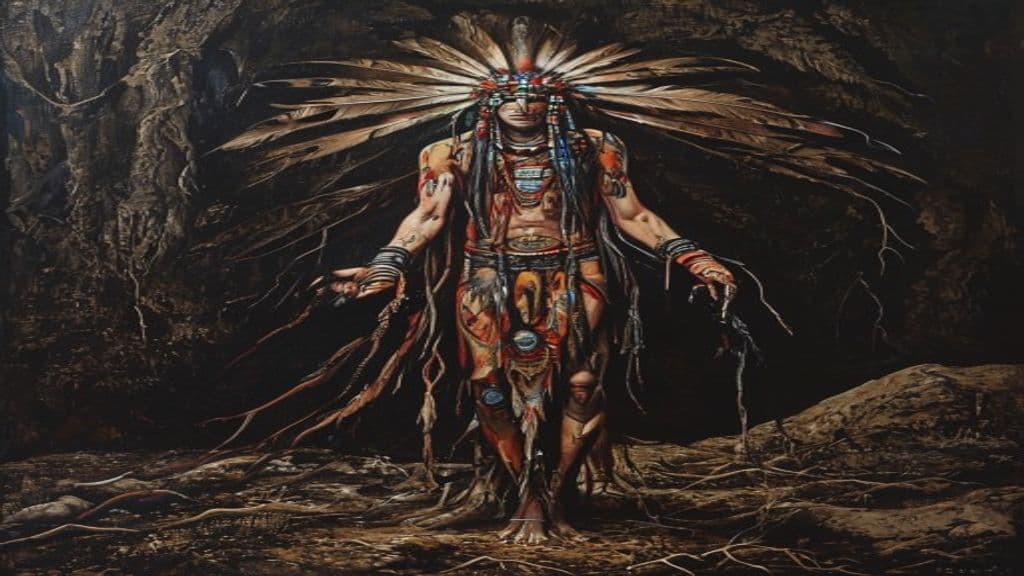
The yeii are believed to be minor deities associated with natural forces and localities, but their exact origin is unclear.
No physical description of the yeii is provided in the source material.
The yeii are associated with specific natural forces (e.g., fire, hunting) and are believed to have control over these domains.
Haashchʼééshzhiní (Black God)
A creator deity in Navajo folklore responsible for placing the stars and possessing supernatural powers. (Note: 1. Power tier should be Primordial, but this needs clarification as it's not explicitly stated in the sources. 2. Abilities section only mentions placing stars and inventing the fire drill. The source)
Yaoguai
Yaoguai is a broad, catch‑all category of uncanny supernatural beings in Chinese folklore and mythology, defined by possession of supernatural powers and by being weird, strange, or unnatural. They are associated with transformation and enchantment and are often reported to dwell on the margins of human settlement where they cause mischief, unexplainable phenomena, and sometimes harm.
Yatagarasu
Yatagarasu (八咫烏) is a divine crow in Japanese myth and Shinto practice that functions as a heavenly messenger and guide, most famously directing the legendary Emperor Jimmu's eastern expedition. Early narrative sources differ on the sender (Kojiki says Takamimusubi; Nihon Shoki says Amaterasu), and the bird later absorbed continental three‑legged solar‑crow imagery in Heian-period texts.
Yato-no-kami
Yato-no-kami (夜刀の神) are local snake deities attested in the Hitachi no Kuni Fudoki tradition, described as araburu-kami (rough, aggressive kami) who lived in fields near the government office of Namegata county and who were both dangerous to households and could be driven off or enshrined by human agents.
Yazata
In Zoroastrian/Avestan religion, a yazata (Avestan: yazata) is a class of divine or holy beings 'worthy of worship or veneration.' The term covers a range of referents—divinities with distinct functions, certain sacred objects or plants, protective fravashis, and even prayers—and denotes the roster of beneficent powers aligned with Ahura Mazda.
Yee Naaldlooshii (Skinwalker)
In Navajo (Diné) tradition, yee naaldlooshii (commonly rendered in English as "skinwalker") denotes a human who has perverted sacred knowledge to become a harmful shapeshifting witch. The figure is portrayed as a traitor within the community whose practices are taboo and who is associated in popular accounts with animal forms such as coyotes, wolves, and owls.
Yei Tso
A powerful being in Navajo mythology associated with chaos and destruction. (Note: - Power tier should be Primordial (consistent with being "the first and most powerful" among the Anaye). - Appearance is missing; add a brief description based on source material. - Abilities should b)
Yel İyesi
Yel İyesi is the Turkic iye (guardian spirit) of wind and air, a culturally ambivalent spirit or deity-form—often called Yel Ana (Wind Mother) or Yel Ata (Wind Father)—responsible for winds, weather phenomena, and related misfortune or aid in Turkic folk cosmology.
Yelbeghen
A multi‑headed monstrous being from Turkic (notably Altai) traditions, originally depicted as a serpentine or draconic creature that in later tellings appears as an ogre‑like behemoth; associated with cosmic predation (eclipses), guarded treasures, great strength, magic, and occasionally sexual relations with humans.
Yellow Emperor (Huangdi / Xuanyuan)
The Yellow Emperor (Huangdi, 黃帝), also known by the clan/name Xuanyuan, is a legendary culture-hero and thearchic sovereign in Chinese tradition who is venerated as an ancestral ruler and cosmic deity associated with the central/earth (yellow) phase, the Yellow Dragon, and certain astral identities. He is traditionally credited with foundational cultural, calendrical, medical, and political knowledge and is incorporated into the Five Regions Highest Deities scheme.
Yemọja
Yemọja is a major water deity (orisha) in the Yoruba religion, venerated as a maternal patron of rivers—particularly the Ogun River in Nigeria—and, in Afro-Cuban and Brazilian Orisha traditions, of the ocean. She is depicted as a protective mother figure associated with fertility, healing, wealth symbolism (cowrie shells), and both nurturing and potentially destructive aspects of water.
Yer iyesi
Yer iyesi is the familiar spirit or guardian of the earth and specific territory in Turkic/Tatar and related Tengrism traditions. Conceived as a land-attached iye, it appears in male and female forms (Yer Ata and Yer Ana) and is associated with protection of land and, in the female aspect, fertility and primordial presence at cosmogony.
Community Record
- [1]Yeiiwiki