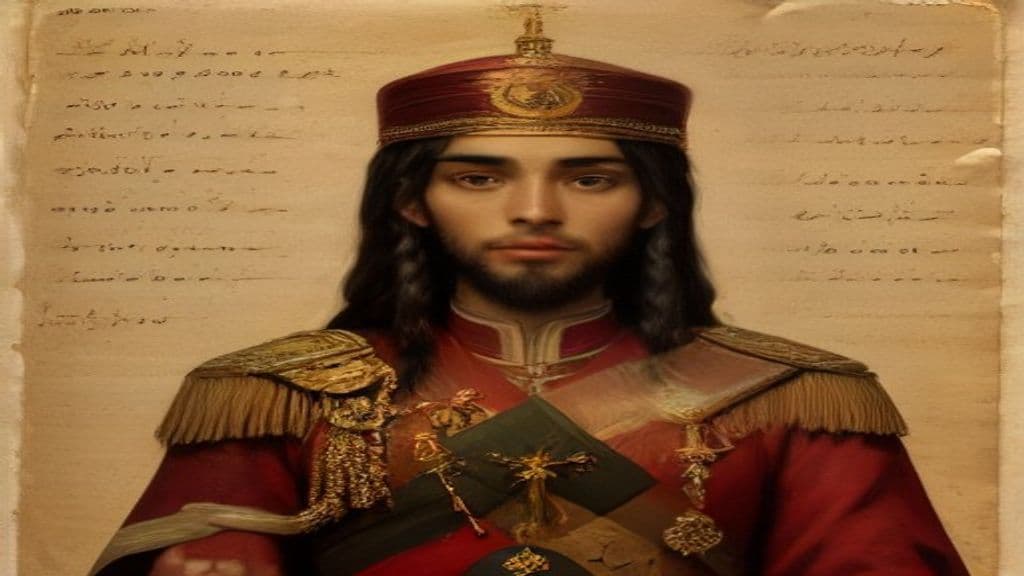
Presented in Coptic hagiographical accounts as a young soldier from Qallin who, at the time of the Diocletian edict to worship idols, publicly refused to perform idolatrous rites. Arrested by the governor Arianus, he endured imprisonment, torture, and miraculous trials, and was ultimately beheaded for his refusal to renounce the Christian faith. Posthumous traditions record miracles and the preservation of his relics in Egyptian monasteries.
The cited narrative identifies him as one of Governor Arianus's soldiers and notes an episode in which he removed and threw down his soldier's uniform before the governor; the supplied sources do not provide an extended iconographic or physical description beyond his status as a youthful soldier from Qallin.
As recorded in the sources, Abaskhiron's notable acts are moral and miracle-bearing: he courageously refused imperial idol worship and inspired other soldiers to join his confession; he endured varied tortures and imprisonment; he drank a sorcerer's poison after making the sign of the cross and suffered no harm; he was healed of blinding by the intervention of the Archangel Michael; and, after his death, tradition attributes to him the miraculous translation of an entire church, its people, a tree and a well to the village of Biho. The accounts also record the conversion and martyrdom of the sorcerer Alexandros following these events.
Weaknesses
- otherNot applicable — sources present Abaskhiron as a protective saint rather than a hostile entity
Wards
- symbolSign of the Cross (as used by Abaskhiron when he drank the poison)
- otherAppeal to God and Archangel Michael (as recorded in healing episode)
Abadiu of Antinoe
Abadiu of Antinoe was a fourth‑century bishop of Antinoe (Antinoopolis, in Roman Egypt) commemorated as a martyr and saint in the Coptic Orthodox Church, with a feast day on 26 December. Sources record that he was killed during a theological dispute with Arian opponents and reference him in collections of Egyptian martyrs.
Abdel Messih El-Makari
Abdel Messih El-Makari (1892–1963) was a Coptic Orthodox monk and priest venerated as a 20th‑century Coptic saint. Associated with the Monastery of Saint Samuel the Confessor and the Monastery of Saint Macarius (Scetes/Wadi El‑Natrun), he is remembered for humility, asceticism, charity, and reported spiritual gifts such as prescience, discerning of spirits, and healing.
Anba George (Saint George of Assiut)
Anba George is a Coptic Orthodox bishop venerated as a saint and martyr in Coptic hagiographical and liturgical tradition. Associated with Assiut in Upper Egypt and the Monastery of St. George, his life is commemorated in Synaxarium-type records; hagiography recounts his leadership of communal fasting and prayer and his subsequent arrest and martyrdom in the 12th century.
Arsenius the Great
Arsenius the Great (c. 350/354–c. 445/450) was a Roman-born imperial tutor who renounced court life to become an anchorite among the Desert Fathers in Egypt. Venerated as a saint in Eastern Orthodox, Coptic, and Roman Catholic traditions, he is remembered for extreme humility, prolonged solitude, silence, copious tears of devotion, and brief monastic writings and sayings preserved in the Apophthegmata Patrum and other collections.
Bashnouna
Bashnouna is a Coptic Christian monk venerated as a saint and martyr in the Coptic Orthodox tradition. According to hagiographical accounts recorded in the Coptic Synaxarion and secondary summaries, he was a monk of the Monastery of Saint Macarius in Scetes, arrested during the Fatimid caliphate of al-'Āḍid, refused to convert to Islam, and was burned alive on 24 Pashons (19 May 1164). His relics are reported buried at the Church of Saint Sergius in Cairo and he is commemorated liturgically on that date.
Bishop Karas (Sorial Ayad Sorial)
Bishop Karas (born Sorial Ayad Sorial, 1955–2002) was a Coptic Orthodox monk, abbot, and the first bishop of the Coptic Orthodox Church in the United States to head its first monastery outside Egypt. He is documented as a historical ecclesiastical figure known for monastic leadership, pastoral care, and ascetic practice.
Abarta (Ábartach)
Abarta (also Ábartach) is a figure of Irish myth who, in surviving accounts, tricks Fionn mac Cumhaill's warriors by giving them a supernatural grey horse that bears them into the Otherworld. Sources variably identify him as a member of the Tuatha Dé Danann or as a Fomorian; after the incident he is compelled to release the captured warriors and is refused entry to the Fianna.
Abas
Abas (Ancient Greek: Ἄβας, gen.: Ἄβαντος) is not a single mythic being but a recurring personal name borne by multiple mortals and minor mythic figures in Greek epic and genealogical traditions — kings, founders, seers, warriors, attendants, a centaur, and a youth transformed by a goddess. The name is glossed in the sources as 'guileless' or 'good-hearted' and appears across Argive, Theban, Trojan, Euboean, and other local cycles.
Abaset
Abaset is a localized ancient Egyptian goddess attested in tomb decoration at El‑Bawiti in the Bahariya Oasis during the 26th Dynasty. She is depicted anthropomorphically with a hedgehog motif incorporated into her headdress and appears on the walls of Qarat Qasr Salim, including twice in the Tomb of Bannentiu. No cult texts, myth narratives, or ritual prescriptions for her are recorded in the cited corpus.
Abath
No corroborated folkloric entity named "Abath" is documented in the provided sources. The string appears in the supplied material only as a surname/personal name in Aruban/Dutch-Caribbean archival records and as an unrelated taxonomic or encyclopedic hit; no mythic attributes, origin stories, rituals, or apotropaic practices for an entity called Abath are present in the documents reviewed.
Abatur
Abatur is an uthra (celestial emanation) in Mandaeism described as the 'father of the Uthras' and called the Ancient (ʿattīqā). He resides on the boundary between the World of Light and lower regions, functions as a judge who weighs souls (Abatur Muzania), and supplies instructions and materials to the demiurgic uthra Ptahil in accounts from the Diwan (Scroll) of Abatur.
Abatwa (Twa / Batwa)
Abatwa (also recorded as Twa, Batwa, Mutwa; singular forms Barhwa or Murhwa in some transcriptions) are indigenous hunter‑gatherer peoples of the Great Lakes region of Central Africa, historically identified as some of the earliest inhabitants of the area. The available sources treat them as human ethnic groups whose livelihoods, lands, and populations have been severely affected by conservation policies and modern violence.
Community Record
- [1]Abaskhiron the Soldier - Wikipedia. Wikipedia, 'Abaskhiron the Soldier'wiki
- [2]Abaskhiron the Soldier - Wikidata. Wikidata entry Q16965864other
- [3]Monastery of Saint Macarius the Great - Wikipedia (contextual monastery information). Wikipedia, 'Monastery of Saint Macarius the Great' (used for contextual monastery references in sources)wiki
- [4]Martyrs :: MKE - Nayrouz (Tasbeha hymn/library). Tasbeha.org, 'Martyrs :: MKE - Nayrouz'folk