
In Vedic–Puranic genealogical accounts Āgneyī is presented as a daughter of Agni and as a wife/mother in royal lineages: sources summarized from Harivamsha and the Vishnu Purana describe her as wife of Ūru and mother of kings Anga, Sumanas, Khyati, Kratu, and Sibi, with the Harivamsha additionally naming Gaya (Wikipedia summary citing Harivamsha and Vishnu Purana). Separately, in Shaiva-Agamic materials the lexical form Agneya (or Anala) appears among the items revealed by the Aghora face of Sadashiva and transmitted by Rishi Bharadvaja (Aghora Agama excerpt). The two strands share a common root in Agni/fire-terminology: the Puranic/Vedic figure is a personified shakti/daughter of Agni, while the Agamic listing records Agneya/Anala as the name of a revealed Agama or item within an Aghora corpus; the supplied sources do not explicitly equate the Puranic goddess-person with the Agama-name beyond their shared nomenclature and fire-association.
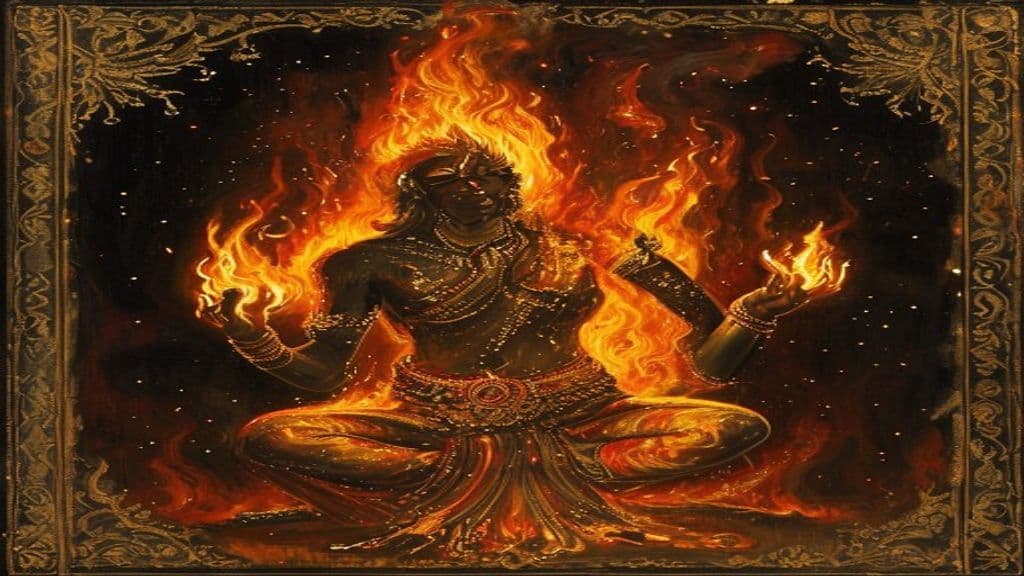
The supplied sources do not preserve a stable iconography for Āgneyī. Vedic and Puranic summaries present her as a divine feminine personage (daughter and shakti of Agni) but give no detailed anthropomorphic description in the provided excerpts (Wikipedia summary; Harivamsha/Vishnu Purana references). In the Aghora Agama material the Aghora face of Sadashiva associated with southward/fire is described as Neela varanam (blue-coloured) and linked to the macro-ingredient of fire, but that description pertains to the Aghora face rather than to an iconography of Āgneyī herself (Aghora Agama excerpt). Any visual association therefore remains inferential (fire symbolism, southeast/directional marking) rather than attested as a canonical image in the supplied texts.
Across sources Āgneyī functions in multiple related registers. Genealogically she is a progenitress — named mother of several kings in Harivamsha and the Vishnu Purana summaries (Anga, Sumanas, Khyati, Kratu, Sibi; Harivamsha adds Gaya) — situating her as a lineal legitimating figure (Wikipedia summary). Linguistically and ritually the masculine adjective Āgneya denotes things 'fiery', 'flammable', or 'consecrated to Agni' and names the southeast cardinal direction (Wikipedia etymology); the feminine Āgneyī can be read as the personified shakti of those fiery/consecrating powers. In a Shaiva-Agamic register the name Agneya (or Anala) is listed among Agamas (Nisvasa, Svayambhuva, Vijaya, Agneya/Anala, Vira) revealed by the Aghora face of Sadashiva and transmitted via Rishi Bharadvaja, which identifies Agneya as part of ritual/ textual transmission rather than as a described miracle-working persona in the supplied excerpts (Aghora Agama excerpt). The supplied materials do not record specific active behaviors (such as granting boons, causing illness, or direct interactions with individuals) or enumerated supernatural powers beyond these ritual-lexical and genealogical functions.
Agastya
Agastya (also Agathiyar/Agasti) is a revered Vedic and later-period Indian rishi (sage) figure credited in textual traditions as an inspired seer, ascetic, teacher, culture-founder, and attributed author of Vedic, Puranic and Tamil works; in South Indian tradition he is associated with origins of Tamil grammar and Siddha medicine and is identified astronomically with the star Canopus.
Angiras
Angiras (Sanskrit Aṅgiras/Aṅgirāḥ) is primarily a Vedic rishi (sage) and eponymous lineage (Angirasa) associated with authorship of Vedic hymns, priestly/fire functions, and transmission of mantras; later Puranic accounts multiply his identities in genealogies and lists of sages.
Ap (the Waters)
Ap (Vedic áp-, Classical Sanskrit āpas/āpa-) denotes the sacred category of 'the waters' in Vedic/Hindu thought: a physical element (water), an animate cosmic principle addressed in Rigvedic hymns, and an elemental category later counted among the Panchamahabhuta. The term names collective waters invoked in ritual, is linked to deities such as Varuna and the epithet Apām Napāt, and survives in related Indo-Iranian vocabularies (Avestan āpō/Aban, Persian āb).
Asuras
In Vedic mythology, the Asuras are a group of beings described as the 'enemies' or 'opponents' of the Devas (gods), often associated with chaos and disorder. (Note: 1. Power tier should be Ancient (or Deity-level), as they are described as eternal enemies of the gods. 2. Sensory cues and wards/weaknesses sections should be filled in, as there's no information to )
Atri
Atri is a principal Vedic rṣi (seer) and eponymous founder of the Atreya lineage credited with composing hymns in the Rigveda (notably Mandala 5). He is portrayed in epic and puranic narratives as a mānasputra of Brahma, a practitioner of tapas whose austerities attract the Trimurti, and as the hospitable hermit-counselor in Ramayana episodes.
Dragon (Long)
Long (龍, "dragon") is a pervasive cultural and artistic motif that appears in Taoist sacred-geographical contexts, Chinese literature, and modern exhibitions; the provided sources treat it as part of the broader mythic imagery present around Taoist sites and ritual scenes rather than as a single, consistently described doctrinal entity.
Gāyatrī
Gāyatrī is the personified form of the Gāyatrī Mantra in Vedic–Puranic Hindu tradition: simultaneously a 24‑syllable Vedic metre, the hymn composed in that metre, and a goddess—often titled Vedamātā, the mother of the Vedas—who embodies sacred Vedic speech and knowledge.
Hiraṇyagarbha
Hiraṇyagarbha (Sanskrit: हिरण्यगर्भ, 'golden womb') is a Vedic and later Hindu cosmological concept: a primordial golden seed or 'cosmic egg/womb' from which the manifested universe is said to originate. It is presented variously as an impersonal formative principle, the 'Soul of the Universe' in Upanishadic language, and in Purāṇic and exegetical contexts as the first-born or creator (identified with Prajāpati or Brahmā).
Parīkṣit
Parīkṣit is a legendary-historical Kuru king of classical north Indian tradition attested in Vedic, epic and Purāṇic materials. He is portrayed as a sacrificial sponsor and righteous ruler whose life intersects with sages, Nāgas, and divine protection; his death by the Nāga Takṣaka and the subsequent snake-sacrifice of his son Janamejaya form central narrative episodes.
Pishach
Among the oldest classified demon-types in Hindu tradition — flesh-eating entities of the cremation ground first named in the Atharva Veda. The Pishach inhabits fresh corpses and possesses the living, causing the specific Ayurvedic condition of 'pishachabadha': madness, speaking in unknown languages, consuming impure things.
Rudras
A plural class of Vedic divine beings regarded as manifestations or attendants of the god Rudra (later identified with Śiva). They function as atmospheric/wind deities, vital forces within the human body, and ritually important gods occupying an intermediate place among the Vedic divinities.
Sea serpent
A large serpentine marine creature attested across many mythologies and sailors' reports. It functions both as a cosmological adversary of storm/sky deities in ancient myth cycles and as a localized monstrous threat in coastal and seafaring folklore and eyewitness accounts.
Community Record
- [1]Agneya - Wikipedia. Wikipedia contributors, 'Agneya,' Wikipedia, The Free Encyclopedia.wiki
- [2]Agneya (Wikidata). Wikidata entry Q16058229 for Agneya.other
- [3]Aghora and Absence of Differences (excerpt). Aghora excerpt listing Aghora-face revelations including Agneya (or Anala) and ritual technical terms (Dakshinagni, Vartulakara homagundam, Nagopaveetam, Varna Mala).literary
- [4]Jeevan Jyoti Samaveda Ke Agneya Parva Ki Vyakhya (archive listing). Archive entry for a Samaveda commentary titled with 'Agneya Parva' (bibliographic presence noted; no extractable ritual facts supplied in excerpts).other
- [5]Doosara Saptak Poems By Agneya (archive listing). Archive entry for a poet/editor using the name 'Agneya' (bibliographic presence; not used for factual claims about the deity in supplied excerpts).literary