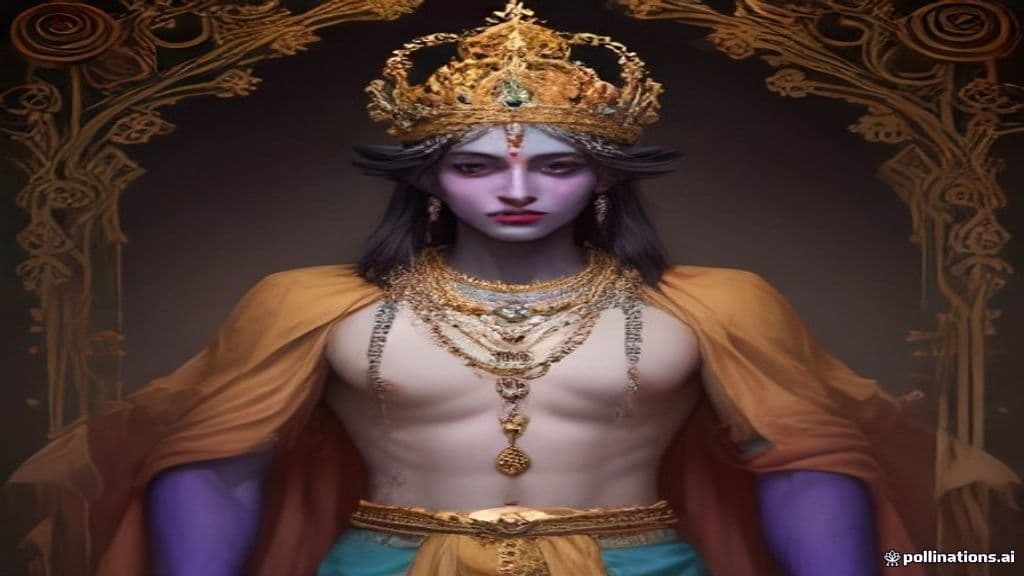
Parīkṣit appears in Vedic and epic genealogies as a scion of the Kuru/Pāṇḍava line whose reign consolidated Kuru political and ritual order. Vedic material eulogises him as a great Kuru king (Atharvaveda hymn). Later narratives relate that, while his mother-in-law Subhadrā was pregnant, Aśvatthāmā launched a Brahmāstra against the fetus; Subhadrā prayed to Kṛṣṇa, who pacified her and protected the child in the womb. As king he performed large Vedic sacrifices (three sacrifices are attributed to him) and sponsored śrauta orthopraxy. His death derives from a curse: in the Mahābhārata/Purāṇic account the sage Śr̥ṅgī (Śamika/Śr̥ṅgī in variants) curses him, and the Nāga king Takṣaka is used as the instrument of that curse. In the aftermath Janamejaya, identified as Parīkṣit's son, organizes the Sarpadāha (snake‑sacrifice or Sarpayajña) to avenge his father, a ritual frame that becomes central to later epic narration.
The supplied sources do not give a physical description of Parīkṣit beyond his status as a crowned king and royal accoutrements implied by his role. No corporeal details (physique, facial features, dress beyond royal regalia) are attested in the provided materials.
Parīkṣit's 'abilities' are social and ritual rather than supernatural: sources present him as a powerful and beneficial ruler who consolidated Kuru political power and Vedic sacrificial practice, credited with arranging or stabilizing hymnic/ritual forms and performing three major sacrifices. Narratively he enforces justice (an episode describes him arresting and preparing to punish a man who abused cattle) and engages with ascetics and personified cosmic forces (e.g., receiving Kali under restrictions). He has no personal supernatural powers in the provided accounts; his fortunes are affected by divine intervention (Kṛṣṇa protecting him before birth) and by supernatural agents (Nāgas acting under a sage's curse).
Weaknesses
- conditionvulnerability to curse-mediated death (Śr̥ṅgī's curse enacted by Nāga Takṣaka)
- conditionexposure to personified Kali and moral decline (Kali-yuga influences)
Wards
- othernone attested in sources
- otherdivine protection by Kṛṣṇa/Viṣṇu (attested in prenatal episode where Subhadrā prays and Kṛṣṇa protects the unborn child)
Agneya / Āgneyī
Āgneyī (feminine) or Āgneya (masculine adjective) is a Vedic–Puranic divine figure and ritual principle tied to the fire-god Agni and the southeastern direction. In textual traditions she appears both as a personified daughter/shakti of Agni and as an adjectival/technical term applied to fire-consecrated things (direction, astra, etc.). She also occurs as the name Agneya (or Anala) among items revealed in a Shaiva-Agamic list associated with the Aghora face of Sadashiva.
Angiras
Angiras (Sanskrit Aṅgiras/Aṅgirāḥ) is primarily a Vedic rishi (sage) and eponymous lineage (Angirasa) associated with authorship of Vedic hymns, priestly/fire functions, and transmission of mantras; later Puranic accounts multiply his identities in genealogies and lists of sages.
Ap (the Waters)
Ap (Vedic áp-, Classical Sanskrit āpas/āpa-) denotes the sacred category of 'the waters' in Vedic/Hindu thought: a physical element (water), an animate cosmic principle addressed in Rigvedic hymns, and an elemental category later counted among the Panchamahabhuta. The term names collective waters invoked in ritual, is linked to deities such as Varuna and the epithet Apām Napāt, and survives in related Indo-Iranian vocabularies (Avestan āpō/Aban, Persian āb).
Asuras
In Vedic mythology, the Asuras are a group of beings described as the 'enemies' or 'opponents' of the Devas (gods), often associated with chaos and disorder. (Note: 1. Power tier should be Ancient (or Deity-level), as they are described as eternal enemies of the gods. 2. Sensory cues and wards/weaknesses sections should be filled in, as there's no information to )
Atri
Atri is a principal Vedic rṣi (seer) and eponymous founder of the Atreya lineage credited with composing hymns in the Rigveda (notably Mandala 5). He is portrayed in epic and puranic narratives as a mānasputra of Brahma, a practitioner of tapas whose austerities attract the Trimurti, and as the hospitable hermit-counselor in Ramayana episodes.
Bharadvaja
Bharadvaja is a canonical Vedic maharṣi (sage) and eponymous progenitor of a lineage and multiple textual corpora in ancient Indian tradition. Treated as an authoritative seer, teacher, and recipient/attributor of ritual, technical, and ethical knowledge, his name appears across Vedic, epic, Purāṇic, and Buddhist literature as an individual sage and as a clan/author label.
Dragon (Long)
Long (龍, "dragon") is a pervasive cultural and artistic motif that appears in Taoist sacred-geographical contexts, Chinese literature, and modern exhibitions; the provided sources treat it as part of the broader mythic imagery present around Taoist sites and ritual scenes rather than as a single, consistently described doctrinal entity.
Gāyatrī
Gāyatrī is the personified form of the Gāyatrī Mantra in Vedic–Puranic Hindu tradition: simultaneously a 24‑syllable Vedic metre, the hymn composed in that metre, and a goddess—often titled Vedamātā, the mother of the Vedas—who embodies sacred Vedic speech and knowledge.
Hiraṇyagarbha
Hiraṇyagarbha (Sanskrit: हिरण्यगर्भ, 'golden womb') is a Vedic and later Hindu cosmological concept: a primordial golden seed or 'cosmic egg/womb' from which the manifested universe is said to originate. It is presented variously as an impersonal formative principle, the 'Soul of the Universe' in Upanishadic language, and in Purāṇic and exegetical contexts as the first-born or creator (identified with Prajāpati or Brahmā).
Pishach
Among the oldest classified demon-types in Hindu tradition — flesh-eating entities of the cremation ground first named in the Atharva Veda. The Pishach inhabits fresh corpses and possesses the living, causing the specific Ayurvedic condition of 'pishachabadha': madness, speaking in unknown languages, consuming impure things.
Rudras
A plural class of Vedic divine beings regarded as manifestations or attendants of the god Rudra (later identified with Śiva). They function as atmospheric/wind deities, vital forces within the human body, and ritually important gods occupying an intermediate place among the Vedic divinities.
Sea serpent
A large serpentine marine creature attested across many mythologies and sailors' reports. It functions both as a cosmological adversary of storm/sky deities in ancient myth cycles and as a localized monstrous threat in coastal and seafaring folklore and eyewitness accounts.
Community Record
- [1]Parikshit — Wikipedia. Wikipedia, article 'Parikshit'.wiki
- [2]Parikshit entry — Mythology & Folklore Encyclopedia. Mythology and Folklore entry on Parikshit.folk
- [3]Source summaries and scholarly notes (compilation). Summary of Vedic, epic and Purāṇic accounts as found in compiled sources cited in the provided research notes (e.g., Atharvaveda eulogy; Mahābhārata and Bhagavata Purāṇa narratives).other
- [4]Reference to Janamejaya's Sarp Dahan Yagna. Summary noting Janamejaya organized the Sarp Dahan Yagna to avenge his father's death (as cited in the supplied material).wiki