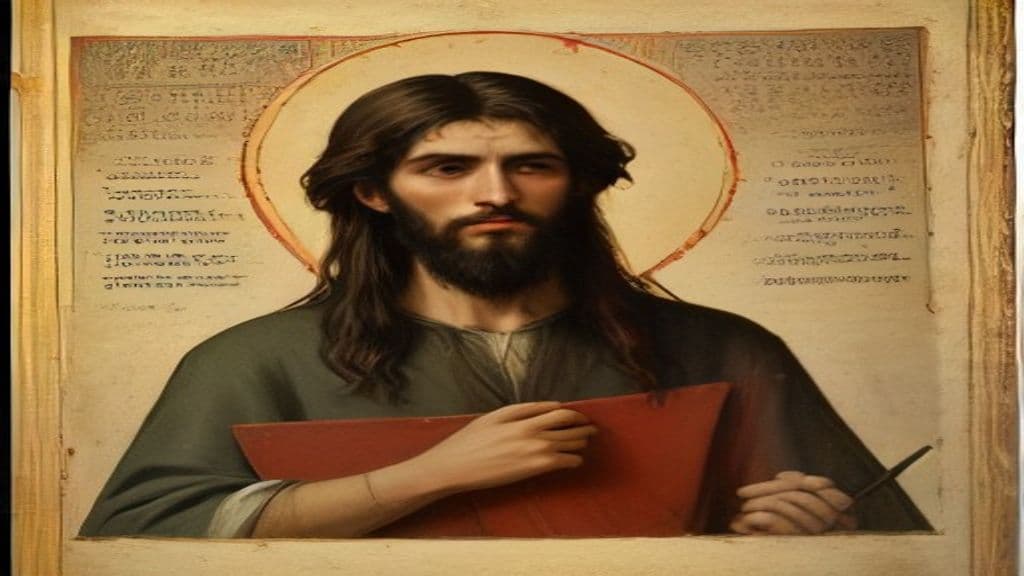
Born in Bethsaida in Galilee into a fishing family (brother of Simon Peter, son of Jonah), Andrew appears in the Gospel narratives as a disciple first attached to John the Baptist who then follows Jesus after John’s testimony. Gospel accounts present him as one of the first two disciples to follow Jesus and as one who introduces others (notably Peter) to Jesus. Later patristic and medieval traditions extend his biography into missionary journeys to regions such as Thrace, Scythia, Byzantium, and the Black Sea coast and report his martyrdom at Patras.
Sources provide no physical or facial description. Biblical and traditional accounts identify his social origin and role: a fisherman from Bethsaida, brother of Simon Peter, and a Galilean participant in Jesus' ministry. Iconographic attributes developed in later tradition (e.g., association with the X-shaped cross) are reported in narratives of his martyrdom but are not described as original physical traits.
Andrew is portrayed as a recognizer and mediator: in the Gospel of John he recognizes Jesus as the Messiah and brings others to him (notably his brother Simon Peter). He participates in key Gospel events (the calling at the Sea of Galilee; bringing the boy with loaves and fishes to Jesus; being consulted when Greeks ask to see Jesus; present at the Last Supper and at the Mount of Olives questioning). Post-biblical tradition credits him with missionary activity and the founding of Christian communities (claims of preaching in Scythia and founding the see of Byzantium), and he is venerated as a martyr whose death at Patras became part of devotional memory.
Andragius
Andragius (also attested Androgius) is a legendary king of the Britons recorded in Geoffrey of Monmouth’s pseudo‑historical regnal lists and later compilations. He appears as a node in a constructed sequence of rulers—not described as a supernatural being—and is principally attested by name, genealogical relationships, and position in succession.
Andras
Andras is a named infernal spirit from the Western grimoire/Goetic tradition, described as a hostile officer who sows discord and is dangerous to conjurers; modern roleplaying adaptations recast him as a demon raised from murderous souls with a purpose to destroy mortals.
Andrast
Andrast is a Sindarin place-name in J. R. R. Tolkien's Middle-earth, denoting a long coastal cape or peninsula in southwest Gondor (also identified with Ras Morthil). It is a geographic toponym recorded in Tolkien's maps and scholarly indexes rather than a sentient or supernatural being.
Andraste
Andraste (also attested as Andrasta or Andate in some passages) is a named supernatural figure invoked by the Iceni in the Roman account of Boudica's rebellion (AD 60). Recorded by Dio Cassius as a recipient of Boudica's rallying prayer, Andraste functions in surviving sources as a tutelary war figure associated with victory and the preservation of liberty.
Andrea Beaumont (the Phantasm)
Andrea Beaumont is a fictional human character in the DC Animated Universe who, as the masked vigilante known as the Phantasm in Batman: Mask of the Phantasm (1993), stages a Death‑like avenger persona. Her apparent supernatural effects are produced by theatrical devices (not innate powers) and she functions narratively as a foil and dark parallel to Bruce Wayne/Batman.
Andrealphus
Andrealphus is a spirit named in the Ars Goetia (Lesser Key of Solomon) tradition, described as a Marquis who governs thirty legions. He is classically credited with teaching geometry, mensuration, and astronomy and with the ability to assume or cause bird/peacock form.
Androgeos
Androgeos (Greek Ἀνδρόγεως, Latin Androgeus) is a personal name borne by mortal figures in classical Greek and Roman literary tradition, most notably a son of Minos and Pasiphaë whose death in mythic narratives precipitates Athenian tribute to Crete. A separate, less-detailed bearer of the name is listed as a Greek soldier present at the sack of Troy in some sources.
Androgeus
Androgeus is a mythic human name borne by at least two distinct figures in Classical Greek and Roman tradition: a Cretan prince, son of Minos and Pasiphaë, famed for athletic victories and whose death in some accounts is linked to the Marathonian/Cretan bull; and Androgeos, a Greek soldier named by Virgil in the Aeneid who, during the sack of Troy, mistakes Aeneas and his companions for fellow Greeks. Both are mortal figures woven into larger heroic and epic cycles rather than supernatural beings.
Androgynos (Judaism)
In rabbinic Jewish literature, the androgynos (Hebrew: אַנְדְּרוֹגִינוֹס, ʾandərôg̲înôs) is a human juridical category for a person who possesses both male and female sexual characteristics. It is treated as a special halakhic classification that raises questions about which gendered legal obligations, prohibitions, and ritual statuses apply.
Androktasiai
Androktasiai (Ἀνδροκτασίαι, sing. Androktasia) are plural personifications in ancient Greek poetry that embody manslaughters or the slayings of men in battle. They appear chiefly as named offspring of Eris in Hesiod's Theogony and as elements in Homeric/Hesiodic ekphrasis (the Shield of Heracles), functioning as poetic embodiments of wartime slaughter rather than individualized cult-deities.
Andromache
Andromache (Ancient Greek Ἀνδρομάχη) is a human figure of ancient Greek literary tradition: the wife of Hector of Troy who exemplifies virtuous fidelity, ritual mourning, and the losses suffered by women in war. She appears in Homeric epic and later classical sources as grieving spouse, captive concubine after Troy's fall, and later queen in post-war narratives.
Andromalius
Andromalius is a named spirit from post-medieval grimoire tradition (Ars Goetia–style catalogues) presented as a ranked officer who recovers stolen goods, exposes thieves and dishonest dealings, and punishes wrongdoers. He appears primarily in modern occult reference compilations derived from the Goetia; ritual details and physical description are not attested in the supplied grimoire excerpts.
Community Record
- [1]Andrew the Apostle — Wikipedia. Wikipedia contributors. "Andrew the Apostle." Wikipedia, The Free Encyclopedia.wiki
- [2]Wikidata: Andrew the Apostle. Wikidata entry Q43399 for Andrew the Apostle.other
- [3]November 30, Feast of Saint Andrew, Apostle - The Eyes of Our Lord (Archive). Archive.org devotional item on the Feast of Saint Andrew.other
- [4]Ante-Nicene Christian library; translations of the writings of the Fathers down to A.D. 325 (Archive). Collected translations of patristic writings referenced for early traditions about the apostles.other
- [5]Archive: 550 | Cuppa Joe | Theo History. Podcast/archive item referenced in research notes (not used for historical claims about the apostle).other