
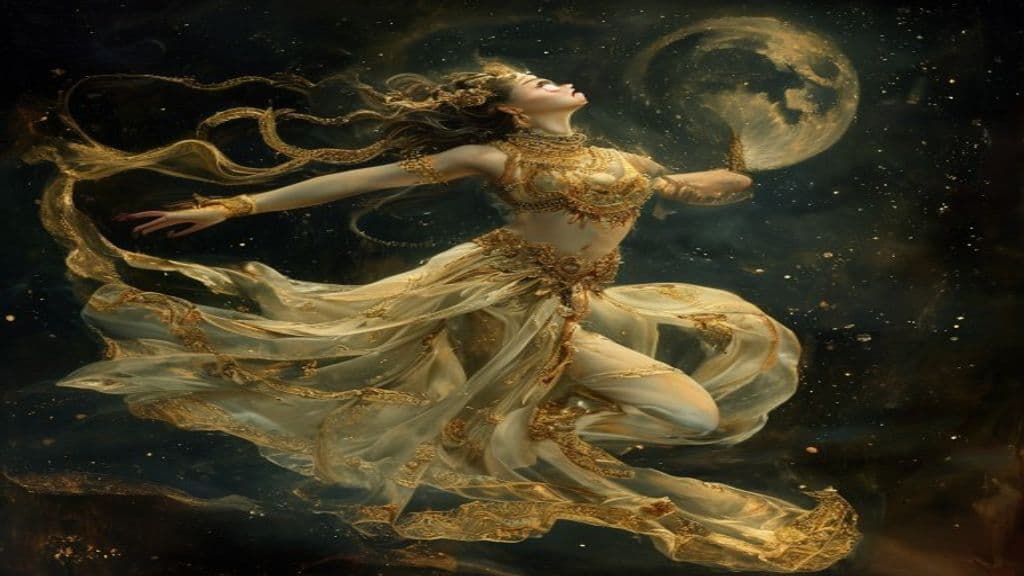
The provided sources do not supply a specific narrative origin for individual bidadari. They present the class as descended from or cognate with the South Asian apsara tradition within Hindu and Buddhist cosmology — female celestial beings associated with clouds and water — and indicate that in later regional imagination these figures function like nymphs or fairies and figure prominently in sculpture, dance, literature and painting.
The sources do not give a canonical, detailed physical description. Instead, bidadari/apsaras are primarily known through artistic and performative depiction: stylized, often beautiful female forms rendered in sculpture, dance, literature and painting across South and Southeast Asia. The emphasis in the material is on cultural representation rather than on fixed anatomical traits.
The provided material frames bidadari as celestial or ethereal female spirits associated with clouds and water and later playing roles analogous to nymphs or fairies. No specific supernatural powers, routine behaviors toward humans, or narrative feats are listed in the supplied sources; the emphasis is on their cultural-artistic presence rather than documented magical actions or interactions.
Agiya Baital
The fire-form of the Vetala — a cremation ground spirit of UP and Bihar that manifests as a wandering flame rather than a corpse-inhabitor, leading night travellers off roads and into marshland or flames with a dancing fire that seems always just ahead.
Aleya
Ghost lights of the Sundarbans delta — flickering flames over swamp water said to be the souls of dead fishermen, luring the living off safe paths into drowning waters.
Angiras
Angiras (Sanskrit Aṅgiras/Aṅgirāḥ) is primarily a Vedic rishi (sage) and eponymous lineage (Angirasa) associated with authorship of Vedic hymns, priestly/fire functions, and transmission of mantras; later Puranic accounts multiply his identities in genealogies and lists of sages.
Ap (the Waters)
Ap (Vedic áp-, Classical Sanskrit āpas/āpa-) denotes the sacred category of 'the waters' in Vedic/Hindu thought: a physical element (water), an animate cosmic principle addressed in Rigvedic hymns, and an elemental category later counted among the Panchamahabhuta. The term names collective waters invoked in ritual, is linked to deities such as Varuna and the epithet Apām Napāt, and survives in related Indo-Iranian vocabularies (Avestan āpō/Aban, Persian āb).
Apsara
Celestial dancers and water nymphs of Hindu cosmology — beautiful semi-divine beings who dance at the court of Indra and, by his command, descend to earth to distract sages from excessive asceticism.
Bhoma
Primordial earth deity in Balinese mythology associated with fertility and vegetation. (Note: 1. Power tier should be Primordial, which is correct. 2. Appearance description matches source material; no corrections needed. 3. Abilities: Add "liminal space between wilderness and human settlement)
Bhoot (bhoota)
A bhoot (also bhoota, bhoot, bhut) is the culturally specific term across parts of the Indian subcontinent for a perturbed, restless spirit generally understood to be the ghost of a deceased person. Sources describe bhoots as arising when a person's death or post-death circumstances prevent them from moving on — for example violent death, unresolved affairs, or failures in funerary rites — and the term appears frequently in modern South Asian media and discussions.
Bordoisila
The storm deity of spring in Assamese tradition — Bordoisila is the daughter of Brahma who visits her mother's home at the end of winter, and whose journey back creates the violent pre-monsoon storms of April and May. She is a goddess-spirit propitiated in Assam for thousands of years.
Brahmadaitya
Bengal's most distinctive ghost: the spirit of a Brahmin who died celibate — before marriage, or having taken a vow of celibacy — whose accumulated learning and unfulfilled life persists. Unlike the North Indian Brahmpret, the Brahmadaitya is often passive or even helpful, but its presence makes any household it inhabits spiritually unsettled.
Brahmarakshas
The most learned and terrible of spirits — the ghost of a Brahmin who misused his scriptural knowledge in life and was condemned after death to be both demon and scholar, haunting places of learning.
Brahmarakshasa
Demon-spirit of a Brahmin who misused sacred knowledge for evil ends — described in the Ramayana and Mahabharata, the Brahmarakshasa combines the destructive force of a Rakshasa with the ritual knowledge of a priest. Among the most dangerous entities in Hindu demonology.
Brahmpret
The ghost of a Brahmin who died before fulfilling his dharmic obligations — more powerful than any ordinary preta, the Brahmpret retains Sanskrit learning, ritual authority, and the capacity to curse. The most feared ghost-class in North Indian villages.
Community Record
- [1]Apsara (Wikipedia). Wikipedia contributors, 'Apsara,' Wikipedia, The Free Encyclopedia.wiki
- [2]Bidadari Cemetery (Wikipedia). Wikipedia contributors, 'Bidadari Cemetery,' Wikipedia, The Free Encyclopedia.wiki
- [3]Bidadari, Singapore (Wikipedia). Wikipedia contributors, 'Bidadari, Singapore,' Wikipedia, The Free Encyclopedia.wiki
- [4]Bidadari Island (Wikidata). Wikidata entry for Bidadari Island.other
- [5]Digging Bidadari’s Past: From Palace to First Muslim State Cemetery | BiblioAsia. BiblioAsia, 'Digging Bidadari’s Past: From Palace to First Muslim State Cemetery.'other
- [6]KM Bidadari Liveaboard Review – Divezone. Divezone.net, 'KM Bidadari Liveaboard Review.'other
- [7]Bidadari Island, Labuan Bajo — Visitor guide & review (Travelfish). Travelfish, 'Bidadari Island, Labuan Bajo — Visitor guide & review.'other
- [8]Archive: several media items with 'Bidadari' in title. Archive.org media item titled with 'Bidadari'.other
- [9]Bidadari — Cheryl Tan — fifth wheel press. Fifth Wheel Press, 'Bidadari — Cheryl Tan.'other
- [10]Gamelatron Bidadari — Boomkat. Boomkat product page for 'Gamelatron Bidadari.'other