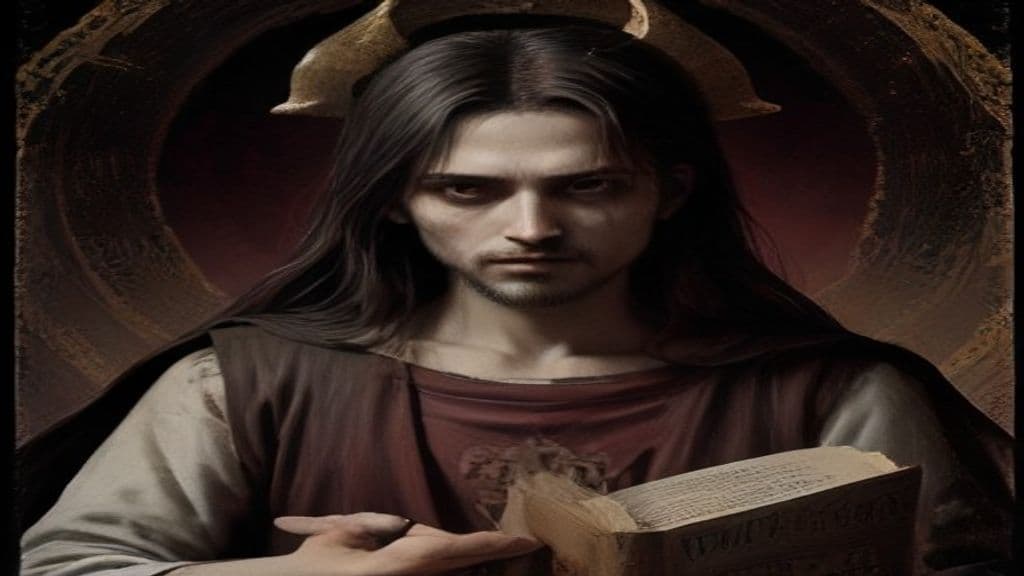
The concept of the Antichrist arises within the New Testament and intertestamental apocalyptic readings that later Christian interpreters expanded. Johannine epistles (1 John) characterize a present 'spirit of the antichrist' and speak of 'many antichrists' as opponents of the confession that 'Jesus Christ has come in the flesh,' marking a category of persons or spirits already active in the world. Pauline eschatology (2 Thessalonians) anticipates a future revealing of the 'man of sin' or 'lawless one,' whose revelation is tied to an end‑time rebellion and the removal of a restraining force (the Katechon); this passage describes a climactic opponent who exalts himself above every object of worship and sits in the temple, leading to a final divine confrontation. Danielic imagery (the 'little horn') and Johannine/apocalyptic images (the Beast of Revelation) were later associated with the same eschatological adversary by interpreters, producing a layered tradition in which Antichrist can be read as both an enduring corrupting spirit and a singular future deceiver (sources: summaries of Biblical texts and interpretive traditions as collected in the provided material).
The supplied sources do not provide a single, consistent physical portrait of the Antichrist. Instead, scriptural texts and subsequent expositions employ symbolic imagery: Daniel's 'little horn,' Paul's 'man of sin' or 'lawless one,' Gospel warnings about 'false Christs' who will appear and perform signs, and Revelation's 'Beast of the Sea.' These images function apocalyptically and polemically rather than as literal physiognomic descriptions; Johannine texts emphasize the Antichrist as a spirit manifested in denial of the incarnate Christ, which frames appearances in moral/theological terms rather than detailed bodily features.
Across the New Testament texts summarized in the sources, the Antichrist is associated with specific hostile actions and deceptive capacities. Johannine passages label as 'antichrists' those who deny the Father and the Son and deny that Jesus Christ has come in the flesh, framing deception and doctrinal denial as central markers. 2 Thessalonians attributes to the 'man of sin' opposition and self‑exaltation — taking a seat 'in the temple of God' and 'declaring himself to be God' — and describes the working of Satan through him, including use of 'power, signs, lying wonders, and every kind of wicked deception.' Gospel passages (e.g., warnings about 'false Christs' in Matthew and Mark) speak of impostors who will perform signs and lead many astray. Together these sources depict a set of behaviors: religious imposture and false messianic claim, doctrinal denial of the incarnation, spectacular deceptive signs and wonders, and leading people away from the truth prior to divine judgment.
Weaknesses
- conditionconfession that 'Jesus Christ has come in the flesh' (Johannine criterion of discernment)
- conditionfinal defeat by Christ (Pauline eschatological outcome: the lawless one is ultimately overthrown)
Wards
- conditiondiscernment grounded in the confession 'Jesus Christ has come in the flesh' (1 John criterion to recognize and resist the spirit of the antichrist)
Anthropophage
A literary-mythical category of peoples described as cannibals in classical, medieval and later European literature and reference works. Originating in ancient ethnographic reports and transformed through compilations of marvels, the Anthropophage functions as an imaginative type marking exotic or monstrous others rather than a documented historical tribe.
Anthus
Anthus (Greek Ἄνθος, 'flower, bloom') is a name applied to more than one mortal figure in ancient Greek myth whose misfortunes are remembered by their metamorphosis into birds; in one tradition Zeus and Apollo transform Anthus and his kin into birds, and the transformed bird called 'anthus' is said to mimic a horse's neigh while fleeing from horses. Another Anthus is an Anthedon youth who is lost in childhood and later recognized by his brother after serving as a cup-bearer.
Anti-Monitor
A fictional cosmic antagonist from DC Comics: an anti-matter–aligned multiversal being whose actions can destroy positive-matter universes and who serves as the cosmic opposite of the Monitor.
Anti-Venom
Anti-Venom is a fictional symbiotic life-form appearing in Marvel Comics. A member of the alien Symbiote race, Anti‑Venom bonds with human hosts (notably Eddie Brock and Flash Thompson in different storylines) to form a hybrid being with enhanced physical abilities and narrative powers described as curative against symbiote-related afflictions.
Antianeira
Antianeira (Ancient Greek: Ἀντιάνειρα, lit. 'a match for men') is a personal name borne by several mortal women in Greek mythic tradition. The name appears in variant genealogical and heroic contexts: as a possible mother of the Argonaut Idmon (in a tradition naming Apollo as father), as mother of the Argonauts Eurytus and Echion in other listings, and as an Amazon (also spelled Antianara) who in some accounts succeeds Penthesilea as queen and fights at Troy.
Antianeira of Argos
Antianeira (Ancient Greek: Ἀντιάνειρα, Antiáneira) is a mortal woman of Argos named in Greek epic catalogue material as the mother of the Argonaut Idmon in some traditions, with Apollo given as the father in those lines. She functions as a genealogical marker linking a hero to place (Argos; the river Amphryssos in the Orphic line) rather than as a supernatural figure.
Anticlea
Anticlea (Ancient Greek: Ἀντίκλεια) is a figure of Greek myth best known as the mother of Odysseus and former queen of Ithaca who appears as a speaking shade in Odysseus’ katabasis to the underworld (Odyssey, Book XI). In Homeric tradition she exemplifies the category of deceased human spirits who can converse with the living under ritualized conditions but are incorporeal and cannot be physically embraced.
Anticlus
Anticlus (Ancient Greek: Ἄντικλος) is a named mortal Greek warrior of the epic Trojan cycle who hid inside the wooden horse at Troy. He is chiefly remembered for nearly revealing the concealed Greeks when Helen imitated the voice of his wife, and for being physically restrained by Odysseus to prevent detection.
Anties
Anties is not a documented supernatural being in the supplied sources; the string appears primarily as a personal name (Antie) in Dutch and early American records and as a lexical element in modern titles and technical names. No coherent folkloric characteristics, rituals, or cosmology are attested in the provided material.
Antigone (daughter of Laomedon)
Antigone is a Trojan princess in Latin literary tradition who, according to a small set of ancient sources, incurred Hera's wrath and was transformed by the gods into a stork (or related crane/stork bird). Her tale functions as a metamorphosis aetiology explaining a bird's enmity to snakes and as a moral exemplar of hubris toward the gods. The story survives mainly in Latin authors (notably Ovid) and later scholiasts and mythographers and exists in several variant forms.
Antilochus
Antilochus is a princely warrior of Pylos in the Homeric epic tradition, son of Nestor and a youthful Achaean fighter at Troy. He is famed for his swiftness, beauty, charioteering skill, close companionship with Achilles, role in the funeral games for Patroclus, and for dying in later epic-cycle accounts while saving his father.
Antimache
Antimache (Ancient Greek: Ἀντιμάχη) is a mortal figure in Greek mythic genealogy—the wife of King Eurystheus of Tiryns (sometimes associated with Mycenae) and mother of his children. She is known from genealogical lists and post-Herculean narratives that link Eurystheus' household to Arcadian lineages and to conflicts following the Labors of Heracles.
Community Record
- [1]Antichrist (Wikipedia). Wikipedia, 'Antichrist' article — summarizes Johannine and Pauline usages, etymology (Greek anti- + Christos), and apocalyptic associations.wiki
- [2]Wikidata: Antichrist. Wikidata entry for Antichrist (identifier and linked data about the concept).other
- [3]Archive: Episode 22: LTC - The Marian Option. Archive.org audio referenced in research notes (contextual discussions of Antichrist traditions included in the provided material).other
- [4]Archive: Daniel 11:36-45 - The Antichrist. Archive.org recording on Danielic readings associated with the Antichrist (provided in research notes).other
- [5]Archive: WE WHO ARE LOST 9.3.2025 What Does Scripture REALLY Teach About THE ‘Anti-Christ?’. Archive.org audio discussing scriptural teachings about the Antichrist (included in sources list).other