
In the surviving Latin literary tradition Antigone is a daughter of King Laomedon of Troy and sister of Priam who provoked Hera's anger—accounts differ as to how (a proud comparison with the goddess, a scholiast's claim that she slept with Zeus, or other formulations). Hera punished her; in some variants she turned Antigone's hair into snakes and later pitying gods transformed her into a stork, while other accounts present a direct transformation into a stork. The tale is transmitted chiefly through Ovid and later mythographers/scholiasts (e.g., Vatican Mythographers, Lactantius Placidus) and functions as a metamorphosis narrative and etiological explanation rather than evidence of cult or ritual practice.
As a human the sources identify Antigone only as a Trojan princess and provide no detailed physical description. In post‑transformation accounts preserved in later mythographic tradition she becomes a stork or a bird closely associated with cranes/storks; one mythographer tradition explicitly describes her as a white stork. Ovid's Metamorphoses mentions Antigone within the tapestry episode of Arachne but does not supply extensive ornithological detail; the fuller bird description appears in later scholiastic/mithographer variants that conflate crane/stork metamorph motifs.
Antigone's primary mythic 'abilities' are those of a transformed mortal: she is changed into a stork and, in the variant preserved by the Vatican Mythographers, is thereafter hostile to snakes (an etiological trait explaining observed avian behaviour) and is described as remaining hostile toward Zeus. No other supernatural powers, recurring hauntings, or cultic functions are attested in the supplied sources; her role is literary and aetiological.
Scylla
A six-headed sea monster lurking in a narrow strait, snatching sailors from passing ships — the original origin of the phrase 'between Scylla and Charybdis.'

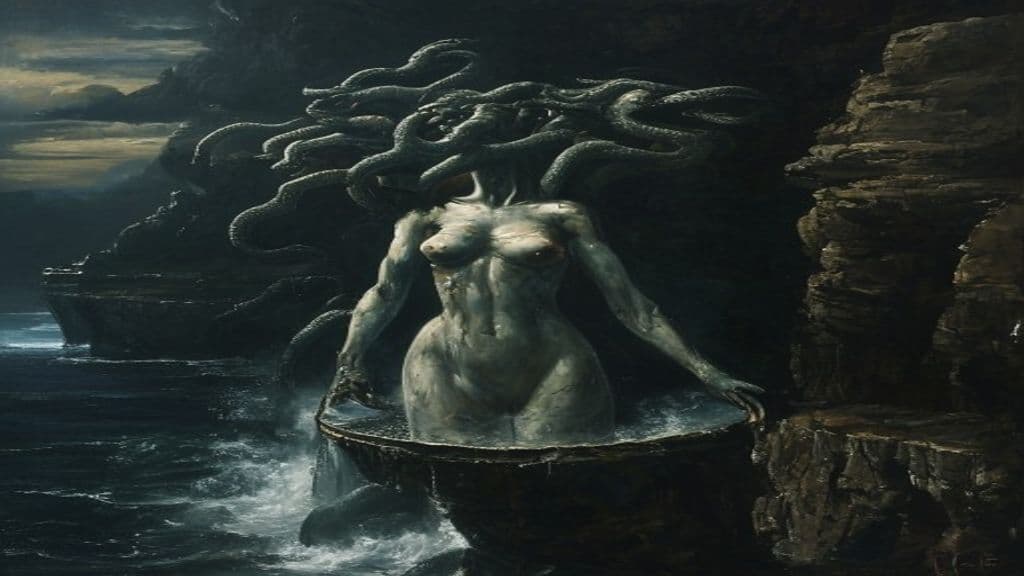
Medusa (the Gorgon)
Medusa, also called Gorgo or the Gorgon, is one of the three Gorgons in ancient Greek mythology. She is described as a mortal woman whose hair is composed of living snakes and whose gaze turns onlookers to stone; she is usually named as a daughter of the sea-associated figures Phorcys and Ceto and sister to Euryale and Stheno.
Antianeira
Antianeira (Ancient Greek: Ἀντιάνειρα, lit. 'a match for men') is a personal name borne by several mortal women in Greek mythic tradition. The name appears in variant genealogical and heroic contexts: as a possible mother of the Argonaut Idmon (in a tradition naming Apollo as father), as mother of the Argonauts Eurytus and Echion in other listings, and as an Amazon (also spelled Antianara) who in some accounts succeeds Penthesilea as queen and fights at Troy.
Antianeira of Argos
Antianeira (Ancient Greek: Ἀντιάνειρα, Antiáneira) is a mortal woman of Argos named in Greek epic catalogue material as the mother of the Argonaut Idmon in some traditions, with Apollo given as the father in those lines. She functions as a genealogical marker linking a hero to place (Argos; the river Amphryssos in the Orphic line) rather than as a supernatural figure.
Antichrist
An eschatological oppositional figure in Christian tradition who opposes Jesus Christ and may appear either as a present spirit or as a single climactic deceiver before the Second Coming. The term functions both as a category of false teachers and as a particular latter‑day 'lawless one' identified with apocalyptic images in Daniel, Paul, and Revelation.
Anticlea
Anticlea (Ancient Greek: Ἀντίκλεια) is a figure of Greek myth best known as the mother of Odysseus and former queen of Ithaca who appears as a speaking shade in Odysseus’ katabasis to the underworld (Odyssey, Book XI). In Homeric tradition she exemplifies the category of deceased human spirits who can converse with the living under ritualized conditions but are incorporeal and cannot be physically embraced.
Anticlus
Anticlus (Ancient Greek: Ἄντικλος) is a named mortal Greek warrior of the epic Trojan cycle who hid inside the wooden horse at Troy. He is chiefly remembered for nearly revealing the concealed Greeks when Helen imitated the voice of his wife, and for being physically restrained by Odysseus to prevent detection.
Anties
Anties is not a documented supernatural being in the supplied sources; the string appears primarily as a personal name (Antie) in Dutch and early American records and as a lexical element in modern titles and technical names. No coherent folkloric characteristics, rituals, or cosmology are attested in the provided material.
Antilochus
Antilochus is a princely warrior of Pylos in the Homeric epic tradition, son of Nestor and a youthful Achaean fighter at Troy. He is famed for his swiftness, beauty, charioteering skill, close companionship with Achilles, role in the funeral games for Patroclus, and for dying in later epic-cycle accounts while saving his father.
Antimache
Antimache (Ancient Greek: Ἀντιμάχη) is a mortal figure in Greek mythic genealogy—the wife of King Eurystheus of Tiryns (sometimes associated with Mycenae) and mother of his children. She is known from genealogical lists and post-Herculean narratives that link Eurystheus' household to Arcadian lineages and to conflicts following the Labors of Heracles.
Antimachus
Antimachus is attested in the provided sources primarily as a classical Greek personal name borne by historical figures (notably Antimachus of Colophon, a poet and grammarian ca. 400 BC, and Antimachus I Theos, a Greco-Bactrian king). The name is also reused in modern contexts (a Wikidata taxon entry and small-press fictional/divinatory pages). The sources do not present Antimachus as a supernatural or folkloric entity.
Antimachus of Teos
Antimachus of Teos (Greek: Ἀντίμαχος ὁ Τήϊος) is an early Greco-Ionian epic poet cited in later antiquity as the putative author or ascription-anchor for fragmentary Theban-cycle material (notably sometimes the Epigoni). Later authors quote or reference him for sententiae and as a chronological marker; his identity is contested and sometimes conflated with the much later Antimachus of Colophon.
Antinoe
Antinoe (Ancient Greek: Ἀντινόη) is primarily attested as a proper name in classical and later sources: several mortal women in Greek myth (founding and tragic narratives) and as the place-name Antinopolis/Antinoë in Roman Egypt. The surveyed materials do not present Antinoe as a discrete supernatural being, nor record rituals or wards directed against an entity by this name.
Antinous
Antinous was a Greek youth from Bithynia who became the favourite of the Roman emperor Hadrian; after his premature death c.130 CE Hadrian ordered his deification and founded an organized cult (including the city Antinoöpolis and commemorative games) that spread across the Roman Empire and was syncretized in some contexts with the Egyptian god Osiris.
Community Record
- [1]Antigone (daughter of Laomedon) — Wikipedia. Wikipedia, 'Antigone (daughter of Laomedon)'wiki
- [2]Antigone 2 - Greek Mythology Link. Greek Mythology Link, 'Antigone 2' (summary of mythographic variants)literary
- [3]Ovid, Metamorphoses (references and summaries). Summary material citing Ovid's Metamorphoses (Arachne tapestry mention)literary
- [4]Vatican Mythographers (summary of variant). Summaries of Vatican Mythographers as preserved in modern references (variant: snake-hair then stork; enmity to Zeus)literary
- [5]Lactantius Placidus (scholiast) — summary. Scholastic tradition (Lactantius Placidus) summarized in modern sources asserting a variant in which Hera transformed Antigone for sleeping with Zeusliterary