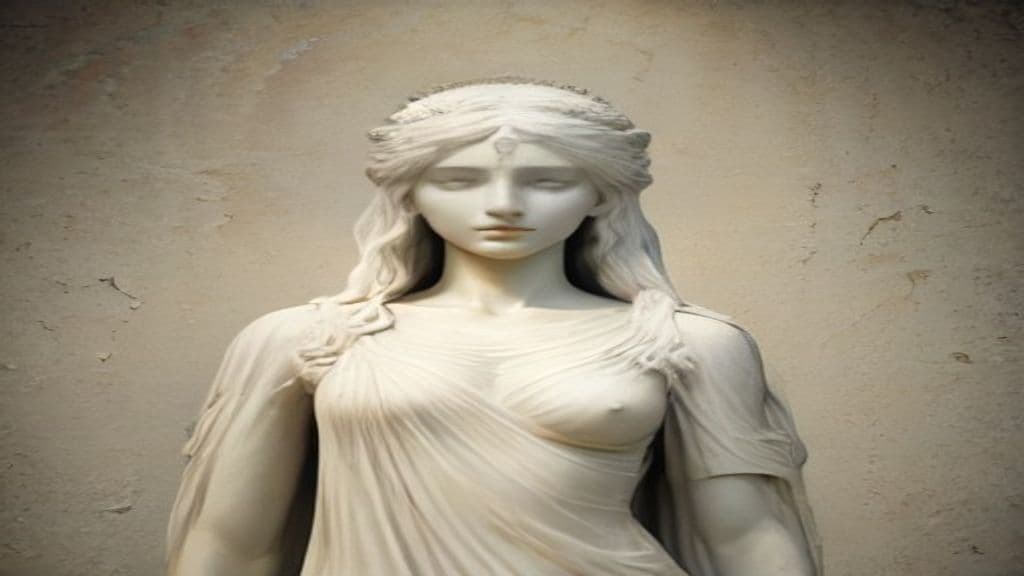
Anticlea is presented in the Homeric genealogical framework as daughter of Autolycus and Amphithea, wife of Laërtes, and mother of Odysseus (though some later accounts give Sisyphus as Odysseus’ father in alternate genealogies). Her primary mythic appearance is posthumous: she is encountered as a shade when Odysseus journeys to the realm of the dead in the Odyssey (Book XI). Later and variant traditions recorded by subsequent authors and summaries attribute differing causes for her death — chiefly grief and longing for her son, and in some accounts suicide after hearing a false report from Nauplius — but these are variants on the Homeric core rather than separate origin narratives.
As a living figure she is named as queen of Ithaca, wife of Laërtes, and mother of Odysseus and Ctimene; classical summaries give no detailed physical portrait. In the Odyssey (Book XI) she appears as an incorporeal shade: Odysseus attempts to embrace her three times but his arms pass through her, and she explains that this intangibility is the condition of all ghosts.
Anticlea does not possess independent supernatural powers in the sources beyond those typical of Homeric shades: when Odysseus performs the necessary ritualized katabasis she is able to converse with him and report news of the household and the cause of her own death. She cannot be physically touched by the living (Odysseus’ embraces fail) and the provided sources do not attribute agency to her to affect the living outside spoken communication during the ritual encounter.
Weaknesses
- conditionincorporeality — cannot be physically embraced or affected by touch
- conditionappearance contingent on ritual/katabasis — she is encountered only when the living perform the prescribed journey and rites
- otherno independent agency to harm the living recorded in sources — treated as an informant rather than an afflicting spirit
Wards
None recorded.

Anthus
Anthus (Greek Ἄνθος, 'flower, bloom') is a name applied to more than one mortal figure in ancient Greek myth whose misfortunes are remembered by their metamorphosis into birds; in one tradition Zeus and Apollo transform Anthus and his kin into birds, and the transformed bird called 'anthus' is said to mimic a horse's neigh while fleeing from horses. Another Anthus is an Anthedon youth who is lost in childhood and later recognized by his brother after serving as a cup-bearer.
Anti-Monitor
A fictional cosmic antagonist from DC Comics: an anti-matter–aligned multiversal being whose actions can destroy positive-matter universes and who serves as the cosmic opposite of the Monitor.
Anti-Venom
Anti-Venom is a fictional symbiotic life-form appearing in Marvel Comics. A member of the alien Symbiote race, Anti‑Venom bonds with human hosts (notably Eddie Brock and Flash Thompson in different storylines) to form a hybrid being with enhanced physical abilities and narrative powers described as curative against symbiote-related afflictions.
Antianeira
Antianeira (Ancient Greek: Ἀντιάνειρα, lit. 'a match for men') is a personal name borne by several mortal women in Greek mythic tradition. The name appears in variant genealogical and heroic contexts: as a possible mother of the Argonaut Idmon (in a tradition naming Apollo as father), as mother of the Argonauts Eurytus and Echion in other listings, and as an Amazon (also spelled Antianara) who in some accounts succeeds Penthesilea as queen and fights at Troy.
Antianeira of Argos
Antianeira (Ancient Greek: Ἀντιάνειρα, Antiáneira) is a mortal woman of Argos named in Greek epic catalogue material as the mother of the Argonaut Idmon in some traditions, with Apollo given as the father in those lines. She functions as a genealogical marker linking a hero to place (Argos; the river Amphryssos in the Orphic line) rather than as a supernatural figure.
Antichrist
An eschatological oppositional figure in Christian tradition who opposes Jesus Christ and may appear either as a present spirit or as a single climactic deceiver before the Second Coming. The term functions both as a category of false teachers and as a particular latter‑day 'lawless one' identified with apocalyptic images in Daniel, Paul, and Revelation.
Anticlus
Anticlus (Ancient Greek: Ἄντικλος) is a named mortal Greek warrior of the epic Trojan cycle who hid inside the wooden horse at Troy. He is chiefly remembered for nearly revealing the concealed Greeks when Helen imitated the voice of his wife, and for being physically restrained by Odysseus to prevent detection.
Anties
Anties is not a documented supernatural being in the supplied sources; the string appears primarily as a personal name (Antie) in Dutch and early American records and as a lexical element in modern titles and technical names. No coherent folkloric characteristics, rituals, or cosmology are attested in the provided material.
Antigone (daughter of Laomedon)
Antigone is a Trojan princess in Latin literary tradition who, according to a small set of ancient sources, incurred Hera's wrath and was transformed by the gods into a stork (or related crane/stork bird). Her tale functions as a metamorphosis aetiology explaining a bird's enmity to snakes and as a moral exemplar of hubris toward the gods. The story survives mainly in Latin authors (notably Ovid) and later scholiasts and mythographers and exists in several variant forms.
Antilochus
Antilochus is a princely warrior of Pylos in the Homeric epic tradition, son of Nestor and a youthful Achaean fighter at Troy. He is famed for his swiftness, beauty, charioteering skill, close companionship with Achilles, role in the funeral games for Patroclus, and for dying in later epic-cycle accounts while saving his father.
Antimache
Antimache (Ancient Greek: Ἀντιμάχη) is a mortal figure in Greek mythic genealogy—the wife of King Eurystheus of Tiryns (sometimes associated with Mycenae) and mother of his children. She is known from genealogical lists and post-Herculean narratives that link Eurystheus' household to Arcadian lineages and to conflicts following the Labors of Heracles.
Antimachus
Antimachus is attested in the provided sources primarily as a classical Greek personal name borne by historical figures (notably Antimachus of Colophon, a poet and grammarian ca. 400 BC, and Antimachus I Theos, a Greco-Bactrian king). The name is also reused in modern contexts (a Wikidata taxon entry and small-press fictional/divinatory pages). The sources do not present Antimachus as a supernatural or folkloric entity.
Community Record
- [1]Anticlea — Wikipedia. Wikipedia entry summarizing classical and later accounts; cites Odyssey Book XI and later variantswiki
- [2]Anticlea — Wikidata. Wikidata item for Anticlea (identifier and linked data)other
- [3]The Odyssey - 1997 - Part 2 of 2 (archive synopsis). Archive synopsis of the 1997 television miniseries depicting Odysseus' sacrifice and meeting with Anticlea (modern dramatization)other
- [4]Odysseus, mora oa Laertes. (archive). Archived material referencing Odysseus and Laërtes (contextual/archival)other
- [5]Anticlea elegans — Wikipedia (modern taxonomic reuse). Modern botanical taxa using the name Anticlea; cited to note later homonymic uses of the mythic namewiki
- [6]Green Deathcamas, ANTICLEA {Zigadenus} VIRESCENS. Popular botanical page discussing species named Anticlea (modern usage of the mythic name)other
- [7]Southwest Colorado Wildflowers — Anticlea & Toxicoscordion. Regional wildflower resource referencing botanical name Anticleaother
- [8]Insects of Britain and Ireland — Anticlea Stephens. Entomological reference to moth genus Anticlea (modern reuse of the mythic name)other