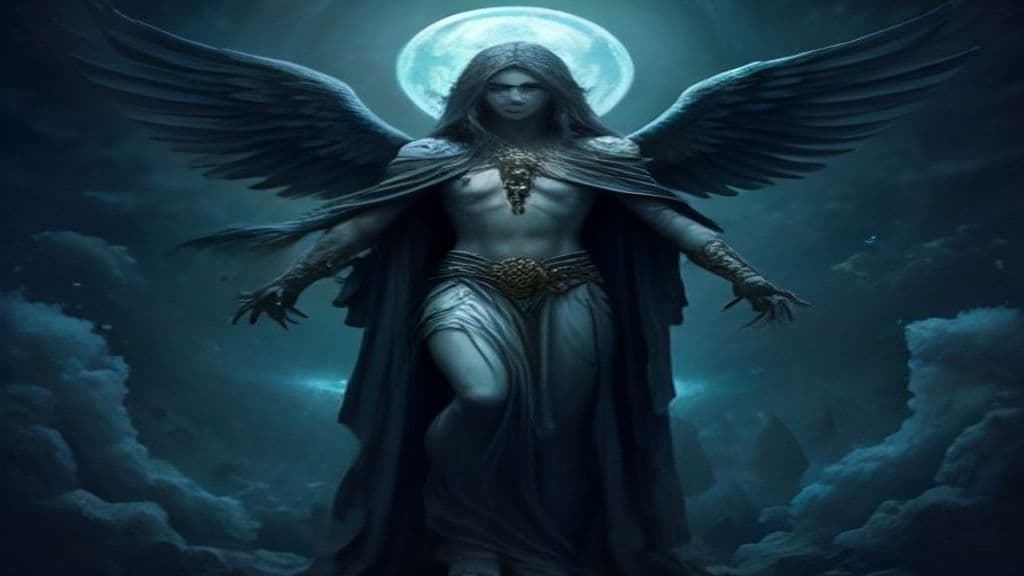
Arphugitonos appears in the revelatory frame of the Greek Apocalypse of Ezra / Revelation of Esdras. In that text Esdras recounts a nocturnal vision in which an angel reveals the names of heavenly beings who will govern at the end of the world; Arphugitonos is given as one of nine such names alongside Michael, Gabriel, Uriel, Raphael, Gabuthelon, Aker, Beburos, and Zebuleon. The attribution derives from the apocryphal apocalypse preserved in Greek and reproduced in modern collections and translations of the Revelation of Esdras (see Ante-Nicene Fathers and other reproductions cited in the sources).
No physical description of Arphugitonos is provided in the supplied sources. The name is recorded only in a list of angels in the vision; the apocalyptic text does not supply form, color, size, garments, or other outward characteristics. The absence of description is consistent with the text's practice of naming celestial functionaries without individualized iconographic detail for some minor or noncanonical names.
The sole attested role in the available materials is that Arphugitonos is one of the nine angels who "will govern 'at the end of the world'." Beyond this collective governance attribution, the supplied sources do not assign individualized duties, actions toward humans, or specific supernatural powers to Arphugitonos. No further behaviors or capacities are described in the provided excerpts.
Michael
Michael is presented in the supplied sources as a masculine given name and disambiguation headword applied to people, historical rulers, cultural works, places, and other uses; the provided material treats it as an onomastic item rather than as a single supernatural being.

Gabriel
A principal heavenly messenger in Jewish, Christian, and Islamic literatures, Gabriel is portrayed as an archangel who reveals and explains divine messages, announces births and divine intent, and executes certain divine judgments in apocalyptic texts.

Uriel
Uriel is an archangel figure in Jewish and Christian apocryphal, liturgical, and popular traditions, variously described as an interpreter of prophecy, guardian of cosmological thresholds (Gate of Eden, Tartarus/pit), regent of light or the sun, and a guide or agent in salvation narratives. His prominence and specific functions vary by tradition (Second Book of Esdras, Ethiopian homily, apocryphal gospels, patristic and later angelologies).

Aker
Aker is an ancient Egyptian personification of the horizon and an earth and underworld deity who is described in surviving summaries as guardian of the eastern (Bakhu) and western (Manu) horizons, marking liminal boundaries between day and night and between the living world and the netherworld.
Arnapkapfaaluk
A fearsome sea-being of the Coronation Gulf Copper Inuit who controls access to seals and other marine mammals; she withholds game as punishment for taboos or indiscretions and thus governs hunters' success.
Arnavāz
Arnavāz is a named royal woman in Persian epic tradition (Shahnameh and related recensions). She is presented as a consort of the usurper Zahhāk who, after his defeat, is taken into Fereydun's household and in some versions is mother of Iraj, thus functioning as a dynastic node in the epic genealogy.
Arne (daughter of Aeolus)
Arne (Ancient Greek: Ἄρνη, Árnē) is a mortal woman in Greek mythic genealogy, presented as daughter of Aeolus and Melanippe and as ancestress of the Boeotians through her son Boeotus. Her narrative links human lineages with divine action (Poseidon) and local eponymy (a city named for her appears in the Iliad's Catalogue of Ships).
Arne Sithonis
A figure from Ovid's Metamorphoses: a princess who accepted Minos' bribe to betray her island and was punished by the gods with metamorphosis into a black-footed, black-winged jackdaw forever attracted to gold and shining objects. The tale is attested only in Ovid (as preserved in modern summaries) and functions as a moral exemplum about greed and betrayal.
Arnemetia
Arnemetia is a local Romano-British goddess attested by a shrine name at Aquae Arnemetiae (modern Buxton, Derbyshire). Her name links her to a sacred grove (nemeton) and to water, suggesting a place-centered divinity associated with spring(s) and grove cults.
Arnim Zola
Arnim Zola is a fictional human-origin supervillain from Marvel Comics: a biochemist and genetic engineer who becomes an enduring antagonist through technological means — notably mind-transfer, cloning, and android bodies — and as an agent of Hydra and the Red Skull across multiple media.
Arquetu
A Cantabrian popular-belief figure depicted as an old man marked with a green cross and seven keys on his forehead who intervenes in human economic affairs by lending money to prodigals and punishing repeat wastefulness with a curse of eternal poverty.
Arrhon
Arrhon (Ancient Greek: Ἄρρων) is a mortal figure preserved in Greek mythic genealogies. The name refers to at least two distinct persons: a Minyan prince of Orchomenus, son of King Clymenus, and an Arcadian genealogical ancestor said to be father of Psophis.
Arrowette
Arrowette is a legacy heroic persona from American comic-book continuity (DC Comics), adopted by two related women across generations: Bonnie King (the original 'Miss Arrowette') and her daughter Suzanne 'Cissie' King-Jones. Within the fictional world she is a human, costume‑wearing archer whose identity functions as a public role, team membership, and a locus for interpersonal and moral drama rather than a supernatural being.
Arsay
Arsay is a goddess attested in the late Bronze Age Ugaritic corpus. She appears as one of the daughters of the storm god Baal in the Baal Cycle and is known from a small number of offering-list and god-list documents; interpretations of her function range between associations with the underworld and with subterranean or meteorological waters, but the textual evidence is ambiguous.
Arsenius the Great
Arsenius the Great (c. 350/354–c. 445/450) was a Roman-born imperial tutor who renounced court life to become an anchorite among the Desert Fathers in Egypt. Venerated as a saint in Eastern Orthodox, Coptic, and Roman Catholic traditions, he is remembered for extreme humility, prolonged solitude, silence, copious tears of devotion, and brief monastic writings and sayings preserved in the Apophthegmata Patrum and other collections.
Arsinoe (daughter of Nicocreon)
Arsinoe is a Cypriot princess in a late-antique account who, after spurning the suitor Arceophon and informing her parents of his advances, is turned into stone by the goddess Aphrodite. The tale survives as a brief mythic variant of a wider Cypriot petrification motif and is presented as an instance where petrifaction signals the subject's cold-heartedness.
Community Record
- [1]Arphugitonos — Wikipedia. Wikipedia, entry 'Arphugitonos'.wiki
- [2]Revelation of Esdras (Revelation/Apocalypse of Ezra) — Pseudepigrapha reproduction. Revelation of Esdras text reproduction listing the nine angels revealed to Esdras.literary
- [3]Revelation of Esdras — Ante-Nicene Fathers, Vol. VIII. Ante-Nicene Fathers, volume VIII: English reproduction of the Revelation of Esdras narrative and angelic list.literary
- [4]Revelation of Esdras — New Advent (Church Fathers). New Advent English rendition of the Revelation of Esdras including the vision framework and list of nine angels.literary
- [5]Beburos — Wikipedia. Wikipedia entry for Beburos; reproduces the same nine-name list that includes Arphugitonos.wiki
- [6]Revelation of Esdras — Ministry Today / Apocrypha reproduction. Online reproduction of the Revelation of Esdras text that lists the nine angels.literary
- [7]Naming Angels of Destiny & Judgement | Book of the Neglected (blog reproduction). Blog post reproducing or discussing the angelic list from Revelation of Esdras; corroborates appearance of Arphugitonos in that roster.other
- [8]Revelation of Esdras — Pseudepigrapha.com (alternate reproduction). Reproduction of the Revelation of Esdras text (same primary source referenced among the supplied materials).literary