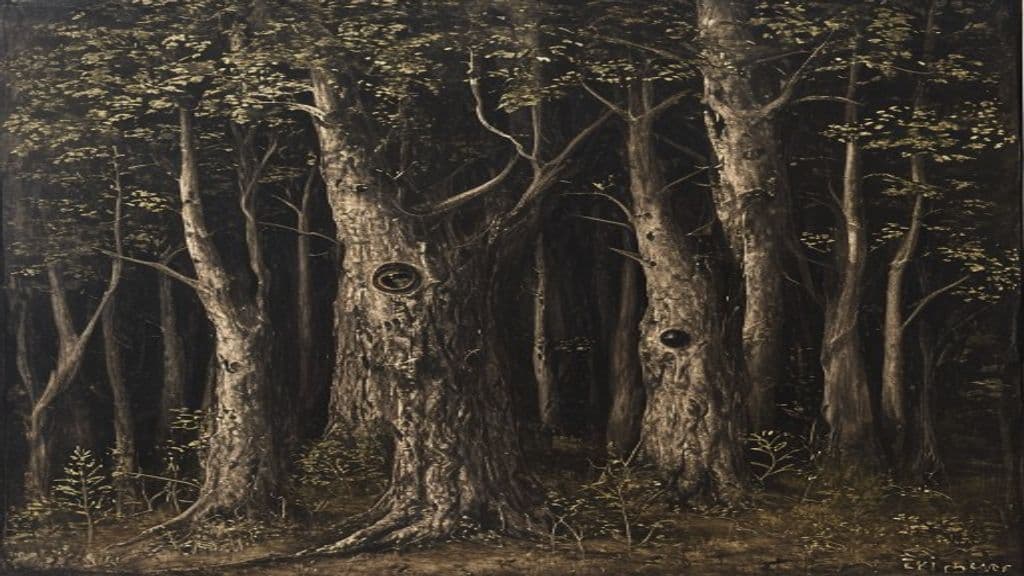
Sources record Askafroa not as a narrative-born deity but as the living presence or 'soul' of a particular ash tree: a female tutelary spirit bound to that tree's physical integrity. Ethnographic accounts (chiefly Hyltén‑Cavallius, as summarized in later sources) present her as an immanent, localized guardian figure—the 'wife' or 'lady' of the ash—whose welfare is identical with the tree's. The documentary record contains no birth or mythic creation narrative; rather, Askafroa is described functionally as the animate personhood attached to an individual ash and integrated into local ritual practice.
The surviving records do not supply a detailed physical description. Contemporary summaries and the primary ethnographic account emphasize her identity as the 'wife' or 'lady' of the ash and as the tree's soul, and they focus on role and behavior rather than anthropomorphic features. Consequently, sources portray Askafroa through her agency and obligations to the tree rather than by visual traits.
Ethnographic sources describe Askafroa as capable of harmful, retaliatory action when her tree is injured: breaking branches or cutting the ash was thought to cause illness to the offender, and she is characterized as 'a very dangerous creature' that 'did much damage' unless appeased. Communities therefore performed an annual propitiation to prevent such harm; the recorded preventive rite involves pouring water over the ash's roots on Ash Wednesday morning while speaking a sacrificial formula. These descriptions emphasize localized protective and punitive agency tied to the physical condition of a specific ash tree.
Weaknesses
- conditionRefrain from injuring the tree (avoid breaking branches or cutting)
- ritualAnnual propitiation (see ritual entry): pouring water over the roots and reciting the sacrificial formula on Ash Wednesday
Wards
- ritualAsh Wednesday sacrifice (pour water over roots; recite 'Nu offrar jag, så gör du oss ingen skada')
Hag
A hag is a folkloric figure typically depicted as an old, wizened woman who appears across European traditions in multiple roles: a nightmare spirit, a witch-like or fairy-type being, a river or household monster, or (in some cases) a form adopted by sovereignty or storm goddesses. The figure functions variously as a cautionary monster, an explanation for sleep paralysis and nightmares, and a liminal test-figure in myth.
Hulder (Huldra)
The hulder (Norwegian huldra) is a class of Scandinavian 'hidden folk' — a forest-associated local spirit traditionally conceived as a race or kind rather than a single individual. They are counted among the rå (wardens/keepers) of particular natural places and are widely attested in Scandinavian toponyms and folk belief.
Skogsrå
A female forest rå in Swedish folklore who rules the woods and its game; she appears as a beautiful woman from the front but reveals non-human features when seen from another angle. She interacts with hunters, woodcutters and charcoal-burners, offering favors (hunting luck, help with work, offspring) or ensnaring men who follow her into the forest.
Asiman
A nocturnal, shape‑changing predatory luminous spirit known from West African accounts; presented in sources as the Dahomey counterpart to the Ashanti obayifo, capable of inhabiting humans by day and manifesting as phosphorescent lights or a flying ball of light by night.
Asira
Asira is described in the available source material as a local god worshipped in pre-Islamic northern Arabia, specifically revered at the oasis-town of Taima (Tayma). The deity is noted as having been strongly influenced by Egyptian culture and is only minimally attested in the historical record (mentioned only by name by the Babylonian king Nabonidus).
Asius
Asius (Ancient Greek: Asios) is a personal name borne by several mortal leaders allied with Troy in Greek epic and mythographic tradition. The figures called Asius appear in leader-lists, genealogies, and battle narratives of the Trojan War cycle rather than as a distinct supernatural entity.
Asiya bint Muzāḥim (Asiya)
Asiya is the Qur'anic figure presented as the wife of the Pharaoh in the era of Moses who secretly embraced monotheism, adopted and preserved the infant Moses, and is venerated in Islamic tradition as an exemplary righteous woman promised a house in Paradise for her faith and steadfastness.
Ask and Embla
In Norse myth Ask (Askr) and Embla (Embla) are the first human man and woman, fashioned from wood/trees by the gods at the beginning of the cosmos and endowed with the gifts that make them human; they serve as the progenitors of humankind in the Norse cosmological narrative.
Askeladden
Askeladden (Ash-lad, Cinderlad) is a stock human folktale protagonist from Norwegian oral tradition, typically the youngest and least-valued child who, through cleverness, patience, and boldness, succeeds where elder siblings and conventional figures fail, often by outwitting trolls or solving enchanted tasks.
Aslan
Aslan is the singular, talking lion figure at the center of C. S. Lewis's The Chronicles of Narnia, functioning as creator, king, judge, savior, and moral authority within that fictional cosmology. The name also appears in unrelated contexts (personal names, a lion-like alien in Traveller RPG) but those are distinct referents.
Aslaug
Aslaug (Old Norse: Áslaug), also called Aslög or by the byname Kráka ("Crow"), is a legendary woman of Old Norse saga tradition, presented in medieval narratives (notably the Tale/Saga of Ragnar Lodbrok and the Völsunga material) as a noble-born figure raised in concealment and later married to the hero Ragnar Lodbrok.
Asmodai
Asmodai (variants: Asmodeus, Asmodaeus, Ashmedai) is a named, kingly malign spirit attested in late-antique and medieval Judaeo-Christian narrative traditions — most prominently the deuterocanonical Book of Tobit and legends about Solomon — where he functions as a leading hostile spirit who troubles humans.
Community Record
- [1]Askafroa — Wikipedia. Wikipedia contributors, 'Askafroa', Wikipedia, The Free Encyclopedia.wiki
- [2]Hyltén‑Cavallius ethnographic account (as cited in secondary sources). Hyltén‑Cavallius (quoted in Wikipedia): description of Ash Wednesday rite and belief that breaking branches caused illness.folk
- [3]Wald- und Feldkulte: der Baumkultus der Germanen und ihrer Nachbarstämme — Wilhelm Mannhardt. Wilhelm Mannhardt, Wald und Feldkulte (sections on 'Die Holundermutter, die Eschenfrau und ihre Sippe' and 'Der Baum als Person'), used for comparative context on tree-guardian figures.academic