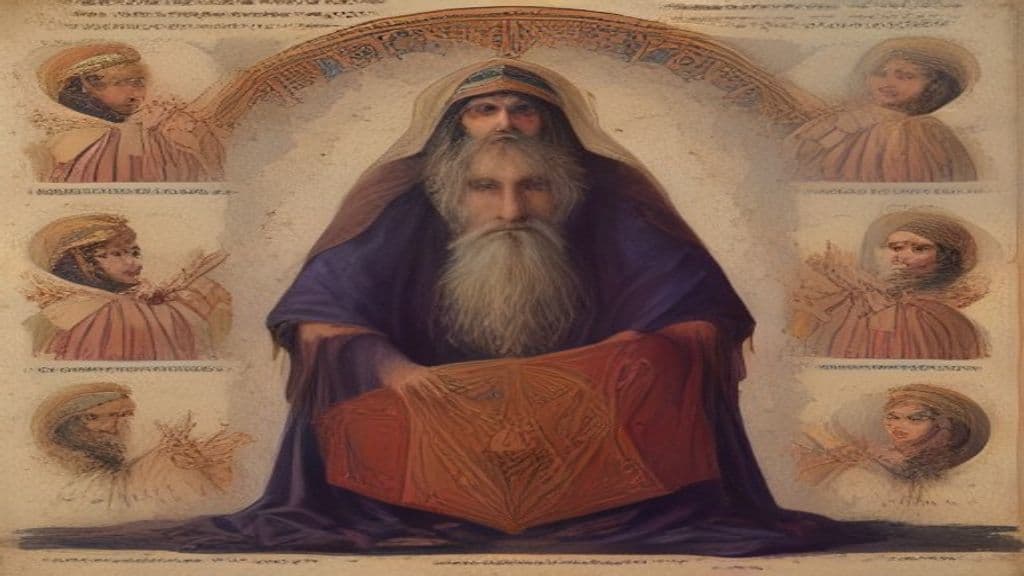
The supplied sources identify Asmodai primarily through literary attestations rather than a single creation myth. The deuterocanonical Book of Tobit is the principal scriptural locus cited; later Talmudic and Solomonic legends incorporate the figure as a powerful hostile spirit or 'king of demons.' Modern reference works summarized in the sources also note a hypothesis that the figure may have conceptual or historical parallels with the Mazdian/Iranian demon Aeshma, but they emphasize that any linguistic or conceptual relationship is uncertain rather than established.
The provided materials do not supply a reliable traditional physical description. Encyclopedic summaries and the cited reference fragments focus on role and attestation (status as a king of demons and presence in Tobit and Solomonic legends) without giving consistent iconographic details in the supplied excerpts.
Within the cited sources Asmodai is presented as a principal hostile spirit and 'king of demons' whose narrative function is to oppose, trouble, or harm humans. The references link him to the Book of Tobit and to Solomonic legends, contexts in which he acts as an active adversary in human affairs; the supplied excerpts do not catalogue a detailed list of powers (possession formulas, supernatural faculties, or specific supernatural acts) beyond this role-based description.
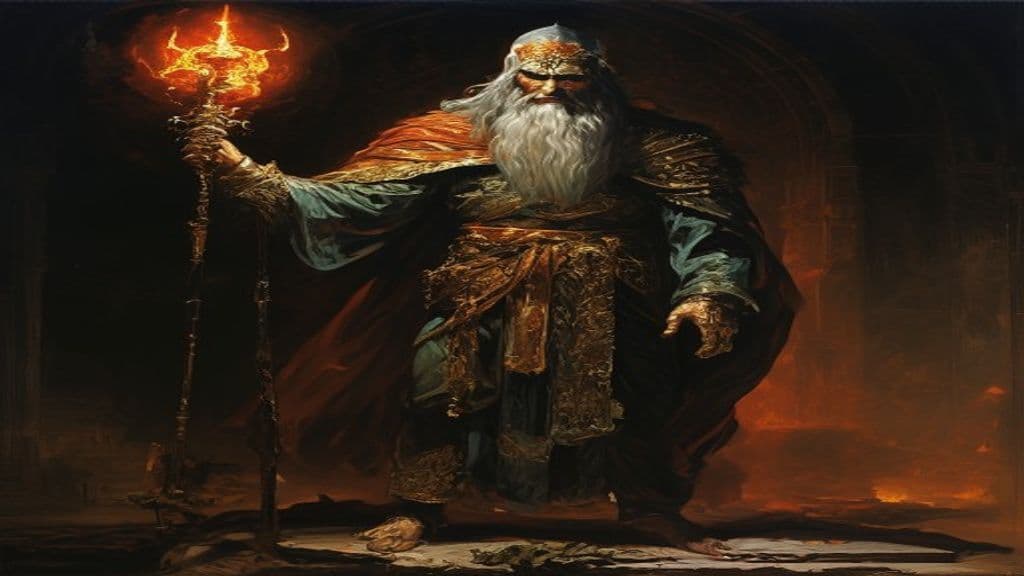
Asiya bint Muzāḥim (Asiya)
Asiya is the Qur'anic figure presented as the wife of the Pharaoh in the era of Moses who secretly embraced monotheism, adopted and preserved the infant Moses, and is venerated in Islamic tradition as an exemplary righteous woman promised a house in Paradise for her faith and steadfastness.
Ask and Embla
In Norse myth Ask (Askr) and Embla (Embla) are the first human man and woman, fashioned from wood/trees by the gods at the beginning of the cosmos and endowed with the gifts that make them human; they serve as the progenitors of humankind in the Norse cosmological narrative.
Askafroa
A female tutelary spirit identified as the localized soul or guardian of an individual ash tree in southern Swedish folk belief (notably Scania). Traditionally propitiated annually on Ash Wednesday to prevent illness or damage that was believed to follow injury to the tree.
Askeladden
Askeladden (Ash-lad, Cinderlad) is a stock human folktale protagonist from Norwegian oral tradition, typically the youngest and least-valued child who, through cleverness, patience, and boldness, succeeds where elder siblings and conventional figures fail, often by outwitting trolls or solving enchanted tasks.
Aslan
Aslan is the singular, talking lion figure at the center of C. S. Lewis's The Chronicles of Narnia, functioning as creator, king, judge, savior, and moral authority within that fictional cosmology. The name also appears in unrelated contexts (personal names, a lion-like alien in Traveller RPG) but those are distinct referents.
Aslaug
Aslaug (Old Norse: Áslaug), also called Aslög or by the byname Kráka ("Crow"), is a legendary woman of Old Norse saga tradition, presented in medieval narratives (notably the Tale/Saga of Ragnar Lodbrok and the Völsunga material) as a noble-born figure raised in concealment and later married to the hero Ragnar Lodbrok.
Asmodeus
Asmodeus (Heb. Ashmedai/Ashmeday; Gr. Asmodaios; Arabic Sakhr in some accounts) is a named malignant spirit appearing in Near Eastern Jewish, Christian deuterocanonical, and later Islamic storytelling. Traditions portray him as a princely or kingly figure among malevolent spirits who intervenes in human affairs—notably hostile to marriages and in contest with King Solomon—and who can be driven off or bound by ritual fumigation and angelic agency.
Asopis
Asopis is the name borne by two distinct women in ancient Greek genealogical traditions: (1) a naiad listed among the daughters of the river-god Asopus and Metope, and (2) a Thespian princess, one of the fifty daughters of King Thespius, who bore Heracles a son named Mentor. The name is explicitly glossed as 'daughter of Asopus' in the cited sources, marking it primarily as a patronymic/eponymic identifier within Greek mythic genealogies.
Asopus
Asopus is a Greek river-eponym: both the name of several rivers and of mythic personages identified with those rivers. Traditions alternately present Asopus as a divine river-god (often as a child of Oceanus and Tethys, or in variant genealogies a son of Poseidon or Zeus), and as a local founding king; he functions as progenitor of many eponymous daughters and as an agent in myths explaining springs, city origins, and river characteristics.
Aspalis
Aspalis is a local heroine and cultic eponym from Melite (Melitaea) in Phthia, Thessaly. According to the tradition preserved via Antoninus Liberalis (summarized in modern compendia), she hanged herself to avoid enforced concubinage under a tyrant; her body vanished and was said to have been replaced by a wooden statue that became a cult image of Artemis, giving rise to an annual ritual in the city.
Aspidochelone
A massive sea creature in Arabian tradition that lures sailors to their deaths with its 'island' appearance, emitting a sweet smell to attract fish. (Note: 1. Power tier should be Primordial (as it's described as a "giant sea monster" and its appearance is often mistaken for an island). 2. No source material mentions any connection to the symbolism of Sa)
Asrai
A female aquatic fairy or water-spirit figure appearing in English-language literature and later folkloric-style retellings; associated with lakes and deep water and variably described as timid, long-lived, and vulnerable to light. Its provenance is disputed between 19th‑century literary origins and later folkloric claims.
Community Record
- [1]Asmodeus — Wikipedia. Wikipedia, Asmodeus, article summarizing Asmodeus as 'a king of demons' in Solomonic legend and related traditions.wiki
- [2]Asmodeus — Wikidata Q733322. Wikidata entry summarizing Asmodeus as 'king of demons from the deuterocanonical Book of Tobit'.wiki
- [3]Asmodai — Thelemapedia (fragment). Thelemapedia entry fragment noting Asmodai's prominence in Tobit, mention in Talmudic legends, and a likely (but not certain) origin in Mazdian religion.other
- [4]Asmodai — New World Encyclopedia. New World Encyclopedia entry noting functional parallels between Zoroastrian Aeshma and Asmodai/Asmodeus while cautioning that linguistic relationship does not necessarily denote conceptual continuity.other
- [5]TV MADNESS - WHY AND HOW THEY LIVE AMONGST US (archive). Archive.org search result / media referencing modern cultural uses of the name 'Asmodai' (modern media instance; not a traditional source).other
- [6]Crown of Thorns Blooper Reel: Chapters 26—50 (archive). Archive.org item showing contemporary/pop-cultural appearance of the name 'KING ASMODAI' among other beings in modern listings (not a primary traditional source).other
- [7]Asmodai — New World Encyclopedia (duplicate citation for etymology note). See New World Encyclopedia entry for discussion of possible parallels with Zoroastrian Aeshma and cautions about etymological claims.other