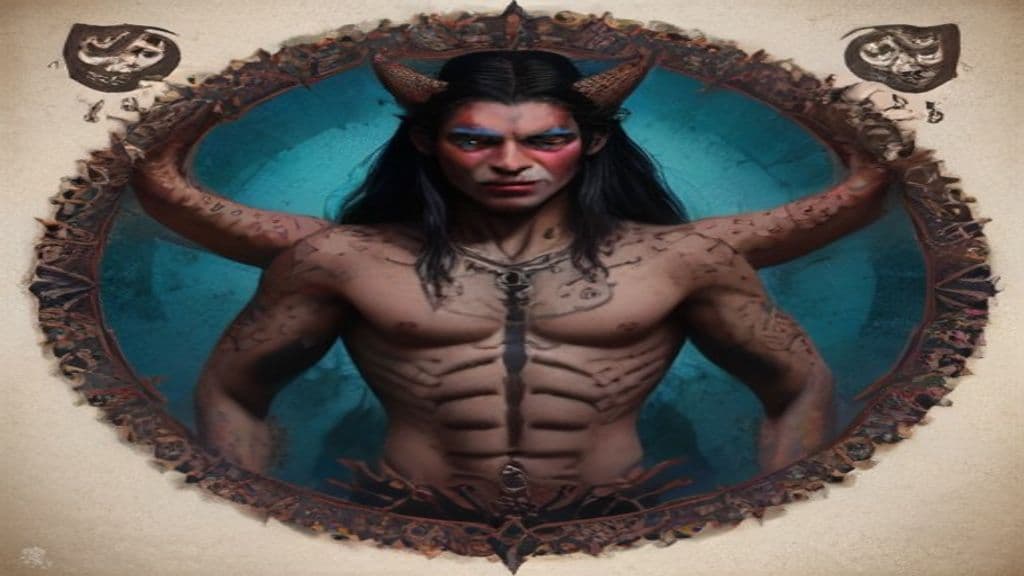
The supplied sources do not contain a traditional mythic origin story for a demon named Balam. English-language reference material (a Wikipedia disambiguation entry) lists 'Balam (demon)' as an entry, and a modern occult/demonology compilation included in the corpus assigns Balam a place in Goetia-style lists and gives modern attributes (e.g., rank 'King') — but no primary medieval, biblical, or ethnographic origin narrative is provided in the materials at hand. The reader is therefore left with modern secondary attributions rather than a documented classical provenance.
No iconographic or morphological description of a demon named Balam appears in the supplied documents. The corpus does note that in Maya languages B'alam/Bahlam means 'jaguar' and is used in names and toponyms; that lexical meaning is distinct from the demon-name listing and should not be conflated with an appearance description absent explicit source linkage.
The materials provided do not give corroborated traditional powers or behaviors for a demon Balam. A modern occult/demonology webpage included in the sources attributes to Balam the title 'King' and the command of '40 legions' in a Goetia-style schema, but this is a modern compilation and the corpus contains no primary-source descriptions of specific abilities, functions, or behaviors in historical religious texts.
Baku
A composite supernatural creature in East Asian (Chinese → Japanese) folklore best known in Japan as a benevolent dream‑devourer invoked to remove bad dreams and protect children at bedside. Its depiction and roles developed over time from an older Chinese chimera (mo) into a household protective being with a cautionary moral about overuse.
Bakunawa
A dragon- or serpent-like mythic being from Philippine tradition associated with the moon and eclipses; its actions explain lunar eclipses and some natural phenomena and were integrated into ritual practice and calendrical knowledge.
Bal-Bal
A Philippine folkloric undead/monster that steals corpses from funerals and graves and feeds on them, noted for keen scent for dead bodies, sharp claws and teeth, foul breath, and reportedly leaving a banana‑tree trunk in the coffin as a substitute for the stolen corpse.
Bala Ganapati
Bala Ganapati (Sanskrit: bāla-gaṇapati) is a child-form aspect of the Hindu deity Ganesha (Ganapati), depicted and venerated as a youthful manifestation emphasizing childhood, growth, abundance and fertility. He is listed as the first of thirty-two canonical forms of Ganesha in the Sritattvanidhi and is represented in iconography and some regional shrines (notably South India, where the child form is sometimes called Pillaiyar).
Bala Tripurasundari
Bala Tripurasundari (Sanskrit: बालत्रिपुरसुन्दरी; also called Balambika) is the youthful or child aspect of the goddess Tripura Sundari in the Tantric Śrī Vidyā tradition. She functions as a tutelary goddess invoked in sādhanā, appears in the Lalita Mahatmya episode of the Brahmāṇḍa Purāṇa as a martial divine agent, and is the object of kavach, mantra, and Pancharathnam devotional material.
Balaam
Balaam (Hebrew Bīlʿām) is a non‑Israelite seer/diviner attested in the Hebrew Bible and in an extra‑biblical West Semitic inscription (Deir Alla). He is portrayed as a liminal prophetic figure who receives divine visions and utters oracular poems but is morally contested in later traditions for his alleged role in leading Israel to transgression.
Balarāma
Balarāma (Sanskrit: बलराम) is a major deity in the Indian religious tradition closely associated with the Krishna cycle and the Vrishni hero-cult. He is described as Krishna's elder brother, an agricultural patron identified with the plough (halā) and club (gaḍā), and is later associated with the cosmic serpent Śeṣa/Saṅkarṣaṇa and incorporated into Viṣṇu avatāra lists; his cult is attested in early coinage and sculpture from c. 2nd century BCE onward and in living traditions such as the Jagannātha triad and village devotional practice.
Balaur
In Romanian folklore the balaur is a monstrous serpentine or dragon‑like being, often many‑headed, that functions as predator/abductor, treasure‑guardian, and an agent of meteorological phenomena; in some regional variants it is said to be ridden or controlled by weather‑sorcerers (Solomonari).
Bald Mountain (Slavic)
A location in Slavic folklore associated with witchcraft and the Witches' Sabbath. (Note: 1. Power tier should be Primordial since it's associated with witchcraft and has connections to deities (witches are often seen as having deity-level powers). Greater is too low of a power level. 2. A)
Balder the Brave
Balder the Brave is the Marvel Comics adaptation of the Norse figure Baldr: an Asgardian prince-warrior who serves as a member of Asgard's ruling family, participates in councils of gods, and whose death or wounding has been used as a catalyst in some Marvel storylines (including Ragnarök-style events).
Baldr
Baldr (Old Norse Baldr; Old English Bældæġ; Old High German Balder/Palter) is a god in Germanic mythology. In the Norse branch he is named as a son of Odin and Frigg and as a member of the Aesir, attested alongside brothers such as Thor and Váli in the supplied sources.
Balin
Balin is identified in the provided sources as a fictional character created by J. R. R. Tolkien, listed as a dwarf in Tolkien's legendarium of Middle-earth. The available references are index-style entries and do not supply in-world narrative details, appearance, abilities, or rituals.
Community Record
- [1]Balam (Wikipedia disambiguation). Wikipedia contributors, 'Balam,' Wikipedia, https://en.wikipedia.org/wiki/Balam (accessed via provided corpus).wiki
- [2]Balam Demon Dictionary - Male Demon Names List & Demonology. HellHorror, 'Balam Demon Dictionary - Male Demon Names List & Demonology,' https://hellhorror.com/demon-names/balam-demon-410.html (excerpted in provided materials).other
- [3]Mayan usages of B'alam (jaguar) — disambiguation note. Wikipedia contributors, 'Balam' (entry noting Maya language name B'alam = 'jaguar'), https://en.wikipedia.org/wiki/Balam (accessed via provided corpus).wiki
- [4]Welcome to Demon School! Iruma-kun (mention of modern fictional use of name). Wikipedia contributors, 'Welcome to Demon School! Iruma-kun,' https://en.wikipedia.org/wiki/Welcome_to_Demon_School%21_Iruma-kun (used in corpus to illustrate modern fictional reuse of the name).wiki