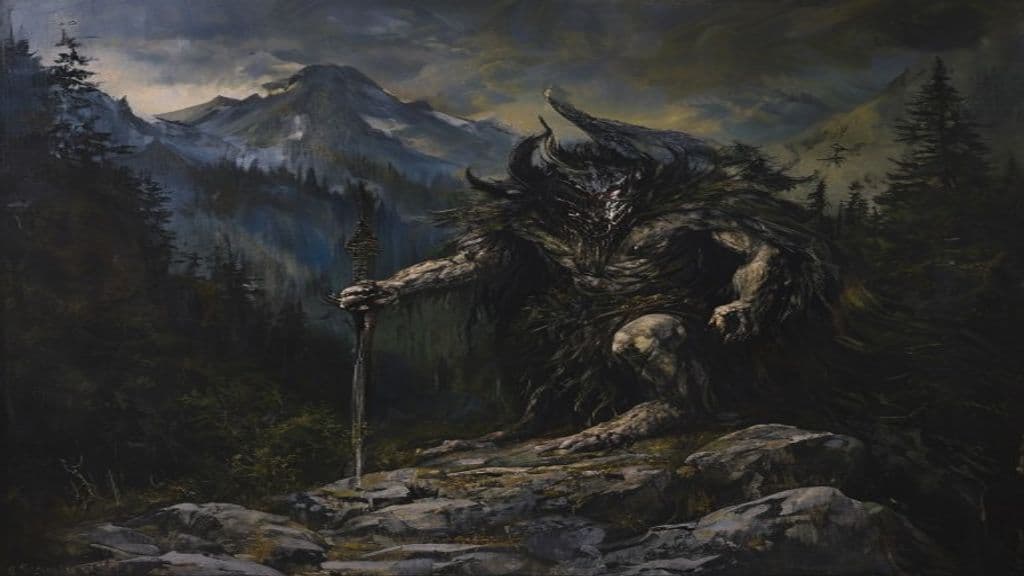
The origin of Orko is not well-documented in the available source material. However, it can be inferred that Orko's association with thunder may be tied to its etymology from 'Orkeguna', which means Thursday in Basque.
No specific physical description is provided for Orko in the source material.
As a thunder god, Orko likely has control over weather-related phenomena, specifically thunderstorms. It is also associated with Thursday, suggesting its worship or reverence may have been practiced on this day of the week.
Arevakhach’
The Armenian eternity sign is an ancient national symbol representing the Armenians' spiritual and celestial connection. It appears as a geometric figure on khachkars and church walls, embodying the significance of faith and symbolism in Armenian tradition. (Note: - Power tier: Primordial (as it's described as an "ancient" national symbol, but there's no indication that it's deity-level) - Appearance: Not enough detail is provided; the source material only ment)
Baltic Mythology
A complex pantheon of gods, spirits, and supernatural beings in ancient Baltic cultures. (Note: 1. Power tier: Change to "Ancient" as Primordial implies a cosmic entity, which is not supported by the source material. 2. Origin story: Specify that the connection with nature and inspiration from t)
Blue Stone (Russia)
A type of sacred stone in Slavic tradition, held significant spiritual significance and venerated through simple rituals. (Note: - Power tier should be Lesser (since they don't have major hallows and are venerated in a simpler way). - Abilities: "Venerated through simple rituals" is vague; clarify that these rituals include pou)
Celtic Sacred Trees
In Celtic tradition, sacred trees are imbued with spiritual significance and serve as symbols, conduits for medicinal properties, or abodes for nature spirits. (Note: 1. Power tier is uncertain; the source material does not explicitly describe the trees' power level. 2. Abilities should be more specific; instead of stating they "possess symbolic significance and se)
Eguzki Amandrea (Sun Mother)
Eguzki Amandrea is the Basque personification of the sun, presented in the cited corpus as a female, familial cosmic figure associated with warmth, growth, and the visible life of the world. Sources frame the sun as an animate, gendered celestial body embedded in a kinship-like cosmology with Earth and the Moon.
Galtxagorri (Galtzagorris)
Galtxagorri (also spelled Galtzagorris in the cited tourism material) are described in the supplied source as tiny elfin beings from Basque mythology who are presented in a local Zarautz tourism experience where they are hidden around the town's historic monuments for families to find.
Intxixu (Intxisua)
A class of small mischievous beings in Basque folklore described in available sources as 'little creatures that make mischief' that can both help people and cause problems. Mentioned in modern English-language summaries of Basque mythology as part of a variety of such creatures.
Lupae
In Roman tradition, Lupae refers to a female wolf or prostitute symbolizing fertility and protection. (Note: - Power tier: Change to Ancient (deity-level) as Lupae's abilities and symbolism suggest a higher level of power than Primordial. - Abilities: Clarify that Lupae is associated with fertility and prote)
Supernatural Beings in Slavic Tradition
In the Slavic tradition, supernatural beings are a part of the natural world, existing alongside humans and other entities. They have a unique relationship with nature, reflecting an interconnected worldview. (Note: 1. The power tier should be Primordial, as it is implied that these supernatural beings are a fundamental part of the natural world and not limited by human regional boundaries. 2. Remove "Their abili)
Tursaansydän
An ancient, swastika-like symbol in Finnish tradition associated with protection, good luck, and blessings. (Note: - Power tier should be Lowered from Primordial to Ancient, as it is described as an "ancient symbol" and not cosmic in power. - No sensory cues or weaknesses are mentioned in the source material; add )
Oriṣa (Orisha / Orixá)
Oriṣa (Yoruba: òrìṣà; Portuguese: orixá; Spanish variants: orisha, oricha, orichá) are the class of divine spirits or deities central to the Yoruba religion of West Africa and to Yoruba-derived religious systems in the Atlantic diaspora (notably Lucumí/Santería in Cuba and Candomblé in Brazil). They function as active sacred presences and intermediaries in communal and individual religious life; in diaspora settings they were often syncretized with Catholic saints as a strategy of continuity under colonial Christian rule.
Ormenus
Ormenus (Ancient Greek Ὄρμενος) is not a single supernatural being but a personal name attested for several mortal figures in Greek mythic genealogies and epic narratives. Bearers include an eponymous king associated with Ormenion/Ormenium in Thessaly, a father of Ctesius (thus ancestor of Eumaeus in the Odyssey), and various minor warriors appearing in lists of combatants (Trojan casualties; the Seven against Thebes). The name functions primarily as a genealogical and toponymic marker across epic and local traditions.
Community Record
- [1]