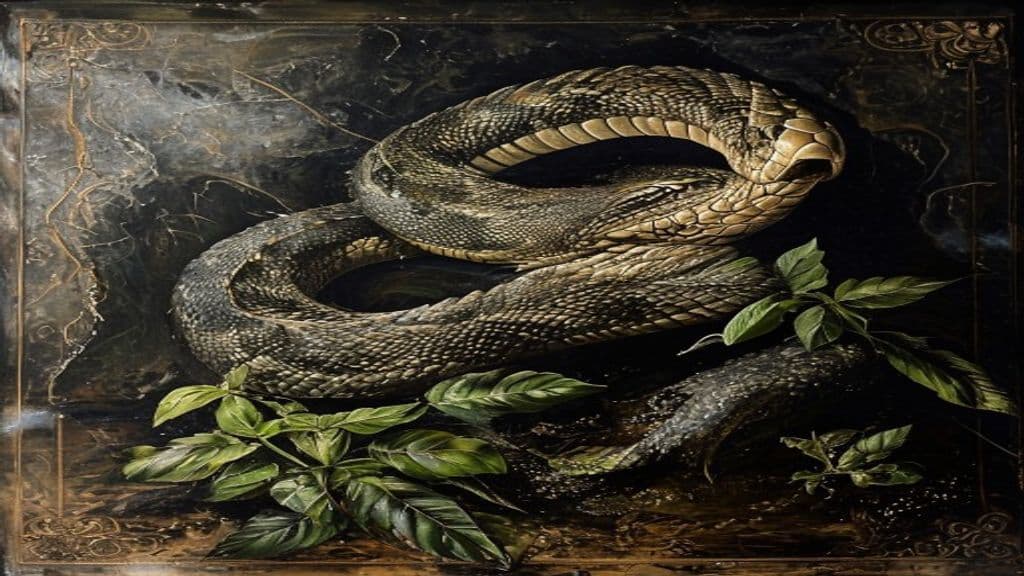
In the Roman natural‑history tradition as received and summarized in modern reference works, the basilisk appears as a prodigious reptile reported by classical writers and localized in at least one named locus — the basilisk of Cyrene as recorded in Pliny's Naturalis Historia. Medieval bestiary compilers inherited and circulated Pliny's description, embedding the creature within the catalogues of marvelous and dangerous animals that populate Roman and later European imaginative geography; in these sources it operates less as a theological being and more as an exemplar of extreme natural danger.
The supplied classical and medieval summaries describe the basilisk as a small serpent; Pliny's description as summarized in reference material explicitly calls it "not more than twelve inches in length." The creature is conventionally labeled a "serpent king" in bestiary usage, indicating an exceptional or regal status among serpents in the literature, but the excerpts provided do not supply consistent iconographic detail (such as crown, crest, coloration, or hybrid features).
According to Pliny's account as summarized in modern sources and as transmitted into medieval bestiaries, the basilisk possesses two specifically noted lethal properties: it is so venomous that it leaves a wide trail of deadly venom in its path, and its gaze is likewise lethal, causing death when looked upon. These extraordinary natural powers place it among other monstrous animals of Roman imagination that threaten humans through excessive or marvelous corporeal capacities.

Basamum
Basamum is attested as a deity worshipped in pre-Islamic South Arabia, tentatively associated with healing through an etymological link to balsam; a single ancient text credits Basamum with curing two sick goats or ibexes. The evidence is limited and leaves most aspects of cult and myth undetermined.
Basan
The Basan is a legendary nocturnal bird-like yōkai from Edo-period Japanese illustrated compendia. Described as a chicken-sized fowl that emits a visible, cold, non-combustive ‘ghost-fire’ and feeds on charred wood and embers, it is associated with mountain bamboo groves and remote villages at night.
Bashe (巴蛇) — Great Horned/Great Ba Snake
Bashe (巴蛇, bā-shé) is a named legendary giant python-like serpent in classical Chinese literature, famed for swallowing elephants whole and disgorging their bones after a long interval. It appears in mytho-geographic and poetic compilations (notably the Shanhaijing and the Chuci Tianwen) and is taken up in materia medica writings (e.g., Bencao Gangmu) and commentaries (Guo Pu) as both marvel and source of medicinal substances.
Bashnouna
Bashnouna is a Coptic Christian monk venerated as a saint and martyr in the Coptic Orthodox tradition. According to hagiographical accounts recorded in the Coptic Synaxarion and secondary summaries, he was a monk of the Monastery of Saint Macarius in Scetes, arrested during the Fatimid caliphate of al-'Āḍid, refused to convert to Islam, and was burned alive on 24 Pashons (19 May 1164). His relics are reported buried at the Church of Saint Sergius in Cairo and he is commemorated liturgically on that date.
Basilides and Potamiana
Basilides and Potamiana are early Christian martyrs venerated in later tradition. Potamiana is remembered as a young virgin of Alexandria whose martyrdom and reported nocturnal appearances inspired conversions; Basilides was a court officer converted by Potamiana’s apparition, baptized, and subsequently executed.
Basilisco chilote
A Chilote household parasite: a rooster-crested, serpentine creature hatched from a chicken's egg that lives beneath houses and feeds on inhabitants' phlegm and saliva, causing dehydration and death. Preventive measures call for burning the egg and killing the laying hen; once hatched the documented remedy is to burn the afflicted house.
Basque Primordial Entity
Very little is known about Basque mythology due to the lack of surviving texts from the pre-Christian worldview. (Note: 1. Summary: Add that most knowledge comes from indirect sources such as legends and place names. 2. Power tier: Remove or change Primordial, as there is no information about its abilities or powers. 3)
Bastet
Bastet (Ancient Egyptian bꜣstt; also rendered Bast, Ubasti, Bubastis) is an ancient Egyptian goddess whose character shifted over millennia from a lioness warrior-protector of the king and Ra to a later cat-associated deity linked to domestic protection, fertility, motherhood, and healing against disease and evil spirits. Her principal cult center was Per-Bastet (Bubastis) in the Nile Delta.
Bat
Bat is an ancient Egyptian cow- and sky-goddess, attested from the late Predynastic period as the chief deity of the 7th Upper Egyptian nome (Seshesh/Hu). She is closely associated with the sistrum and was later syncretized into the cult of Hathor by the Middle Kingdom.
Bata
Bata is an Egyptian local deity associated with cattle and with a territorial cult in Upper Egypt. In New Kingdom religious geography he appears as the co-representative of the 17th Upper Egyptian Nome alongside Anubis and also functions as the protagonist of the Tale of Two Brothers (Papyrus D’Orbiney), a mythic narrative that includes motifs of kinship, death and postmortem continuity.
Batara Guru
Batara Guru is a supreme divine figure in multiple Indonesian mythological traditions (Indonesian Hinduism, Batak, Bugis, Javanese). He functions variously as a guru-aspect of Shiva, a creator or world-recoverer in Batak narrative fragments, an ancestor and progenitor in Bugis and Batak genealogies, and a high deity of the kahyangan in Javanese cosmology.
Batara Kala
Batara Kala is a Javanese and Balinese underworld deity associated with death, time, and destruction; feared as an ogre-like devourer of the unlucky, he is also ritually propitiated to avert misfortune, especially for at-risk children.
Community Record
- [1]Basilisk (Wikipedia). Wikipedia, 'Basilisk' (summary of Pliny's description and bestiary tradition)wiki
- [2]Monsters of Roman Folklore (video). Monsters of Roman Folklore, chapter listing including 'The Basilisk' (popular video summary of Roman imaginative creatures)other