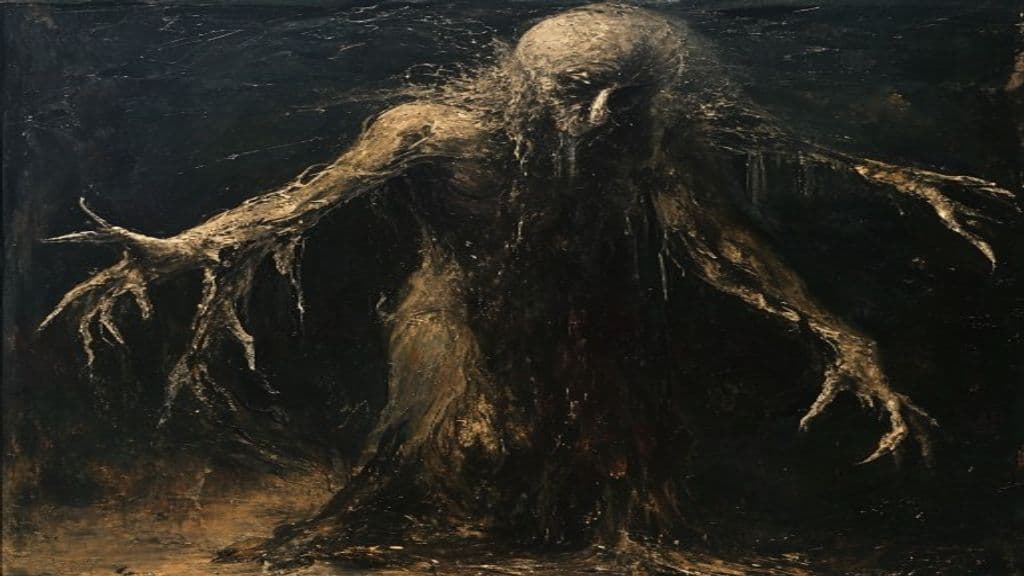
The origin story of this entity is unknown due to the lack of surviving texts from the pre-Christian era.
No physical description of the entity is provided in the source.
No information about the entity's abilities or behaviors is available.
Bashe (巴蛇) — Great Horned/Great Ba Snake
Bashe (巴蛇, bā-shé) is a named legendary giant python-like serpent in classical Chinese literature, famed for swallowing elephants whole and disgorging their bones after a long interval. It appears in mytho-geographic and poetic compilations (notably the Shanhaijing and the Chuci Tianwen) and is taken up in materia medica writings (e.g., Bencao Gangmu) and commentaries (Guo Pu) as both marvel and source of medicinal substances.
Bashnouna
Bashnouna is a Coptic Christian monk venerated as a saint and martyr in the Coptic Orthodox tradition. According to hagiographical accounts recorded in the Coptic Synaxarion and secondary summaries, he was a monk of the Monastery of Saint Macarius in Scetes, arrested during the Fatimid caliphate of al-'Āḍid, refused to convert to Islam, and was burned alive on 24 Pashons (19 May 1164). His relics are reported buried at the Church of Saint Sergius in Cairo and he is commemorated liturgically on that date.
Basilides and Potamiana
Basilides and Potamiana are early Christian martyrs venerated in later tradition. Potamiana is remembered as a young virgin of Alexandria whose martyrdom and reported nocturnal appearances inspired conversions; Basilides was a court officer converted by Potamiana’s apparition, baptized, and subsequently executed.
Basilisco chilote
A Chilote household parasite: a rooster-crested, serpentine creature hatched from a chicken's egg that lives beneath houses and feeds on inhabitants' phlegm and saliva, causing dehydration and death. Preventive measures call for burning the egg and killing the laying hen; once hatched the documented remedy is to burn the afflicted house.
Basilisk
A legendary serpent from classical and medieval bestiary tradition, the basilisk is described as a paradigmatic "king" of serpents whose gaze, breath, or venom is fatal and whose presence scorches and corrupts the surrounding environment. Treated variously as a monstrous animal, materia for alchemy, and a locus of local legend, it features recurrent countermeasures (weasel, rooster, mirror) in the sources.
Basilisk
A legendary serpent‑king from Roman and medieval European bestiary tradition, described in Pliny's reception as a small but uniquely deadly snake whose venomous trail and lethal gaze can kill. It functions in those corpora as one of several marvelous or dangerous creatures catalogued by natural historians and compilers of bestiaries.
Bastet
Bastet (Ancient Egyptian bꜣstt; also rendered Bast, Ubasti, Bubastis) is an ancient Egyptian goddess whose character shifted over millennia from a lioness warrior-protector of the king and Ra to a later cat-associated deity linked to domestic protection, fertility, motherhood, and healing against disease and evil spirits. Her principal cult center was Per-Bastet (Bubastis) in the Nile Delta.
Bat
Bat is an ancient Egyptian cow- and sky-goddess, attested from the late Predynastic period as the chief deity of the 7th Upper Egyptian nome (Seshesh/Hu). She is closely associated with the sistrum and was later syncretized into the cult of Hathor by the Middle Kingdom.
Bata
Bata is an Egyptian local deity associated with cattle and with a territorial cult in Upper Egypt. In New Kingdom religious geography he appears as the co-representative of the 17th Upper Egyptian Nome alongside Anubis and also functions as the protagonist of the Tale of Two Brothers (Papyrus D’Orbiney), a mythic narrative that includes motifs of kinship, death and postmortem continuity.
Batara Guru
Batara Guru is a supreme divine figure in multiple Indonesian mythological traditions (Indonesian Hinduism, Batak, Bugis, Javanese). He functions variously as a guru-aspect of Shiva, a creator or world-recoverer in Batak narrative fragments, an ancestor and progenitor in Bugis and Batak genealogies, and a high deity of the kahyangan in Javanese cosmology.
Batara Kala
Batara Kala is a Javanese and Balinese underworld deity associated with death, time, and destruction; feared as an ogre-like devourer of the unlucky, he is also ritually propitiated to avert misfortune, especially for at-risk children.
Batara Sambu
Batara Sambu is a deity in Javanese Hinduized mythology described as the god or patron of teachers, the first-born son of the high god Batara Guru and queen Batari Uma. In wayang (Javanese shadow-play) tradition he is depicted as a ruler of clouds, ancestor of rakshasa (giants), and resident of the southern heavenly realm Kahyangan Swelagringging; his pasaran (Javanese calendar day) is Pa(h)ing and his palace is said to be made of copper.
Community Record
- [1]Basque Mythologywiki