No coherent mythic pedigree or narrative origin for Belenus survives in the cited material. The evidence presents him instead as a longstanding local and regional deity attested before Roman contact and continuing under Roman rule. Epigraphic and archaeological data (some 51 inscriptions with the name, many concentrated at Aquileia) indicate an indigenous cult centered on springs and civic sanctuaries rather than a reconstructed genealogical origin story; later personal and place-name survivals in Britain and Ireland suggest the name persisted in onomastic memory but do not provide a mythic account.
The supplied sources do not record a consistent or detailed anthropomorphic iconography for Belenus. No surviving literary description or agreed visual type is given in the excerpts; instead the deity is known through inscriptions, place associations (for example dedications to 'Fons Beleni'), and sanctuary contexts. Because the primary evidence is epigraphic and topographical rather than descriptive, scholars refrain from assigning specific visual attributes without further archaeological corroboration.
Across the cited scholarship Belenus is characterized primarily as a healing and protective god. He is closely associated with medicinal waters and therapeutic springs (attested by dedications to fountains such as 'Fons Beleni' and sanctuary contexts), served civic-protective functions — most prominently as a patron of Aquileia — and in some places had oracular or sanctuary roles. Under interpretatio romana Belenus was commonly equated with Apollo in inscriptions and Roman sources, a linkage that frames him in the overlapping classical categories of healing, light/brightness, and civic protection. Linguistic debate about his name (see etymology) further ties him conceptually to brightness/solar attributes, medicinal plants (henbane), springs/sources, or potency/mastery, but no single functional portrait is imposed by the sources beyond his healing/protective prominence.
Weaknesses
- otherNo known weaknesses recorded in sources
Wards
- otherNo apotropaic wards against Belenus are attested; cultic dedications and maintenance of sanctuaries and springs serve religious relations with the deity
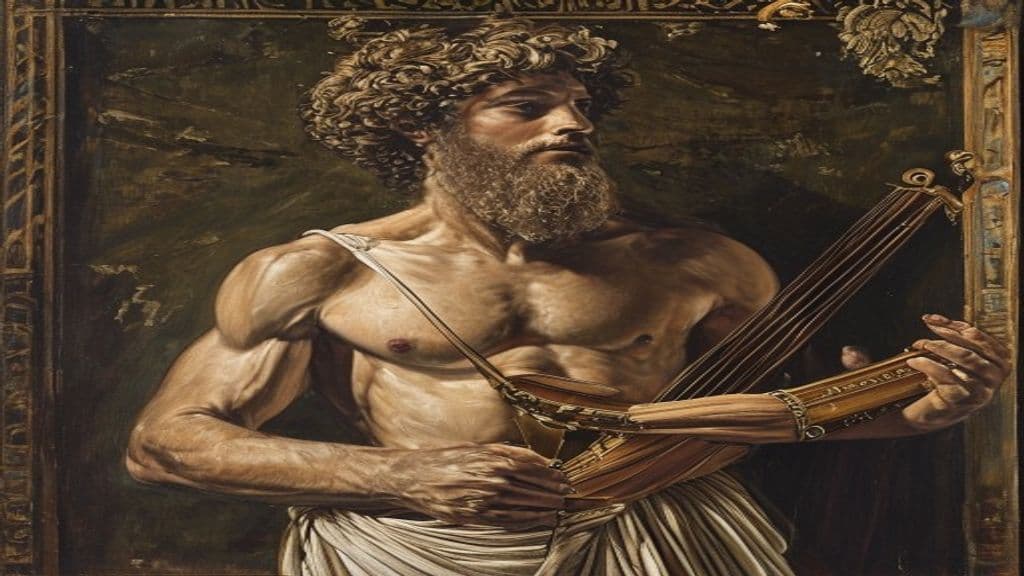
Apollo
Olympian deity of ancient Greek religion associated with prophecy, healing, music, archery, purification, and civic order. Principal patron of the Delphic oracle, protector of youth and flocks, and ambivalently both healer and bringer of plague.

Belisama
Belisama is a Gaulish goddess attested in Roman-period inscriptions and place-names. Epigraphic evidence records formal dedications (including a nemeton and a votive sacrum) and at least one inscription equates her with the Roman Minerva; scholars debate whether her name denotes brightness, strength, or a plant-name, and toponymic evidence also suggests riverine associations.
Abandinus
Abandinus is a locally attested Romano‑Celtic theonym known from a single inscribed bronze feather (votive object) dedicated at Godmanchester (the Roman fort Durovigutum) in Cambridgeshire. Scholars interpret him as a local god or male spirit tied to a specific place and possibly associated with a nearby spring or stream; this association is tentative and based on etymological readings of the name.
Albiorix
Albiorix is a Celtic theonym attested in modern reference works as a Gaulish divine name that, in available summaries, is presented as an epithet or local identification of the Roman god Mars. The surviving remarks in the supplied sources are limited to name listings and disambiguation entries rather than narrative myth or cult detail.
Anextiomarus
Anextiomarus (Gaulish Anextlomāros; feminine Anextlomara) is an ancient Celtic theonym or epithet attested in Romano-British and Gallo-Roman inscriptions. In the sources it functions as an epithet of a solar deity syncretized with the Roman god Apollo and is glossed in one source as meaning roughly "Great Protection," indicating a protective, beneficent cult function in votive contexts.
Anextlomarus
Anextlomarus (also Anextiomarus; feminine Anextlomara) is a Romano-Celtic theonym attested in inscriptions from Roman Britain and Gaul. The name, interpreted as 'Great Protector', appears in dedicatory contexts and in one instance is equated with the Roman god Apollo, indicating a locally venerated protective deity integrated into Roman civic-religious practice.
Ankou
The Breton personification of death — the last person to die in a parish each year who drives a creaking cart collecting the dead, whose appearance or sound presages death.
Anu
Anu (also Ana, Anann, Anand) is a mother-figure in early Irish tradition associated with nourishment, territorial fertility and prosperity—especially in Munster—and is variably conflated with other maternal or war-related goddesses in later sources.
Banshee
A female spirit of Irish and Scottish folklore whose wail heralds an impending death in a family of Gaelic descent. Not a cause of death — a witness to it.
Breton Mythology
A collection of explanatory and heroic tales forming part of the Celtic mythos, rooted in ancient Celtic tradition. (Note: 1. Power tier: Primordial is incorrect; it should be Ancient (deity-level) as Breton mythology is rooted in ancient Celtic tradition but doesn't match the primordial level of cosmic entities. 2. Origi)
Clṻd
Clṻd (reconstructed Brittonic: Clṻd / Clọ:tā; Latin: Clōta) is a hypothesised, place-bound river-goddess inferred for the River Clyde basin. The figure is a scholarly reconstruction from hydronymy, regional archaeology (notably a 1967 tricephalic statue near the Clyde), and the widespread Celtic pattern of female water-deities; direct evidence of cult or rites is not preserved in the cited sources.
Condatis
Condatis is a local Celtic deity attested in Roman Britain, known from a small group of Latin votive inscriptions in which he is consistently identified with the Roman god Mars (inscriptions read 'Mars Condatis'). The name derives from the Celtic word condate, 'confluence', and the deity is associated with river‑junctions and related sacred geography; some scholars have proposed a link with healing waters, but direct ritual details are not preserved.
Cunomaglus
Cunomaglus is a Celtic epithet applied to the Greco‑Roman god Apollo at a Romano‑British sanctuary in Nettleton Shrub, Wiltshire. The name, translated as 'Hound Lord', appears on a votive inscription and marks a localized aspect of Apollo associated in the sources with hunting and possibly healing.
Daolghas
Member of the Fianna, a band of warriors in Irish mythology, with supernatural abilities. (Note: * Power tier: Inconsistent with abilities described; should be Primordial or Ancient due to its cosmic/deity-level powers. * Abilities: Not entirely accurate; it's specifically stated that Daolghas ca)
Community Record
- [1]Belenus (Wikipedia entry). Wikipedia, 'Belenus' (summary of epigraphic, archaeological, and linguistic scholarship)wiki
- [2]Wikidata entry for Belenus. Wikidata: Belenus (entity record — note: includes unrelated taxonomic homonymy)other