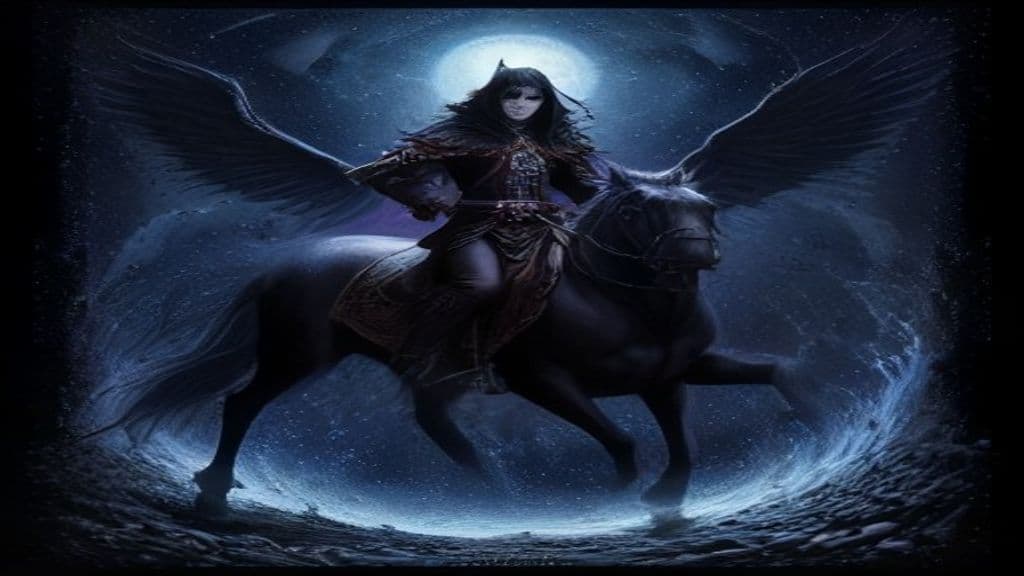
Beleth is attested within the taxonomy of Renaissance and early-modern grimoires. In the Pseudomonarchia Daemonum tradition as summarized in secondary sources, a mythic note links human contact with Beleth to Ham, son of Noah, who is said to have invoked him after the Flood and written a book with his help; otherwise Beleth's attestation and role derive from his listing and protocols in grimoire compendia.
Grimoire summaries consistently report that Beleth rides a pale horse, that a variety of music is heard before him, and that he appears fierce when first manifested—this fierceness is said to be used to frighten the conjurer or to test courage. The provided excerpts do not give a fuller, consistent bodily description beyond these elements.
Sources describe Beleth as a king who rules eighty-five legions of demons and as able to bind both men and women in 'foolish' or obsessive love until the conjurer's will is fulfilled. He is reported to assume a fierce aspect on appearance (interpreted as intimidation or testing of the conjurer) and his arrival is heralded by diverse music. Modern fictional sources attribute additional powers (e.g., shapechanging or longevity), but those are derivative and not corroborated by the cited grimoire summaries.
Weaknesses
- conditionconjurer courage and proper preparation (the conjurer must be brave)
- ritualprocedural containment: must be compelled into a drawn triangle
- ritualpaying respect by holding a silver ring on the middle finger of the left hand against the face (Dictionnaire Infernal)
Wards
- ritualdrawn triangle (struck toward the south, east, and upwards) to contain and command Beleth
- substancehazel wand (conjurer holds hazel wand during summoning)
- ritualsilver ring on middle finger of left hand held against the face to show respect to his rank
Belatucadros
Belatucadros is a native Brittonic/Celtic deity attested in northern Britain (modern Cumbria) whose cult continued into the Roman period; in Romano-British inscriptions he is commonly equated with the Roman god Mars (Mars Belatucadrus). Archaeological evidence shows roughly 28 inscriptions in the Hadrian's Wall region and small, simple altars, suggesting a local tribal protector and martial focus worshipped by Britons and lower-ranked Roman soldiers.
Beldgabred
Beldgabred is a legendary king of the Britons attested in Geoffrey of Monmouth's pseudo-historical king lists and repeated in later compilations and summaries. In Geoffrey's account (as summarized in modern sources) he is said to have surpassed other musicians on every instrument and is in some later remarks described as being 'claimed to be the god of minstrels.' His attestation is literary and genealogical rather than independently historical.
Belet Nagar
Belet Nagar is the tutelary goddess of the ancient Syrian city Nagar (Tell Brak). She functions as the city's divine patron in political and cultic contexts, connected to kingship, treaty-witnessing, and the ritual movement of her statue in civic festivals; many details of her character and identification with other goddesses remain uncertain in the sources.
Belet-ekalli (Ninegal)
Belet-ekalli, also rendered Ninegal, is a Mesopotamian palace tutelary deity whose name means 'lady of the palace.' She appears in canonical god lists and in interstate treaty enumerations, indicating a recognized role in palace cult and state-level ritual contexts.
Belet-ili
Belet-ili is a Mesopotamian divine womb-mistress invoked in cosmogonic texts as the artisan who forms humanity at the gods' commission. She functions as a female creator-midwife within the council of gods, shaping the first humans and receiving contributions of attributes from other deities.
Belet-Šuḫnir and Belet-Terraban
A paired set of Mesopotamian goddesses attested chiefly in Ur III administrative and ritual archives. Treated as two distinct but habitually paired 'ladies' of toponyms (Šuḫnir and Terraban), they were incorporated into the royal cult of Shulgi and appear in god lists, offering lists, seals, and festival contexts whose tone has been described as lugubrious.
Belfagor (Arcidiavolo)
A literary arch-demon figure originating in Niccolò Machiavelli’s Renaissance novella and later adapted in theatrical and operatic works (notably Respighi’s 1923 opera). In these narratives Belfagor is a high-ranking infernal envoy sent to the human world on a defined investigatory mission, who uses disguise, wealth, and deception as part of his role.
Belfagor arcidiavolo
The title character of Niccolò Machiavelli's Renaissance novella, presented as an archdevil (arcidiavolo) sent from Hell to Earth to investigate male complaints about marriage; a literary adaptation of an older folktale motif about a supernatural being assuming human guise and entering domestic life.
Belfaygor
Belfaygor is a fictional baron from Ruth Plumly Thompson's Jack Pumpkinhead of Oz (1929) and later Oz character lists. He is a sympathetic, comic nobleman afflicted by a magically accelerated beard growth that complicates his life and adventures in the Quadling Country.
Beli
Beli is a jötunn (giant) in Old Norse myth known chiefly as an adversary slain by the god Freyr. Attestations are fragmentary: he appears in Eddic and skaldic references as the named foe of Freyr and as an element in kennings, and scholars treat the fuller myth as largely lost.
Beli Mawr
Beli Mawr is a legendary ancestral king and eponymous progenitor in medieval Welsh genealogies and literature, presented as the father of several named mythic figures and as an origin-figure for royal houses. Modern scholarship sometimes hypothesizes a connection with the continental Celtic deity Belenus/Belenos, but medieval sources principally treat Beli as an ancestral/kingly figure rather than explicitly as a deity.
Beli's bane
A kenning-style epithet from the Old Norse poetic corpus, rendered from Old Norse bani Belia (with an adjectival bjart = 'bright' in some transmissions). It functions as 'the slayer (bane) of Beli' within the prophetic catalogue of Ragnarök in Völuspá rather than as a fully independent named being with its own cult or origin story.
Community Record
- [1]Beleth — Wikipedia. Wikipedia article summarizing grimoire attestations (Pseudomonarchia Daemonum, Lesser Key of Solomon, Dictionnaire Infernal).wiki
- [2]Beleth — Thelemapedia. Thelemapedia entry summarizing traditional grimoire material concerning Beleth's rank, appearance, and ritual protocols.other
- [3]Marvunapp: Beleth (fictional/fallen angel entry). Modern popular/fictional account referenced in research notes; treated as derivative and not as primary grimoire evidence.literary
- [4]Pseudomonarchia Daemonum / Lesser Key of Solomon (summarized in secondary sources). Primary grimoire tradition cited in summaries: describes rank (eighty-five legions), the ability to bind lovers, hazel wand and triangle procedures, and the fierceness test.other
- [5]Dictionnaire Infernal (as cited). Citation in secondary summaries for the silver ring gesture to pay respect to Beleth's rank.other