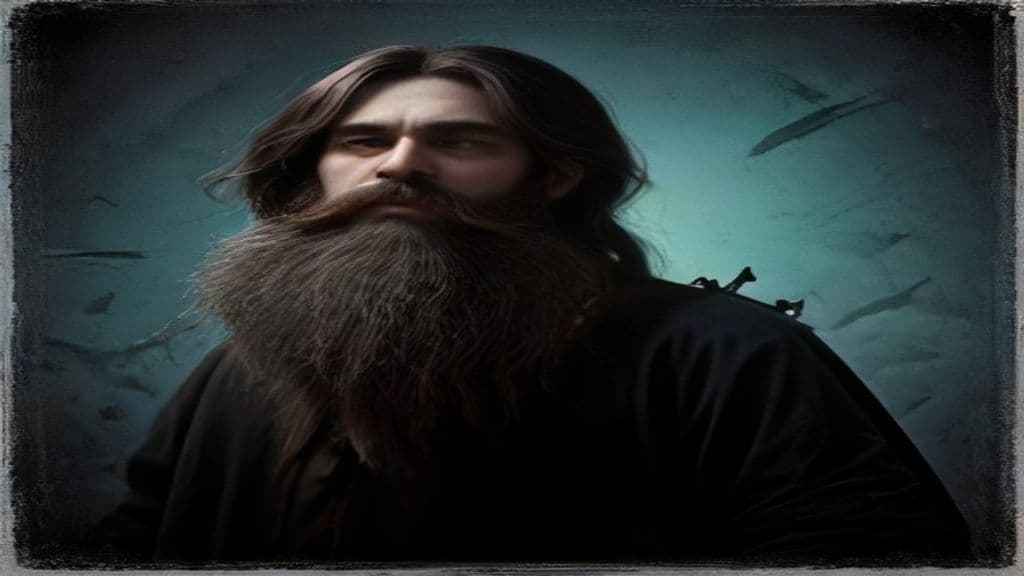
In Ruth Plumly Thompson's Jack Pumpkinhead of Oz (1929) Belfaygor is a baron of Bourne who requested "a beard for his wedding day" from his personal spellcaster (referred to in summaries as his "Miserable Mesmerizer"). The spell was poorly cast, producing an uncontrollably fast-growing beard rather than a normal bridal beard; this botched magic is presented as a comic mishap that drives elements of his storyline rather than as part of a folkloric ritual tradition.
Sources consistently describe Belfaygor as notable for a beard that grows at an extremely rapid rate; he must carry scissors to cut it constantly. Summaries note this growth causes practical problems such as difficulty sleeping and hazards in confined spaces. No consistent additional physical description (height, clothing, facial features beyond the beard) is provided in the cited materials.
Belfaygor possesses no inherent supernatural powers in the sources beyond being subject to the accidental magical affliction of a rapidly growing beard caused by a poorly cast spell. He functions as a romantic and comic nobleman who joins a rescue party to save his fiancée, Shirley Sunshine, and is captured alongside companions (Peter Brown, Jack Pumpkinhead, and Snif) during the adventure in Baffleburg. His beard's excessive growth creates complications and close-calls for those imprisoned with him.
Weaknesses
- conditionmagical affliction — uncontrollably fast-growing beard (result of a botched spell)
Wards
None recorded.
Belet-ekalli (Ninegal)
Belet-ekalli, also rendered Ninegal, is a Mesopotamian palace tutelary deity whose name means 'lady of the palace.' She appears in canonical god lists and in interstate treaty enumerations, indicating a recognized role in palace cult and state-level ritual contexts.
Belet-ili
Belet-ili is a Mesopotamian divine womb-mistress invoked in cosmogonic texts as the artisan who forms humanity at the gods' commission. She functions as a female creator-midwife within the council of gods, shaping the first humans and receiving contributions of attributes from other deities.
Belet-Šuḫnir and Belet-Terraban
A paired set of Mesopotamian goddesses attested chiefly in Ur III administrative and ritual archives. Treated as two distinct but habitually paired 'ladies' of toponyms (Šuḫnir and Terraban), they were incorporated into the royal cult of Shulgi and appear in god lists, offering lists, seals, and festival contexts whose tone has been described as lugubrious.
Beleth
Beleth is a high-ranking infernal king attested in Renaissance and early-modern grimoire tradition, described as commanding eighty-five legions of demons and as a spirit that ritual conjurers may summon, test, or bind for specific ends.
Belfagor (Arcidiavolo)
A literary arch-demon figure originating in Niccolò Machiavelli’s Renaissance novella and later adapted in theatrical and operatic works (notably Respighi’s 1923 opera). In these narratives Belfagor is a high-ranking infernal envoy sent to the human world on a defined investigatory mission, who uses disguise, wealth, and deception as part of his role.
Belfagor arcidiavolo
The title character of Niccolò Machiavelli's Renaissance novella, presented as an archdevil (arcidiavolo) sent from Hell to Earth to investigate male complaints about marriage; a literary adaptation of an older folktale motif about a supernatural being assuming human guise and entering domestic life.
Beli
Beli is a jötunn (giant) in Old Norse myth known chiefly as an adversary slain by the god Freyr. Attestations are fragmentary: he appears in Eddic and skaldic references as the named foe of Freyr and as an element in kennings, and scholars treat the fuller myth as largely lost.
Beli Mawr
Beli Mawr is a legendary ancestral king and eponymous progenitor in medieval Welsh genealogies and literature, presented as the father of several named mythic figures and as an origin-figure for royal houses. Modern scholarship sometimes hypothesizes a connection with the continental Celtic deity Belenus/Belenos, but medieval sources principally treat Beli as an ancestral/kingly figure rather than explicitly as a deity.
Beli's bane
A kenning-style epithet from the Old Norse poetic corpus, rendered from Old Norse bani Belia (with an adjectival bjart = 'bright' in some transmissions). It functions as 'the slayer (bane) of Beli' within the prophetic catalogue of Ragnarök in Völuspá rather than as a fully independent named being with its own cult or origin story.
Belial
In Hebrew Bible usage Belial is originally a pejorative term for worthlessness; in Second Temple (Dead Sea Scrolls) literature it is personified as the malign leader of the 'Sons of Darkness', an angelic/oppositional figure who commands hostile spirits and features in Qumran dualist eschatology.
Belinus
Belinus is a legendary king of the Britons as recounted in Geoffrey of Monmouth’s Historia regum Britanniae and later summaries: a warrior-king and lawgiver who fights his brother Brennius, unites Britain, campaigns in Gaul and Italy, founds or restores cities (notably Kaerusc/Caerleon), and is cremated atop a great tower at his death. His name is probably derived from the ancient god Belenus according to some modern summaries, but the sources treat him as a human legendary ruler rather than a deity.
Belisama
Belisama is a Gaulish goddess attested in Roman-period inscriptions and place-names. Epigraphic evidence records formal dedications (including a nemeton and a votive sacrum) and at least one inscription equates her with the Roman Minerva; scholars debate whether her name denotes brightness, strength, or a plant-name, and toponymic evidence also suggests riverine associations.
Community Record
- [1]Jack Pumpkinhead of Oz by Ruth Plumly Thompson (1929) - Project Gutenberg listing. Ruth Plumly Thompson, Jack Pumpkinhead of Oz (1929); Project Gutenberg entry and title listingliterary
- [2]List of Oz characters (post-Baum) — Wikipedia. Wikipedia, List of Oz characters (post-Baum)wiki
- [3]Jack Pumpkinhead of Oz — Wikipedia. Wikipedia entry for Jack Pumpkinhead of Oz (1929) by Ruth Plumly Thompsonwiki
- [4]Belfaygor — Public Domain Super Heroes (fan) entry. pdsh.fandom.com character summary for Belfaygorwiki
- [5]Jack Pumpkinhead of Oz — Oz Wiki. Oz Wiki (Fandom) entry on Jack Pumpkinhead of Oz and associated characterswiki