
In Mesopotamian cosmogonic narrative fragments (notably the Atrahasis Epic and Akkadian creation passages) the gods decide that humans will be created to bear the labor of the gods. At this commission the divine womb-figure Belet-ili is invoked to form mankind: "Belet-ili the womb goddess is present. Let her create a mortal man." Texts record Ea and the "great gods" directing or contributing to her task; Belet-ili thus acts as the artisan-mother who gives form to the thinking/deciding man while other major gods bestow specific qualities. These passages place her as a ministerial but high-status female divine agent within the council of gods who implements the collective decision to create humans (Atrahasis Epic; Akkadian creation fragments cited in the provided notes).
Ancient literary sources emphasize Belet-ili's functional role rather than describing a consistent corporeal form; the surviving Akkadian lines present her present at the creation scene but offer no sustained physical description. Modern artistic usages (ABSU song lyrics) address her with epithets such as "great pythoness" and mention "wings," but those images are modern poetic reworkings and are not attested in the classical Mesopotamian fragments provided.
Texts attribute to Belet-ili the capacity to form and give shape to human beings at the gods' commission: commands in Akkadian instruct her to "form" the king/the thinking-deciding man and to cover his form with excellence. Her activity is a constructive, generative role carried out in collaboration with other deities who contribute particular attributes; she is not portrayed in the provided material as hostile or as exercising possession or destructive magic.
Weaknesses
- othernone attested in sources
Wards
- othernone attested in sources
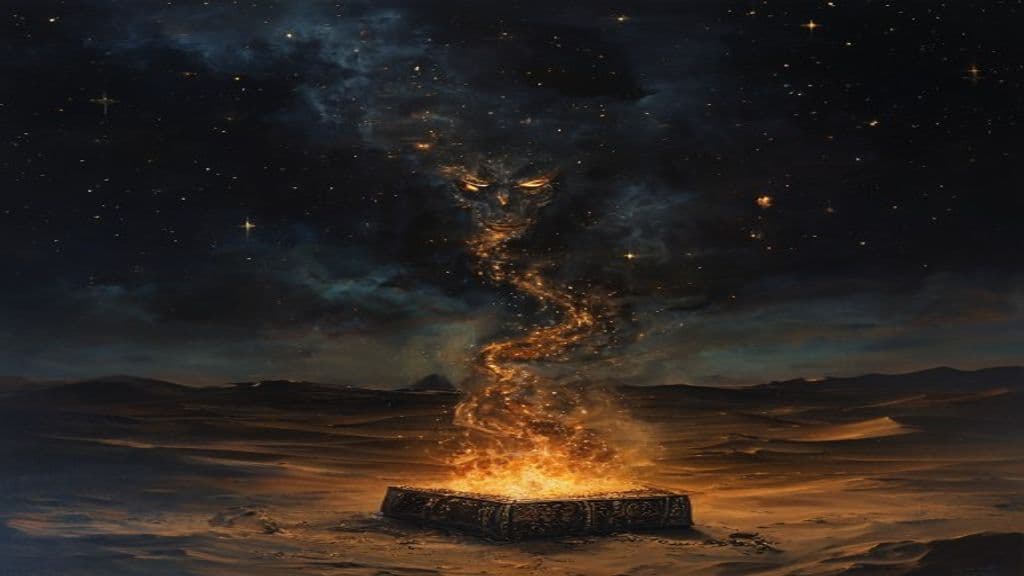
Djinn
The class of supernatural beings created from smokeless fire in Islamic cosmology — a parallel civilization to humanity, capable of belief or unbelief, with their own prophets, society, and judgment before God.
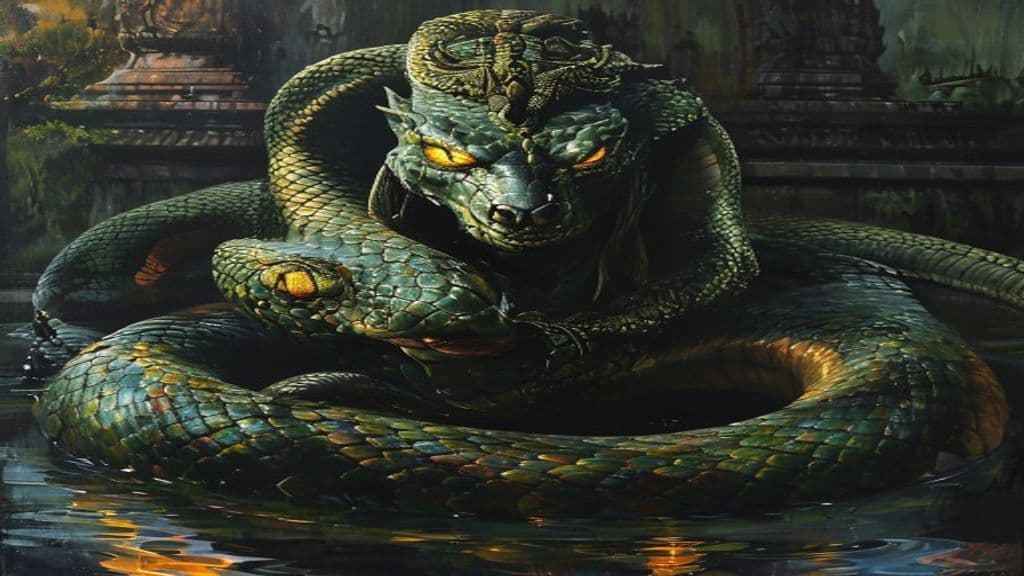
Naga
Divine serpent beings of Hindu, Buddhist, and Jain cosmology — powerful guardians of water, earth, and underground treasures. Revered as deities in South and Southeast Asia.
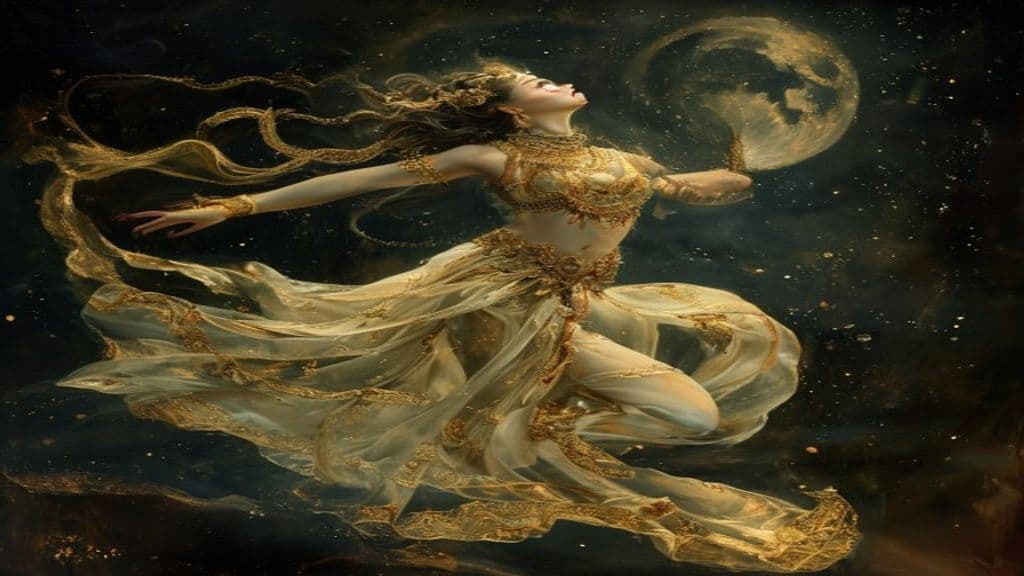
Apsara
Celestial dancers and water nymphs of Hindu cosmology — beautiful semi-divine beings who dance at the court of Indra and, by his command, descend to earth to distract sages from excessive asceticism.
'Ain Samiya Goblet
Silver cup from the Middle Bronze Age I, discovered in a tomb at Ain Samiya. (Note: 1. Power tier should be "None", but add a note explaining that historical artifacts don't fit into the typical power tier classification. 2. Add a description of its appearance based on it being a sil)
Alalu
Alalu (also Alala/Alal) is a primordial, ancestral god attested in Mesopotamian, Hurrian and Hittite sources. He appears in genealogical lists as an early progenitor of later sky-gods and in Hurrian myth (the Kumarbi Cycle) as a former 'king in heaven' overthrown and forced to flee to the underworld.
Apsu (Abzu)
Apsu (Sumerian Abzû; Akkadian Apsu) is the primeval freshwater principle in Mesopotamian cosmology, conceived both as the subterranean freshwater ocean/aquifer and as a hypostatic divine presence. Paired with the saltwater Tiamat, Apsu is a progenitor of earlier divine generations and the source of lakes, springs, rivers, rain and floodwaters; in Enūma Eliš he is slain by the younger god Ea and his domain becomes Ea's dwelling.
Ara
Ara (Sumerian: A) is a minor Mesopotamian goddess attested as a servant or attendant of the god Enki. Earlier scholarship sometimes conflated her theonym with the attendant deity Isimud, but modern treatments distinguish Ara as a separate divine household figure.
Aya
Aya is a Mesopotamian goddess associated with the dawn and worshiped as the consort of the sun god Shamash. She is principally attested in the city of Sippar, appears in royal inscriptions there, and was incorporated into Hurrian religion as the wife of the Hurrian sun Šimige.
Damgalnuna (Damkina)
Damgalnuna, commonly called Damkina, is a Mesopotamian goddess attested as the consort of the god Enki/Ea. She is associated in surviving summaries with ritual purification and with interceding on behalf of human supplicants; she appears in multiple myths and had cult centers such as Eridu and Malgium.
Dragon (Long)
Long (龍, "dragon") is a pervasive cultural and artistic motif that appears in Taoist sacred-geographical contexts, Chinese literature, and modern exhibitions; the provided sources treat it as part of the broader mythic imagery present around Taoist sites and ritual scenes rather than as a single, consistently described doctrinal entity.
Geshtinanna
Geshtinanna is a Sumerian goddess functioning as the underworld's chief scribe and a specialist in scribal arts and dream interpretation; mythically she is the sister of Dumuzi and participates in his death‑and‑return cycle, once residing in the netherworld for part of the year in his stead.
Goddess
A goddess is a female deity — a sacred female divine figure found across many polytheistic and religious traditions. The term functions as a classificatory label for diverse culturally specific female divinities and metaphysical female principles, ranging from local patronesses to supreme cosmic realities.
Hanbi
A scarcely attested Mesopotamian figure described in modern summaries as the "lord of evil" and as the father of the better-known spirit Pazuzu; preserved mainly in classificatory or genealogical statements rather than narrative myth. Modern commentators sometimes (tentatively) compare him to later Near Eastern concepts of malign shadow-spirits, but primary attestations are fragmentary.
Kur (Mesopotamian underworld)
Kur is the ancient Mesopotamian subterranean realm of the dead, conceived as the lowermost part of the cosmos — a dark, cavernous region where the deceased live in a diminished, shadow-like continuation of earthly existence. Early beliefs depicted Kur as a place of neutral continuation rather than moral judgment; the living sustained the dead through libations.
Lamashtu
The most feared demoness of ancient Mesopotamia — a divine daughter of Anu who preyed on pregnant women, caused miscarriages, and killed infants by nursing them with venom.
Community Record
- [1]Atrahasis Epic (creation passages). "Belet-ili the womb goddess is present. Let her create a mortal man"; "So that he may bear the yoke, the work of Ellil, Let man bear the load of the gods." — Atrahasis Epic (as supplied in research notes)literary
- [2]Akkadian creation passages (quotations cited in notes). "Belet-ili, you are the mistress of the great gods. You have created, banu, lullu-man: form, patiqu now the king, the thinking-deciding man. With excellence cover his whole form..." — Akkadian passage cited in the provided notesliterary
- [3]Summary description of Beletili's commission. "Beletili fulfilled her commission with the major gods contributing specific attributes." — summary in supplied research notesliterary
- [4]ABSU lyrics (modern artistic usage). "Belet-ili, O great pythoness, kiss me... Belet-ili, O great pythoness, caress me." — ABSU song lyrics cited in research notes (modern, poetic reuse)other
- [5]Notes on Mesopotamian mother-goddess context (Wikipedia: Ninhursag). Wikipedia entry for Ninhursag supplied in notes as context for mother-goddess figures in Mesopotamia (provided source list).wiki
- [6]Myth of Anzu and related fragments (contextual references). Fragmentary lines in the supplied notes reference phrases such as 'son of Belet-ili' in mythic contexts; these are noted as fragmentary/uncertain in the research notes.literary