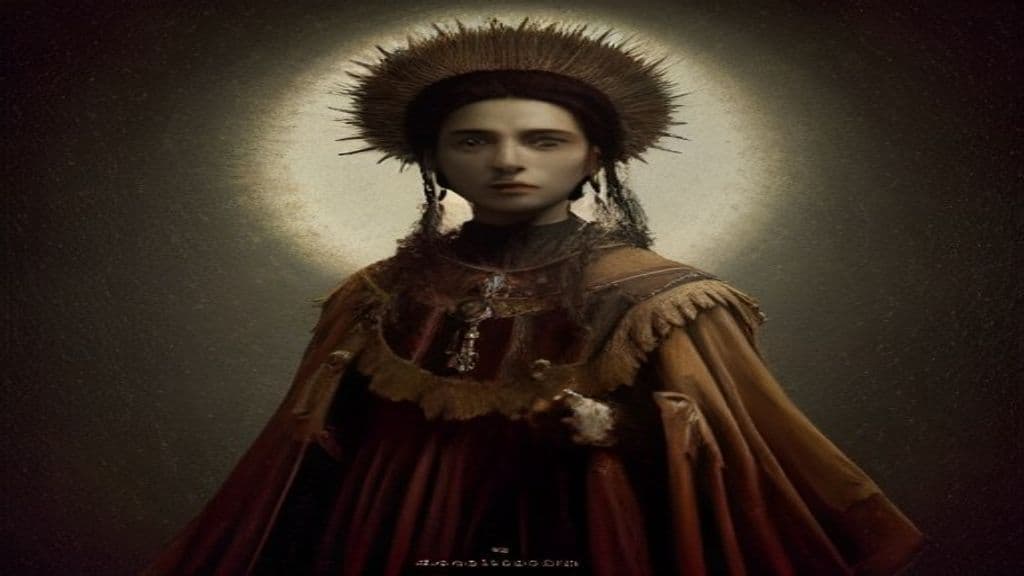
The figure appears first in Renaissance literary sources as the protagonist of Niccolò Machiavelli’s novella Belfagor arcidiavolo, written between 1518 and 1527 and first published in collections of his works in 1549. In Machiavelli’s treatment the title names him explicitly as an 'arcidiavolo' (arch-demon). Later authors adapted the tale into dramatic and musical forms (including a comedy by Ermanno Morselli and Ottorino Respighi and Claudio Guastalla’s 1923 opera), which preserve the core premise of a high-ranking infernal being dispatched from the underworld on a temporal mission among humans.
Primary sources do not supply a single fixed monstrous form; instead the narratives emphasize Belfagor’s capacity for human disguises. In Respighi’s opera he first appears in a village, later assumes the identity of the handsome and immensely rich Ipsilonne to secure a wife, and in the epilogue adopts the guise of a vagabond. Machiavelli’s novella gives the character his arch-demonic title but the supplied summaries do not record a detailed, consistent physical description.
As presented in the literary and operatic sources, Belfagor is an infernal envoy sent from the underworld with a defined investigatory task (in Respighi’s opera: to discover whether marriage is 'truly a hell for mankind'). He employs disguise and social guile, can present himself as a wealthy noble (using money as inducement), and engineers deception to test or unsettle human characters. Narratives portray him assuming multiple social appearances (nobleman, vagabond) and leaving or vanishing from the human scene after his episodes; these are plot behaviors attested in the adaptations rather than catalogued thaumaturgic mechanics.
Weaknesses
- conditionnarrative-counter by divine intervention (opera)
Wards
- ritualAppeal to the Madonna (narrative episode)
Demogorgon
A name that emerged in Latin medieval commentary and was later taken up in Renaissance and early modern literature and demonology as a powerful, primordial subterranean or infernal figure associated with fate and accountability. Modern popular culture reuses the name for monsters, but those visualizations are distinct from the medieval and Renaissance textual tradition.
Beldgabred
Beldgabred is a legendary king of the Britons attested in Geoffrey of Monmouth's pseudo-historical king lists and repeated in later compilations and summaries. In Geoffrey's account (as summarized in modern sources) he is said to have surpassed other musicians on every instrument and is in some later remarks described as being 'claimed to be the god of minstrels.' His attestation is literary and genealogical rather than independently historical.
Belet Nagar
Belet Nagar is the tutelary goddess of the ancient Syrian city Nagar (Tell Brak). She functions as the city's divine patron in political and cultic contexts, connected to kingship, treaty-witnessing, and the ritual movement of her statue in civic festivals; many details of her character and identification with other goddesses remain uncertain in the sources.
Belet-ekalli (Ninegal)
Belet-ekalli, also rendered Ninegal, is a Mesopotamian palace tutelary deity whose name means 'lady of the palace.' She appears in canonical god lists and in interstate treaty enumerations, indicating a recognized role in palace cult and state-level ritual contexts.
Belet-ili
Belet-ili is a Mesopotamian divine womb-mistress invoked in cosmogonic texts as the artisan who forms humanity at the gods' commission. She functions as a female creator-midwife within the council of gods, shaping the first humans and receiving contributions of attributes from other deities.
Belet-Šuḫnir and Belet-Terraban
A paired set of Mesopotamian goddesses attested chiefly in Ur III administrative and ritual archives. Treated as two distinct but habitually paired 'ladies' of toponyms (Šuḫnir and Terraban), they were incorporated into the royal cult of Shulgi and appear in god lists, offering lists, seals, and festival contexts whose tone has been described as lugubrious.
Beleth
Beleth is a high-ranking infernal king attested in Renaissance and early-modern grimoire tradition, described as commanding eighty-five legions of demons and as a spirit that ritual conjurers may summon, test, or bind for specific ends.
Belfagor arcidiavolo
The title character of Niccolò Machiavelli's Renaissance novella, presented as an archdevil (arcidiavolo) sent from Hell to Earth to investigate male complaints about marriage; a literary adaptation of an older folktale motif about a supernatural being assuming human guise and entering domestic life.
Belfaygor
Belfaygor is a fictional baron from Ruth Plumly Thompson's Jack Pumpkinhead of Oz (1929) and later Oz character lists. He is a sympathetic, comic nobleman afflicted by a magically accelerated beard growth that complicates his life and adventures in the Quadling Country.
Beli
Beli is a jötunn (giant) in Old Norse myth known chiefly as an adversary slain by the god Freyr. Attestations are fragmentary: he appears in Eddic and skaldic references as the named foe of Freyr and as an element in kennings, and scholars treat the fuller myth as largely lost.
Beli Mawr
Beli Mawr is a legendary ancestral king and eponymous progenitor in medieval Welsh genealogies and literature, presented as the father of several named mythic figures and as an origin-figure for royal houses. Modern scholarship sometimes hypothesizes a connection with the continental Celtic deity Belenus/Belenos, but medieval sources principally treat Beli as an ancestral/kingly figure rather than explicitly as a deity.
Beli's bane
A kenning-style epithet from the Old Norse poetic corpus, rendered from Old Norse bani Belia (with an adjectival bjart = 'bright' in some transmissions). It functions as 'the slayer (bane) of Beli' within the prophetic catalogue of Ragnarök in Völuspá rather than as a fully independent named being with its own cult or origin story.
Community Record
- [1]Belfagor. Wikipedia article 'Belfagor' (Respighi opera synopsis and production details)wiki
- [2]Belfagor arcidiavolo. Wikipedia article 'Belfagor arcidiavolo' (Machiavelli novella title and publication information)wiki
- [3]Belfagor : commedia lirica in un prologo, due atti, un epilogo. Respighi/Guastalla, vocal score and synopsis (Archive.org)literary
- [4]Belfagor (Respighi, Ottorino) - IMSLP. IMSLP entry for Respighi's Belfagor (score and production information)other