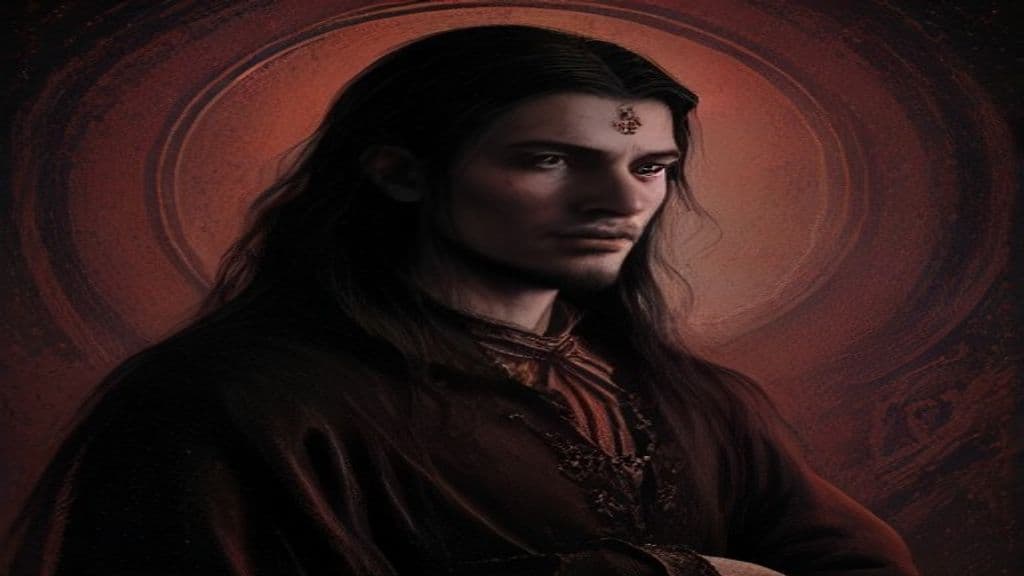
Within Machiavelli's novella, Belfagor is an infernal official — a former archangel now an archdevil — who is named and ranked in a bureaucratic Hell. Pluto summons a parliament to address the complaint that many male souls blame their wives for their misery; the assembly decides to send Belfagor to Earth as an investigator. Scholarly and popular summaries trace Machiavelli's narrative to an older family of folktales (credited in the provided sources as deriving from Medieval Slavic folklore) and to later German/Northern variants (e.g., Friar Rush), situating Machiavelli's treatment as a literary adaptation of a circulating motif rather than as an original ethnographic entity.
Machiavelli's tale presents Belfagor primarily through his offices in Hell and through the human identity he adopts on Earth. In the novella he assumes a human persona — presented as Roderigo of Castile — and lives among Florentine citizens; the provided summaries do not record distinct monstrous or infernal physical traits beyond his status as an archdevil and his disguised human form.
In the narrative Belfagor functions as an infernal emissary capable of assuming human form and living undercover as a mortal. He comes to Florence bearing wealth (a hundred thousand ducats) supplied for his mission, marries, suffers domestic and financial disaster, and ultimately returns to Hell. The tale also relates that Belfagor grants a peasant (Gianmatteo) the power to drive devils out of possessed women — a narrated conferral of exorcistic capacity — but the sources do not specify the mechanism, words, or material form of that grant. Abilities as described in the supplied materials are therefore limited to: official infernal rank/authority, shapechanging into a human identity, possession or provision of wealth, and the narrative capacity to empower a human to expel spirits.
Weaknesses
- conditionvulnerability to domestic social and economic pressures
Wards
None recorded.
Belet Nagar
Belet Nagar is the tutelary goddess of the ancient Syrian city Nagar (Tell Brak). She functions as the city's divine patron in political and cultic contexts, connected to kingship, treaty-witnessing, and the ritual movement of her statue in civic festivals; many details of her character and identification with other goddesses remain uncertain in the sources.
Belet-ekalli (Ninegal)
Belet-ekalli, also rendered Ninegal, is a Mesopotamian palace tutelary deity whose name means 'lady of the palace.' She appears in canonical god lists and in interstate treaty enumerations, indicating a recognized role in palace cult and state-level ritual contexts.
Belet-ili
Belet-ili is a Mesopotamian divine womb-mistress invoked in cosmogonic texts as the artisan who forms humanity at the gods' commission. She functions as a female creator-midwife within the council of gods, shaping the first humans and receiving contributions of attributes from other deities.
Belet-Šuḫnir and Belet-Terraban
A paired set of Mesopotamian goddesses attested chiefly in Ur III administrative and ritual archives. Treated as two distinct but habitually paired 'ladies' of toponyms (Šuḫnir and Terraban), they were incorporated into the royal cult of Shulgi and appear in god lists, offering lists, seals, and festival contexts whose tone has been described as lugubrious.
Beleth
Beleth is a high-ranking infernal king attested in Renaissance and early-modern grimoire tradition, described as commanding eighty-five legions of demons and as a spirit that ritual conjurers may summon, test, or bind for specific ends.
Belfagor (Arcidiavolo)
A literary arch-demon figure originating in Niccolò Machiavelli’s Renaissance novella and later adapted in theatrical and operatic works (notably Respighi’s 1923 opera). In these narratives Belfagor is a high-ranking infernal envoy sent to the human world on a defined investigatory mission, who uses disguise, wealth, and deception as part of his role.
Belfaygor
Belfaygor is a fictional baron from Ruth Plumly Thompson's Jack Pumpkinhead of Oz (1929) and later Oz character lists. He is a sympathetic, comic nobleman afflicted by a magically accelerated beard growth that complicates his life and adventures in the Quadling Country.
Beli
Beli is a jötunn (giant) in Old Norse myth known chiefly as an adversary slain by the god Freyr. Attestations are fragmentary: he appears in Eddic and skaldic references as the named foe of Freyr and as an element in kennings, and scholars treat the fuller myth as largely lost.
Beli Mawr
Beli Mawr is a legendary ancestral king and eponymous progenitor in medieval Welsh genealogies and literature, presented as the father of several named mythic figures and as an origin-figure for royal houses. Modern scholarship sometimes hypothesizes a connection with the continental Celtic deity Belenus/Belenos, but medieval sources principally treat Beli as an ancestral/kingly figure rather than explicitly as a deity.
Beli's bane
A kenning-style epithet from the Old Norse poetic corpus, rendered from Old Norse bani Belia (with an adjectival bjart = 'bright' in some transmissions). It functions as 'the slayer (bane) of Beli' within the prophetic catalogue of Ragnarök in Völuspá rather than as a fully independent named being with its own cult or origin story.
Belial
In Hebrew Bible usage Belial is originally a pejorative term for worthlessness; in Second Temple (Dead Sea Scrolls) literature it is personified as the malign leader of the 'Sons of Darkness', an angelic/oppositional figure who commands hostile spirits and features in Qumran dualist eschatology.
Belinus
Belinus is a legendary king of the Britons as recounted in Geoffrey of Monmouth’s Historia regum Britanniae and later summaries: a warrior-king and lawgiver who fights his brother Brennius, unites Britain, campaigns in Gaul and Italy, founds or restores cities (notably Kaerusc/Caerleon), and is cremated atop a great tower at his death. His name is probably derived from the ancient god Belenus according to some modern summaries, but the sources treat him as a human legendary ruler rather than a deity.
Community Record
- [1]Belfagor arcidiavolo (Wikipedia). Wikipedia entry 'Belfagor arcidiavolo'.wiki
- [2]Favola di Belfagor — Niccolò Machiavelli (Archive.org). Archive.org edition of Machiavelli's 'Favola di Belfagor'.literary
- [3]Multilingual Short Works Collection 033 - Poetry & Prose (LibriVox / Archive.org). LibriVox recording including 'Belfagor'.literary
- [4]Belfagor (Wikipedia: related entry). Wikipedia summary and transmission notes for the Belfagor motif.wiki
- [5]Belphegor (Public Domain Super Heroes / Fandom) — demonological associations (related tradition). Fandom summary of demonological Belphegor (not Machiavelli's novella but related onomastically and thematically).other