According to the archival catalogue descriptions for recordings of Rajasthani folk-spiritual music, Bheruji 'originates from the fearful Bhairava mentioned in various puranas.' The materials frame Bheruji as a regional, folk manifestation or agent that derives from the Puranic figure Bhairava and functions within a Śaiva register. The recordings documenting 'The Tale of Bheru Ji' and related songs were collected from Naik artistes and from Manganiyar and Jogi artistes in Rajasthan, and the catalogue notes explicitly describe Bheruji as 'considered to be the commissioner of Lord Shiva,' indicating a localized role delegated by Shiva in vernacular narrative and performance contexts.
The archive summaries do not provide a detailed iconographic or physical description. The only descriptive quality recorded in the metadata is that Bheruji 'originates from the fearful Bhairava,' which places him conceptually in the fearsome/terrifying aspect tradition associated with Bhairava in Puranic literature. Beyond this inferential association, the sources contain no statements about attire, iconography, weapons, mounts, coloration, facial features, or other material markers in performance or cult practice; the absence of such detail in the catalogue notes means the recordings must be consulted directly for any performance-specific appearance data.
The provided archive descriptions state that Bheruji is 'considered to be the commissioner of Lord Shiva,' a role-label recorded in the metadata of the musical narratives. The summaries do not enumerate specific supernatural abilities, powers, or behaviors (for example, possession, healing, punitive actions, or protective functions are not described in the supplied notes). The available evidence therefore limits claims about abilities to his designation as an empowered agent acting on behalf of Shiva within the folk-spiritual repertoire.
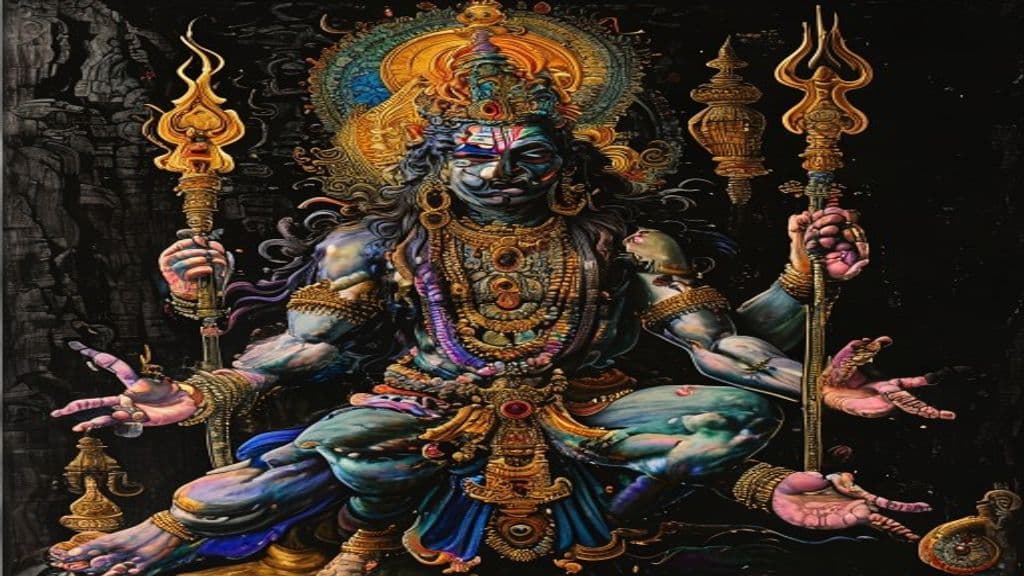
Bhairava
Bhairava is a fierce Shaivite deity and tantric figure—an intense manifestation of Shiva—worshipped across Hindu and Vajrayāna Buddhist traditions as executor of divine punishment, guardian of sacred sites, and a tantric teacher/meditational yidam.

Shiva
Shiva (Sanskrit: Śiva) is one of the principal deities of Hinduism, central to Shaivism and pan-Hindu worship. Portrayed as a paradoxical figure—ascetic yogi, householder, warrior and cosmic agent—he is described as the auspicious One who creates, protects and transforms the universe and is commonly associated with dissolution within the Trimurti framework.
Bharata (Mahābhārata)
Bharata (Sanskrit: भरत) is a legendary human emperor and ancestral king in the Indic epic tradition. Portrayed as a cakravartin‑type sovereign and progenitor, his deeds, rituals, and lineage provide an eponymous foundation for the name Bhārata and for later dynastic identity.
Bharata (Ramayana)
Bharata is the younger half-brother of Rāma in the Hindu epic Rāmāyaṇa, who refuses the throne after Rāma's exile and serves as regent of Ayodhyā from Nandigrāma, ruling in Rāma's name while living an ascetic life. In devotional and pilgrimage traditions he is also assimilated into divine schema—described in some sources as an incarnation of Viṣṇu's Panchajanya and presented among the quadruple expansion of Rāmācandra.
Bhargava (Hindu tradition)
A Brahmin race or dynasty founded by the legendary sage Bhrigu in Hindu mythology. (Note: - Power tier should be Ancient (deity-level), not Primordial, as there's no indication of cosmic powers. - Abilities section needs clarification that the source doesn't provide specific information on)
Bhasmasura
Bhasmasura is an asura in Shaiva-derived regional lore who was granted a boon by Shiva that made anyone whose head he touched with his hand instantly turn to ash (bhasma). His arrogance leads Vishnu (in the form Mohini) to trick him into placing his hand on his own head during a dance, causing him to burn himself to ashes.
Bhavānī
Bhavānī (भवानी) is an aspect/epithet of the Hindu Mother Goddess (Devī/Shakti) revered as a giver of life and a warrior who defeats demons; she is both a cultic tutelary deity (notably at Tulja Bhavani, Tuljapur) and a pan-Indian manifestation identified with forms such as Durgā, Katyayani and Mahalakshmi in the cited sources.
Bheru (Bhairu)
No supplied sources describe Bheru/Bhairu as a supernatural being in Rajasthani folk belief. The element "Bheru" appears only in personal names and place-name materials in the provided documents; there is no ethnographic or folkloric description of an entity by this name in the source set.
Bhikshatana
An aspect of the Hindu god Shiva manifested as the 'Supreme mendicant' — a naked, wandering ascetic who begs for alms as a penitential and pedagogical form. Presented in Puranic narratives and South Indian iconography, Bhikshatana enacts a Kapali vow of expiation and provokes sages and householders as part of a revelatory drama.
Bhoma
Primordial earth deity in Balinese mythology associated with fertility and vegetation. (Note: 1. Power tier should be Primordial, which is correct. 2. Appearance description matches source material; no corrections needed. 3. Abilities: Add "liminal space between wilderness and human settlement)
Bhoot (bhoota)
A bhoot (also bhoota, bhoot, bhut) is the culturally specific term across parts of the Indian subcontinent for a perturbed, restless spirit generally understood to be the ghost of a deceased person. Sources describe bhoots as arising when a person's death or post-death circumstances prevent them from moving on — for example violent death, unresolved affairs, or failures in funerary rites — and the term appears frequently in modern South Asian media and discussions.
Bhoota (ghost)
A bhoota (Sanskrit: भूत, bhūta) is a class of supernatural beings in South Asian traditions most commonly identified as the restless ghost of a deceased person. Depending on region and context a bhoota may be feared as a harmful, perturbing spirit or worshipped and integrated as a local protective spirit or demigod (notably in Tulu Nadu practices).
Bhrigu
Bhrigu (Bhṛgu) is a Vedic rishi — one of the Saptarṣi and a mānasaputra (mind-born son) of Brahmā — remembered in Hindu tradition as a progenitor (Bhārgava), Upanishadic inquirer, contributor to legal and ritual corpus, and the attributed compiler of the astrological compendium Bhrigu Saṃhitā.
Bhrikuti
Bhrikuti is a historic-legendary 7th-century Nepali princess of the Licchavi line who became queen-consort to the Tibetan king Songtsen Gampo and, in Tibetan religious imagination, is represented iconographically and devotionally as an emanation or incarnation of Green Tara. Sources credit her with bringing sacred Buddhist images, skilled Newar craftsmen, and patronage that aided the establishment of Buddhism in Tibet; she is not presented in the sources as a harmful folk spirit.
Community Record
- [1]The Tale of Bheru Ji by Naik Artistes (catalogue entry RS-533-AC). Archive catalogue record RS-533-AC, 'The Tale of Bheru Ji' — metadata noting origin from Bhairava and designation as commissioner of Lord Shiva; recorded from Naik artistes in Rajasthan.folk
- [2]The Tales of Bheru Ji and Jagdev Kankali by Naik Artistes (catalogue entry RS-535-AC). Archive catalogue record RS-535-AC, 'The Tales of Bheru Ji and Jagdev Kankali' — metadata situating the tale within Rajasthani folk-spiritual music performed by Naik artistes and linking Bheruji to Bhairava/Shiva.folk
- [3]The Tale of Bheru Ji by Manganiyar and Jogi Artistes (catalogue entry RS-536-AC). Archive catalogue record RS-536-AC, 'The Tale of Bheru Ji' — metadata documenting performance by Manganiyar and Jogi artistes in Rajasthan and stating that Bheruji originates from Bhairava and is considered commissioner of Lord Shiva.folk