
In multiple Puranic accounts (Kurma Purana, Shiva Purana, Skanda Purana, Matsya Purana, Vamana Purana, Varaha Purana) Bhikshatana originates after Shiva (in his Bhairava aspect) severs Brahma's head. To atone for the sin of brahmahatya Shiva assumes the Kapali vow and wanders the three worlds as a naked mendicant carrying Brahma's skull (kapala) as his begging bowl. Narrative variants across the Puranas differ in some details (for example, the immediate triggers and intermediaries of Brahma's decapitation and the Vishnu-encounter episodes), but they agree that the wanderings end with expiation upon reaching Varanasi (Kashi), where the skull falls away and the sin is absolved.
Bhikshatana is typically depicted as a nude, sometimes youthful four-armed man adorned with ornaments and unbound hair, carrying a begging bowl — specifically Brahma's skullcup (kapala) — and a staff with a few possessions. Temple sculpture and bronzes often show him accompanied by bhutas (goblin attendants) and followed by enamoured women who sing and dance. Some sculptural programs place sandals on him or show additional Shiva attributes (third eye, crescent moon, cobra), while variant iconography related to the post‑slaying episodes depicts a corpse impaled on his trident: this corpse-bearing form is related but distinct and is known as Kankala-murti (the 'one with the skeleton'), connecting Bhikshatana to the fiercer Bhairava/Kankala-Bhairava imagery in some narratives.
As a form of Shiva, Bhikshatana functions mythically rather than as an independent spirit: he undertakes the Kapali vow of expiation, wandering the three worlds and begging with Brahma's skull. In the Deodar (Daruka) Forest episode he deliberately shocks and seduces sages' wives, using transgressive nudity and allure to overturn complacent orthodoxy and to establish Linga worship; thus his power is pedagogical and revelatory. In Puranic variants connected to his Bhairava identity he is linked to acts of violence (the severing of Brahma's head) and, in some tellings, to the killing of opponents such as Vishnu's gatekeeper — episodes that lead to related iconographic forms like Kankala-murti. He traverses heaven, earth, and the netherworld in the mythic geography and can be depicted as transforming into or being identified with other Shiva aspects (Bhairava, Nataraja in some variants). The narratives emphasize expiatory agency, transgressive provocation, and the integration of sin and purification rather than enumerating discrete magical powers.
Weaknesses
- conditionexpia tory goal — absolution upon reaching Varanasi (Kashi)
Wards
None recorded.
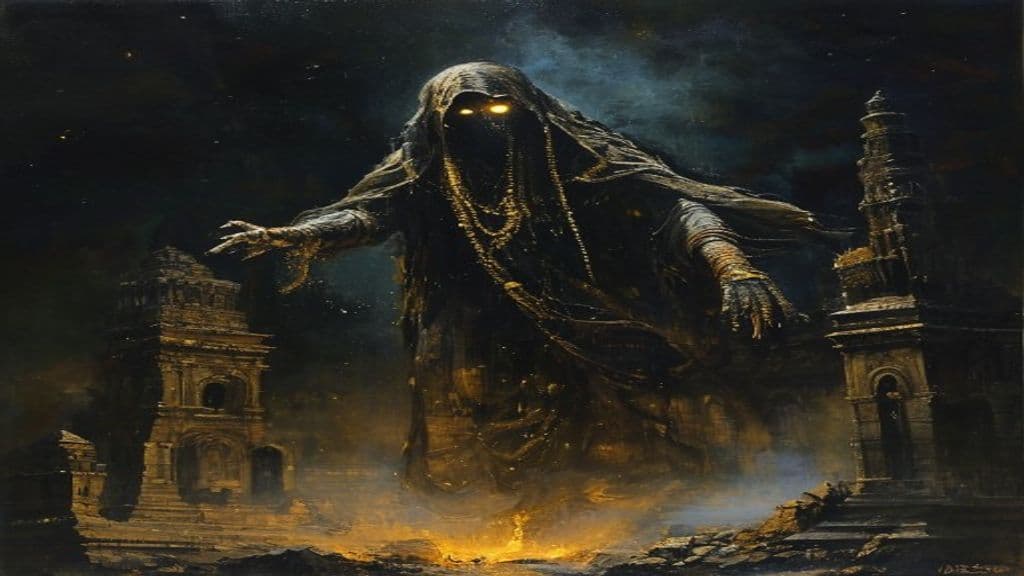
Brahmarakshas
The most learned and terrible of spirits — the ghost of a Brahmin who misused his scriptural knowledge in life and was condemned after death to be both demon and scholar, haunting places of learning.
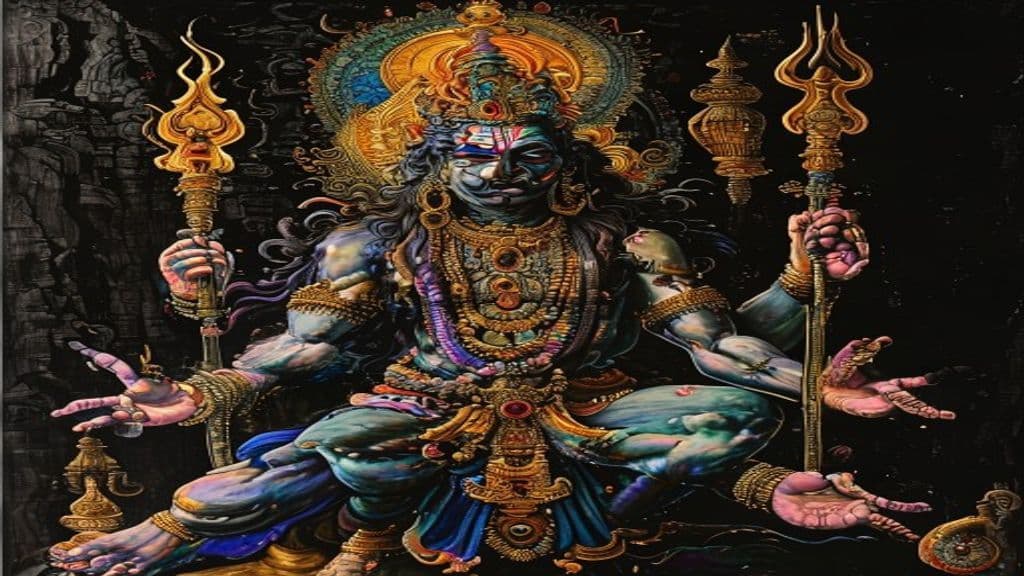
Bhairava
Bhairava is a fierce Shaivite deity and tantric figure—an intense manifestation of Shiva—worshipped across Hindu and Vajrayāna Buddhist traditions as executor of divine punishment, guardian of sacred sites, and a tantric teacher/meditational yidam.
Alakh Niranjan
A doctrinal and devotional formula in the Nath-yogi tradition denoting the unseen, unblemished ultimate reality (Nirguna Brahman/Atman). Used as a salutational invocation, theological name, and signifier of realised Self rather than a personified supernatural being.
Ardhanārīśvara
Ardhanārīśvara is an androgynous iconographic form in Hindu tradition combining Shiva and his consort Pārvatī into a single deity split vertically as male and female, symbolizing the inseparability and synthesis of masculine and feminine cosmic principles.
Devi
Devi (Sanskrit: Devī) is the general term for goddess in Indian religious thought, signifying the divine feminine or Shakti; in different texts and traditions she appears as individual goddesses (e.g., Parvati, Lakshmi, Saraswati) or as the supreme reality (notably in Shaktism and certain Upanishads). Sources treat Devi both as a class/category of female divinities and as a philosophical identification with ultimate reality.
Hindu deities
Hindu deities (Deva/Devi) are the diverse gods and goddesses recognized across Hindu traditions, ranging from Vedic forces of nature to later personalized major gods and goddesses. They function as patrons of rites, embodiments of moral and cosmic principles, and focal points for temple cults, festivals, and devotional traditions while often also being interpreted as aspects of a single Ultimate Reality (Brahman).
Kaal Bhairav
Kaal Bhairav (Kāla Bhairava, Kalabhairava) is a fierce Shaivite manifestation of Shiva associated with Time (kāla), death, guardianship, and punitive justice. Worshipped in Hindu and some Vajrayāna Buddhist tantric contexts, he functions as a guardian, enforcer and protector who is propitiated by devotees through mantras, puja and yantra practice.
Maruts
A troop of Vedic storm-deities portrayed as violent, young warrior-gods associated with thunder, lightning, cloud-splitting and rain; they act as a martial retinue attendant to higher gods (notably Indra) and are variably described as offspring of Rudra and Prisni or, in later tradition, born from Diti.
Meenakshi
Meenakshi is a South Indian Hindu goddess, principal deity of the Meenakshi–Sundareswarar Temple in Madurai. Regarded as a regional manifestation of Parvati/Adi Shakti, she is portrayed in literary legend as a warrior-queen and is the focus of major public festivals and hymnody.
Para Brahman
Para Brahman (Sanskrit: परब्रह्म, parabrahma) is a Hindu metaphysical designation for the Supreme Brahman — the highest, ultimate Reality described as beyond all descriptions and conceptualisations. Depending on school it denotes the attribute‑less absolute (nirguṇa) or the supreme personal God (saguṇa) identified with a sectarian deity.
Parvati
Parvati is a principal goddess in Hindu tradition, worshipped as the consort of Shiva and as his shakti (divine power). She embodies a range of roles — devoted wife and mother, fertility and nourishment-giver, and in other manifestations a ferocious protector who destroys evil.
Prajapati
Prajapati (Sanskrit: प्रजापति) is a Vedic-Brahmana creator figure whose name means "lord of creatures." In Vedic and Brahmana texts he functions as a primordial creative principle and progenitor; in later Puranic layers the term becomes a flexible title applied to multiple creator‑figures (including Brahma and others).
Shiva
Shiva (Sanskrit: Śiva) is one of the principal deities of Hinduism, central to Shaivism and pan-Hindu worship. Portrayed as a paradoxical figure—ascetic yogi, householder, warrior and cosmic agent—he is described as the auspicious One who creates, protects and transforms the universe and is commonly associated with dissolution within the Trimurti framework.
Bheru (Bhairu)
No supplied sources describe Bheru/Bhairu as a supernatural being in Rajasthani folk belief. The element "Bheru" appears only in personal names and place-name materials in the provided documents; there is no ethnographic or folkloric description of an entity by this name in the source set.
Community Record
- [1]Bhikshatana — Wikipedia. Wikipedia, 'Bhikshatana'wiki
- [2]Bhikshatana — Wikidata. Wikidata entry Q4901711wiki
- [3]Kurma Purana and related Puranic summaries (as cited). Archive.org, Bhiksha Tana Charite (Puranic narrative summaries)literary
- [4]Kankalamurti — Wikipedia. Wikipedia, 'Kankalamurti'wiki
- [5]Indian Art - Hoysaleshvara Temple - Bhikshatana / Bhairava. Art-and-archaeology.com, Hoysaleshvara Temple sculpturesother
- [6]Indian Art - Kailasanatha Temple - Shiva Bhikshatana. Art-and-archaeology.com, Kailasanatha Temple sculptureother
- [7]What is the significance of Bhikshatana in Hinduism? (Hinduism StackExchange summary). Hinduism StackExchange discussion summarizing significanceother
- [8]Kapala — Visual Melt. VisualMelt, 'Kapala' (skullcup imagery and usage)other
- [9]Bronze Shiva as Bhikshatana (Lotus Sculpture listing). Lotus Sculpture description of Bhikshatana bronzesother