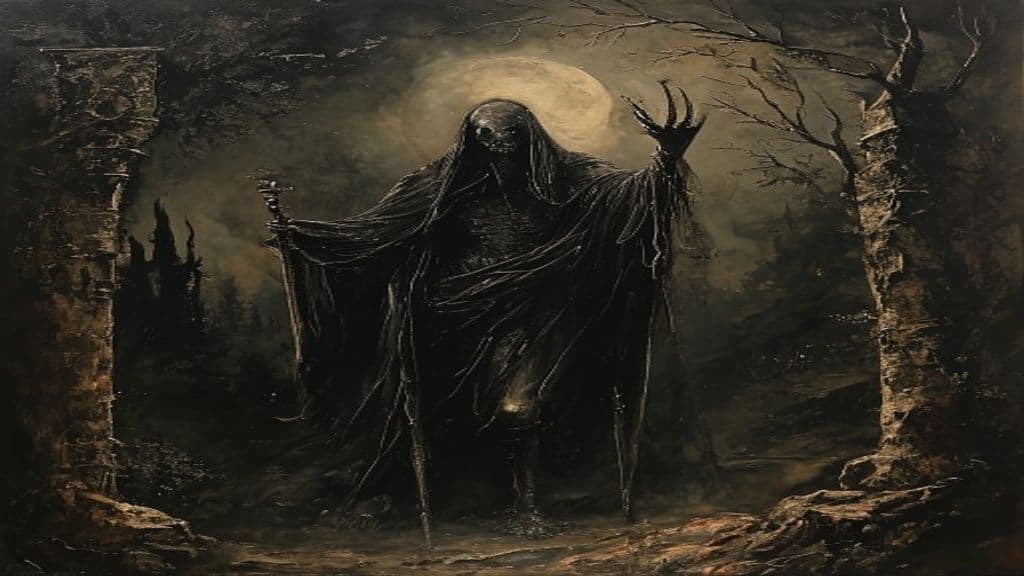
No specific origin story is mentioned in the source material.
No physical description of a supernatural entity is provided.
No information about the abilities or behaviors of a specific entity is available.
Borjgali
Symbol in Georgian tradition representing the sun and eternity, with no supernatural connotations. (Note: 1. Power tier: Lower the power tier to Lesser, as there's no indication of cosmic or deity-level abilities. 2. Abilities: Remove "supernatural" from the description, but keep in mind that the entity h)
Dali (Goddess)
Patron deity of hoofed wild mountain animals in Georgian mythology, associated with hunting and the natural world. (Note: 1. Power tier should be Greater, not Ancient, given that Dali's abilities are deity-level but not cosmic. 2. Origin story could benefit from a more direct quote or clearer summary of how she is introd)
General Sinui
A legendary figure in Korean tradition who attempted to cheat death, but failed. (Note: 1. Power tier: Incorrectly classified as Minor Spirit. Given that General Sinui is a legendary figure who defied death, it's likely he should be categorized as a Greater (powerful regional) or at leas)
Genevieve of Brabant
Genevieve of Brabant (Genoveva, Genoveffa) is a legendary/hagiographic medieval European heroine: a chaste wife falsely accused of adultery who survives execution, lives in exile with her child nourished by a roe deer, and is later vindicated and restored to honour. The tale functions as a moral exemplum and became popular in early modern drama, opera and puppet theatre.
Gengen-Wer
Gengen-Wer (also Negeg-Wer) is an Egyptian mythological avian figure presented in secondary summaries as a celestial goose associated with the origin of life; sources describe it either as bearing or guarding a cosmic egg from which creation emerged and note a minor textual appearance in Chapter 59 of the Book of the Dead.
Genius (genii)
In Roman tradition, the genius is the guiding, tutelary spirit associated with an individual, a family (gens), or a place (genius loci). Originally a numinous presence tied to birth, generation, and lineage, the term later developed a secondary meaning of exceptional personal inspiration or talent.
Genius Loci
In classical Roman religion the genius loci is the protective, guiding spirit inherent to a particular place. It functions as the object of local cult and sacrifice intended to secure the well-being and continuity of houses, neighborhoods, and by extension political territory.
Geraestus the Cyclops
Geraestus (Geraistos) is a named member of the Cyclopes in Greek tradition whose tomb near Athens is cited in mythic histories. He is chiefly attested as the occupant/identifier of a grave that functions as the location for an extreme ritual (the sacrificial slaying of the daughters of Hyacinth) ordered by an oracle during a famine and pestilence in the generation of Aegeus and the Minos conflict. The name also appears as a toponym in Homeric itineraries.
Geraint
Geraint is a personal name borne by overlapping human figures in Welsh and Brittonic tradition: a valiant warrior celebrated in early medieval poetry, the protagonist of the Arthurian romance Geraint and Enid, and a king of Dumnonia attested in a saints' vita. The name links heroic, courtly, and hagiographic registers rather than a supernatural taxonomy.
Geraint son of Erbin
Geraint son of Erbin (Middle Welsh: Geraint uab Erbin / Geraint mab Erbin) is a medieval Welsh legendary hero celebrated in early Middle Welsh englynion for his deeds at the Battle of Llongborth and later as the protagonist of the prose romance "Geraint and Enid," an adaptation of Chrétien de Troyes' Erec and Enide. He functions in the Welsh literary tradition as a martial exemplar situated in the heroic past rather than as a supernatural being.
German
German is a South Slavic male vegetation and weather spirit recorded in eastern Serbia and northern Bulgaria. Known primarily through ritual effigies and rites performed by girls and young women, he is associated in folk belief with bringing rain and hail and with a symbolic death-and-revival cycle tied to agricultural fertility.
Germanic Dragon
A large, serpentine creature from Germanic mythology that hoards gold and shares characteristics with cosmic beings. (Note: 1. Power tier should be Ancient instead of Primordial, as the source describes them sharing characteristics with "other dragons in European mythology", implying a level below cosmic. 2. Remove "venomo)
Community Record
- [1]