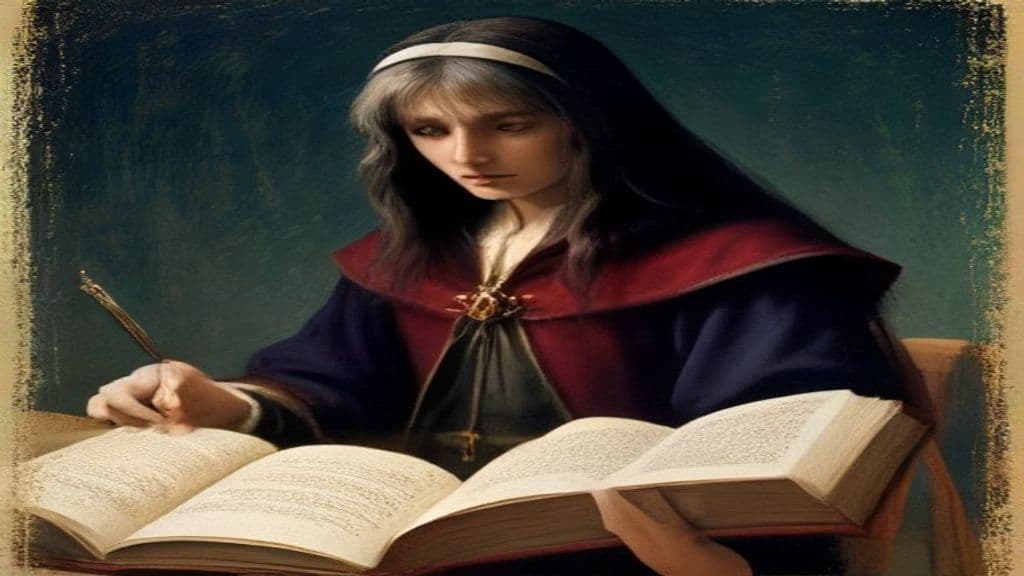
Documentary traces place Cacciaguida as a historical Florentine figure attested in records of 1189 and 1201 naming him and his sons (including Alighiero, ancestor of Dante). Dante, composing in the early 14th century, transforms this genealogical figure into a beatified ancestor in the narrative of the Divine Comedy: in the poem Dante meets Cacciaguida among the blessed in the Heaven of Mars during the pilgrim's vision dated to spring 1300. Within Dante's poetic account Cacciaguida recounts a life as a crusader—reportedly joining the Second Crusade and being knighted by Emperor Conrad III—and is presented as Dante's forebear who, from the blessed state, confirms family lineage and offers prophetic and moral counsel. The historical documentary attestations and Dante's poetic biography coexist in the sources: the archival mentions provide the historical anchor while the poet's narrative supplies the fuller biographical and theological framing.
Dante's account and the supplied summaries do not preserve an extended literal physical portrait in the provided materials; within the poem Cacciaguida is presented and received as an elderly, dignified ancestor and martial exemplar situated among the warrior-saints of the Heaven of Mars. He functions as a knightly forebear and paternal presence addressed with familial language by the pilgrim; later visual traditions (for example, Royal Academy depictions titled 'Dante Discoursing with Cacciaguida') commonly render him as an older, authoritative figure conversing with Dante. Documentary sources from 1189 and 1201 give no bodily description, and the supplied materials note the absence of a detailed textual physical portrait.
Within Dante's Paradiso, Cacciaguida's capacities are those proper to a blessed soul: the ability to converse directly with the living pilgrim, to recount and confirm genealogical facts, to exemplify moral virtues, and to pronounce prophetic admonitions concerning the pilgrim's future and Florentine civic fortunes. The supplied sources emphasize that these are communicative, pedagogical, and providential functions rather than miraculous or interventive powers; he does not exercise agency in the earthly realm in the provided accounts and is bound to his place in the ordered hierarchy of Paradise.
Weaknesses
- conditionBound to his paradisal sphere and non-interventive
- otherNo earthly agency; authority is moral/prophetic rather than physical
Wards
None recorded.
Calcabrina
Calcabrina is one of the Malebranche — a named demon/jailer appearing in Dante Alighieri's Inferno who helps guard the fifth bolgia of the eighth circle of Hell. The name has been reused in modern fiction and games where adaptations portray Calcabrina as a guardian or combatant (gargoyle, construct, or voidsent), distinct from Dante's literary role.
Farinata degli Uberti
Farinata degli Uberti (born Manente degli Uberti, 1212–11 November 1264) was a 13th‑century Florentine aristocrat, knight, and leader of the Ghibelline faction whose political career, posthumous inquisitorial prosecution (1283), and literary depiction by Dante have made him a charged exemplar in medieval debates about heresy and the afterlife.
Caanthus
Caanthus (Ancient Greek: Κάανθος) is a figure of Greek myth and Theban local cultic tradition, described as a son of Oceanus and Tethys who was sent to recover his sister Melia from Apollo, burned Apollo's sanctuary when he failed, and was slain by Apollo. His tomb was pointed out near the Ismenion at Thebes and he functions in sources as both a genealogical offspring of the Titan/Oceanic generation and as a local heroic/cultic tomb-figure.
Caballucos del Diablu
In Cantabrian tradition the Caballucos del Diablu are supernatural horses—described as the damned souls of sinners—that are said to appear on the night of St John (June 23). They form part of a regional bestiary of fantastic beings and are linked to Christian notions of sin, punishment, and the annual bonfire rites.
Cabeiri
The Cabeiri (Ancient Greek: Κάβειροι) are a group of enigmatic chthonic divinities in ancient Greek religion, associated with subterranean/forge fire, smithing, and mystery-cult initiation. Their cults were locally rooted (notably at Lemnos, Samothrace, and Thebes), secretive, and variable in number, sex, and depiction across places and periods.
Cabeiro
Cabeiro (also spelled Kabeiro) is a figure in Greek mythology identified as a daughter of the shape‑shifting sea‑god Proteus and, by union with the forge‑god Hephaestus, the mother of the groups known as the Cabeiri and the Cabeirian nymphs. She appears in genealogical accounts linking marine and smithing divine lineages.
Caca
Caca is an ancient Roman female deity associated with the sacred hearth, attested in late sources as possessing a sacellum (shrine) in Rome where sacrifices were made through the agency of the Vestal priesthood. Later tradition and modern summaries report that her cult was succeeded or replaced by Vesta, and some secondary accounts link her mythically to Cacus.
Cacodemon
A term originating in Ancient Greek (κακοδαίμων, kakodaimōn) denoting an "evil spirit" — the morally malign subset of daimōn — later reused in literature, psychiatry (cacodemonia), occult fragments, and popular culture where it appears as a videogame monster. Sources present the cacodemon both as a moralized spirit-type in classical-language summaries and as various modern imaginative creatures rather than a single fixed biological species.
Cactus Cat
A legendary 'fearsome critter' of American Southwestern frontier folklore: a bobcat-like feline covered in thorny spines, said to slash cacti to drink their fermented juices. It appears in tall-tale storytelling among miners, cowboys, and regional compendia rather than in documented ritual or indigenous cosmologies.
Cacus
Cacus is a monstrous, fire‑breathing giant of Roman myth who lived in a cave on the site of the future Rome (Aventine Hill/Forum Boarium). He stole cattle, preyed on humans, and was slain by the hero Heracles/Hercules; his death is etiologically linked to the founding of a local altar (the Ara Maxima) and to annual rites to Hercules in that district.
Cadejo
A dog‑shaped nocturnal spirit from Central American and adjacent Mexican popular belief, the cadejo appears on lonely roads as a protective or dangerous companion. Rooted in Mesoamerican ideas of animal companions and psychopomps, modern accounts present white (benevolent) and black (malevolent) variants with regionally variable features.
Cadmus
Cadmus is a legendary Phoenician prince and culture-hero in Greek myth, credited with founding Thebes, slaying a local dragon/guardian, marrying Harmonia, and—by some ancient sources—bringing a Phoenician script to Greece.
Community Record
- [1]Cacciaguida (Wikipedia). Wikipedia, 'Cacciaguida' entry (summary of documentary attestations and Dantean presentation)wiki
- [2]Dante's Paradiso - Mars (University of Texas/DanteWorlds). Heavens of Mars page situating Cacciaguida in Paradiso (Cantos XIV–XVIII) and explaining his role among the blessedacademic
- [3]Paradiso 15 – Digital Dante. Digital Dante commentary and text notes on Paradiso Canto XV (meeting with Cacciaguida)literary
- [4]Paradiso 17 – Digital Dante. Digital Dante commentary and text notes on Paradiso Canto XVII (Cacciaguida's answers about prophecy and family)literary
- [5]Meditations on the Divine Comedy of Dante Alighieri: Paradiso 15 to 21 (A. S. Kline). Translation-oriented commentary treating Cacciaguida's role in Paradisoother
- [6]Royal Academy - 'Dante Discoursing with Cacciaguida' (Work of Art). Art historical record showing visual tradition of Dante conversing with Cacciaguidaother
- [7]Archive: The Divine Comedy (dramatic reading). Audio recording resource for the Divine Comedy (contextual primary text access)other
- [8]Archive: Studi danteschi (historical Dante scholarship). Scholarly material on Danteic studies (archival reference cited in notes)academic