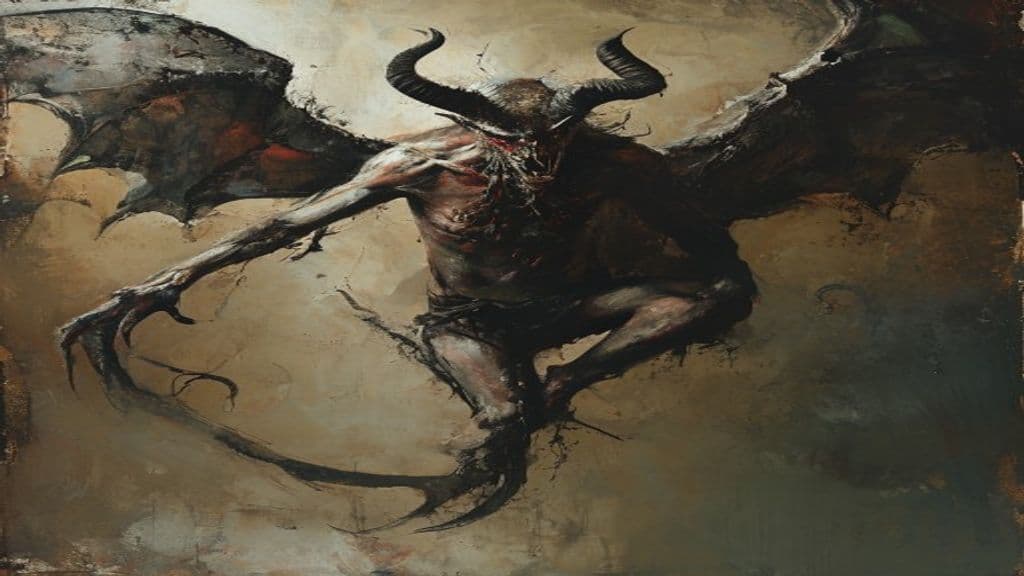
Linguistically the term derives from Ancient Greek κακοδαίμων (kakodaimōn), literally 'evil spirit', formed from κακό- (kako-, 'bad/evil') + δαίμων (daimōn, 'spirit' or intermediary being). In Greek thought the term designates the malign subset of daimons rather than a single mythic progenitor. Modern sources repurpose the label in varied ways: as a clinical label for a delusional belief of possession (cacodemonia), as an iconographic figure in later literature, and as a name applied to fictional monsters in videogames and role-playing media (a usage that sometimes invents in-game origin myths such as lingering demon souls becoming cacodemons in fantasy lore).
Classical/iconographic summaries describe a cacodemon in mythic imagery as a horned or winged-browed youth with exaggerated genitalia trailing between his legs. In modern popular-culture and videogame contexts the cacodemon is frequently rendered as a floating, round or semi-gaseous monstrous head or globe (notably the DOOM series' floating head-like enemy), often bulky with a large mouth or single eye in fan models, toys, and sprites. The sources emphasize these as distinct iconographic traditions rather than a single consistent appearance.
In classical-language summaries the cacodemon is defined as a malevolent spirit and is reported in some accounts as capable of shapeshifting; the term can also be applied pejoratively to morally malign persons. Psychiatric usage (cacodemonia/cacodemonomania) denotes a delusional belief of being possessed by an evil spirit (a clinical belief state) rather than describing abilities of an external being. In modern gaming and role-playing lore cacodemons act as mobile antagonists: in DOOM-family texts they are semi-gaseous, floating attackers; in some RPG/fan paraphrases a cacodemon can be the lingering soul of a powerful demon after death. Such game-derived abilities are part of fictional worldbuilding rather than historical tradition.

Agathos Daimon (Agathodaemon)
A beneficent household and civic daemon attested in classical Greek and Graeco‑Egyptian religion. In domestic Greece it is a household spirit honored with post‑meal libations; in Ptolemaic Alexandria it appears prominently in serpentine civic and household forms and is syncretised with various Egyptian protective and fate deities in late antiquity.
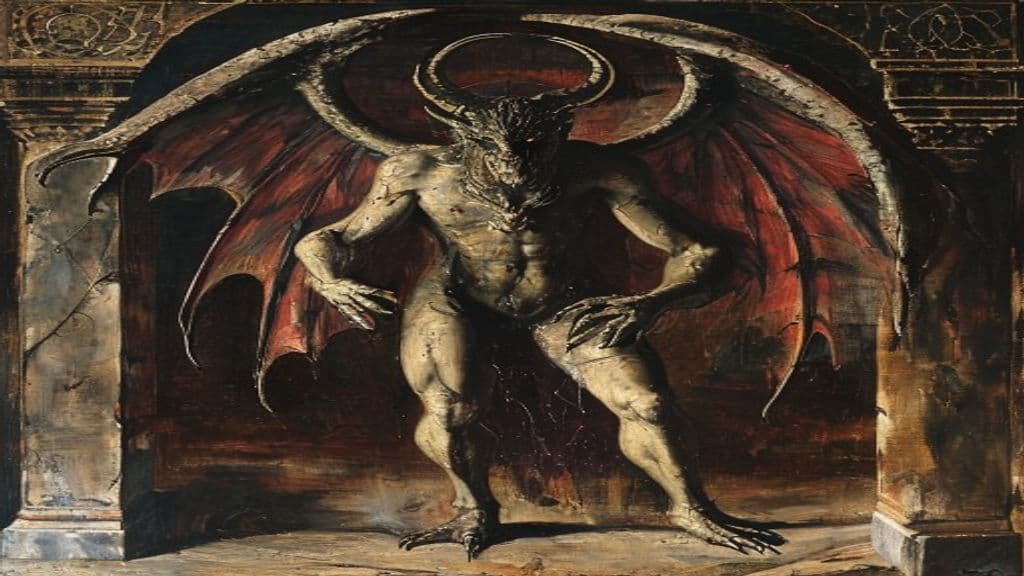
Demon (tradition)
A broadly attested category of harmful or malevolent supernatural beings found across many cultures, used to explain illness, death, misfortune, temptation, and social disruption. The concept is historically flexible, ranging from neutral intermediary spirits in ancient contexts to negatively valenced agents in many later religious traditions, and is the object of ritual responses such as exorcism or magical conjuration in some traditions.
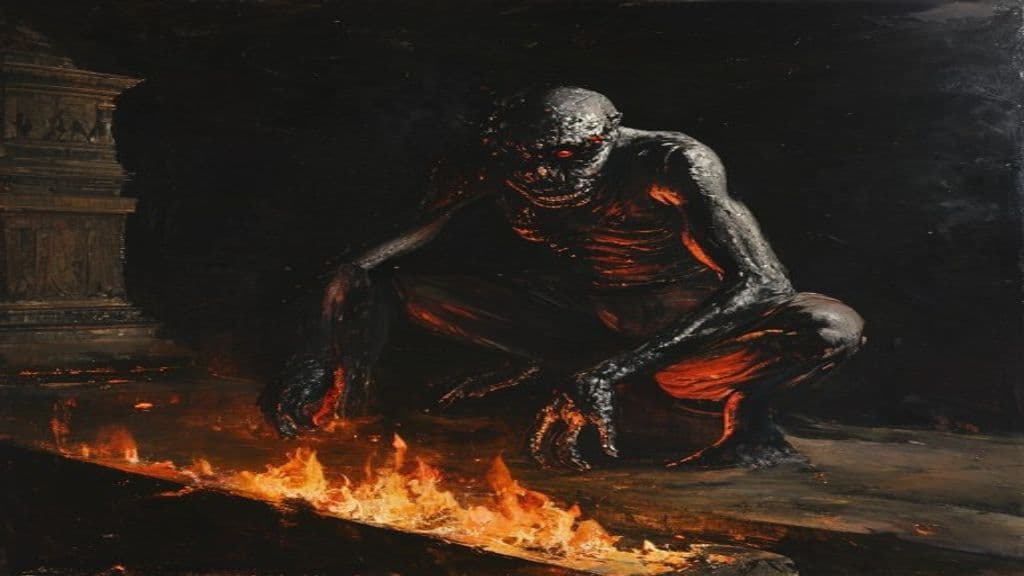
Pishach
Among the oldest classified demon-types in Hindu tradition — flesh-eating entities of the cremation ground first named in the Atharva Veda. The Pishach inhabits fresh corpses and possesses the living, causing the specific Ayurvedic condition of 'pishachabadha': madness, speaking in unknown languages, consuming impure things.
Caanthus
Caanthus (Ancient Greek: Κάανθος) is a figure of Greek myth and Theban local cultic tradition, described as a son of Oceanus and Tethys who was sent to recover his sister Melia from Apollo, burned Apollo's sanctuary when he failed, and was slain by Apollo. His tomb was pointed out near the Ismenion at Thebes and he functions in sources as both a genealogical offspring of the Titan/Oceanic generation and as a local heroic/cultic tomb-figure.
Caballucos del Diablu
In Cantabrian tradition the Caballucos del Diablu are supernatural horses—described as the damned souls of sinners—that are said to appear on the night of St John (June 23). They form part of a regional bestiary of fantastic beings and are linked to Christian notions of sin, punishment, and the annual bonfire rites.
Cabeiri
The Cabeiri (Ancient Greek: Κάβειροι) are a group of enigmatic chthonic divinities in ancient Greek religion, associated with subterranean/forge fire, smithing, and mystery-cult initiation. Their cults were locally rooted (notably at Lemnos, Samothrace, and Thebes), secretive, and variable in number, sex, and depiction across places and periods.
Cabeiro
Cabeiro (also spelled Kabeiro) is a figure in Greek mythology identified as a daughter of the shape‑shifting sea‑god Proteus and, by union with the forge‑god Hephaestus, the mother of the groups known as the Cabeiri and the Cabeirian nymphs. She appears in genealogical accounts linking marine and smithing divine lineages.
Caca
Caca is an ancient Roman female deity associated with the sacred hearth, attested in late sources as possessing a sacellum (shrine) in Rome where sacrifices were made through the agency of the Vestal priesthood. Later tradition and modern summaries report that her cult was succeeded or replaced by Vesta, and some secondary accounts link her mythically to Cacus.
Cacciaguida degli Elisei
A historically attested medieval Florentine ancestor whom Dante depicts in the Paradiso (Cantos XV–XVII) as a beatified soul in the Heaven of Mars; he functions as a paternal interlocutor who confirms Dante's lineage and imparts moral counsel and prophetic admonitions.
Cactus Cat
A legendary 'fearsome critter' of American Southwestern frontier folklore: a bobcat-like feline covered in thorny spines, said to slash cacti to drink their fermented juices. It appears in tall-tale storytelling among miners, cowboys, and regional compendia rather than in documented ritual or indigenous cosmologies.
Cacus
Cacus is a monstrous, fire‑breathing giant of Roman myth who lived in a cave on the site of the future Rome (Aventine Hill/Forum Boarium). He stole cattle, preyed on humans, and was slain by the hero Heracles/Hercules; his death is etiologically linked to the founding of a local altar (the Ara Maxima) and to annual rites to Hercules in that district.
Cadejo
A dog‑shaped nocturnal spirit from Central American and adjacent Mexican popular belief, the cadejo appears on lonely roads as a protective or dangerous companion. Rooted in Mesoamerican ideas of animal companions and psychopomps, modern accounts present white (benevolent) and black (malevolent) variants with regionally variable features.
Cadmus
Cadmus is a legendary Phoenician prince and culture-hero in Greek myth, credited with founding Thebes, slaying a local dragon/guardian, marrying Harmonia, and—by some ancient sources—bringing a Phoenician script to Greece.
Cadoc
Cadoc (Medieval Latin: Cadocus; Welsh: Cadog or Catwg) is represented in medieval Welsh sources as a late 5th–6th century Christian saint, monastic founder and teacher centered on Llancarfan. His Vita records portents at his birth, miraculous signs (a holy well, a vanishing boar) and numerous foundations and dedications across Wales, Cornwall, Brittany and Scotland; his life-functions in the sources are hagiographical: miracle-worker, educator and local patron invoked for cures in some Breton sites.
Cador
Cador (Latin Cadorius; early forms Cado, Cadwy) is a legendary aristocratic figure of the Arthurian and early British pseudo‑historical tradition, portrayed in medieval sources as a duke/earl/king and a military commander allied with King Arthur. His historicity is uncertain and debated by scholars; details derive from Geoffrey of Monmouth, later medieval poets (Layamon, Mannyng) and later genealogical interpretations.
Community Record
- [1]Cacodemon - Wikipedia. Wikipedia: 'The word cacodemon comes through Latin from the Ancient Greek κακοδαίμων kakodaimōn, meaning an "evil spirit"... A cacodemon is depicted as a horned (or winged browed) youth with oversized genitalia... In psychology, cacodemonia (or cacodemonomania) is a form of insanity in which the patient believes that they are possessed by an evil spirit.'wiki
- [2]Cacodemon (Doom2.net single entry). doom2.net: 'The Cacodemon is a member of the Narereperea family, which is the classification for creatures which have a semi-gaseous body and whose only mobility is through floating above the ground.'other
- [3]How powerful does a demon need to be to leave a Cacodemon upon death? (RPG.SE paraphrase of Demonomicon). RPG.StackExchange paraphrase referencing Demonomicon lore: 'When a particularly powerful demon perishes, its soul might persist for a time as a cacodemon.'other
- [4]Cacodemon coin bank - The Doom Wiki. DoomWiki product blurb quoted on doom2.net: promotional copy describing a merchandise sculpt of the DOOM cacodemon.other
- [5]Thingiverse / Archive: Cacodemon - Split with arms (fan model). Archive item: fan-made 3D model and related description showing modern creative depiction of the videogame cacodemon.other
- [6]Minecraft Mob Battles Mods: ORC SHAMAN VS CACODEMON, MUTANTS, & MAGE (Archive). Archive: video example of cacodemon used as a modded game monster in modern gaming communities.other
- [7]Axayacatl: Cacodemon Brita Gnosis / Triarchic Cacodemon Hypothesis (archived fragments). axayacatl fragments: modern occult/esoteric appropriation and essayistic fragments invoking 'cacodemonic' language (fragmentary, not ritual scripts).other
- [8]Glorious Trainwrecks: 'Cacodemon Saves The Christmas' (indie game page). Indie game listing using cacodemon as a character in a modern creative narrative.other