
The sources do not provide a single mythic birth-narrative for the Camenae. Roman literary and encyclopedic sources present them as longstanding local goddesses of wells, fountains, childbirth, and prophecy. Over time Latin authors used the term camena as an equivalent for the Greek mousa (Muse); for example, Livius Andronicus rendered the Greek Mousa as Camena in his translation of the Odyssey, and later poets such as Horace refer to the Camenae in contexts that equate them with the Muses. The tradition thus records both an indigenous role as local water- and childbirth-deities and a later literary identification with the Muses rather than a single foundational origin tale.
The provided sources supply no consistent iconographic description of the Camenae. They are primarily characterized by function—water‑goddeses and prophetic inspirers—rather than by bodily appearance. In later literary usage, when Latin poets equate the Camenae with the Greek Muses (for example Horace's reference to the 'nine Camenae'), they may be poetically invoked in the same register as the Muses, but no concrete physical attributes or standardized imagery are attested in the cited material.
Literary and religious sources ascribe several functional powers to the Camenae: they are goddesses of springs, wells and fountains (locative divine function); they are prophetic deities who provide poetic or prophetic inspiration (Horace and the tradition of rendering Mousa as Camena); and they have a protective role in childbirth, a function reflected in associations with figures such as Antevorta (Porrima/Prorsa) and Postverta (Postvorta) who were believed to protect women in labor and were sometimes referred to as Carmentae. These attributions come from Roman encyclopedic and literary usage, which also records ambiguity about whether some named figures (Carmenta, Egeria, Antevorta/Postverta) are distinct from or aspects of the Camenae.
Weaknesses
- otherNo weaknesses recorded in the provided sources
Wards
- otherNo protective or warding rites against the Camenae are described in the provided sources

Naiad
A class of female nature-spirits in ancient Greek religion whose being is bound to particular bodies of fresh water (springs, wells, fountains, streams). Naiads are local, embodied presences venerated in community cults and invoked in rituals of purification, healing, and life-cycle events, yet they may also act harmfully toward humans.
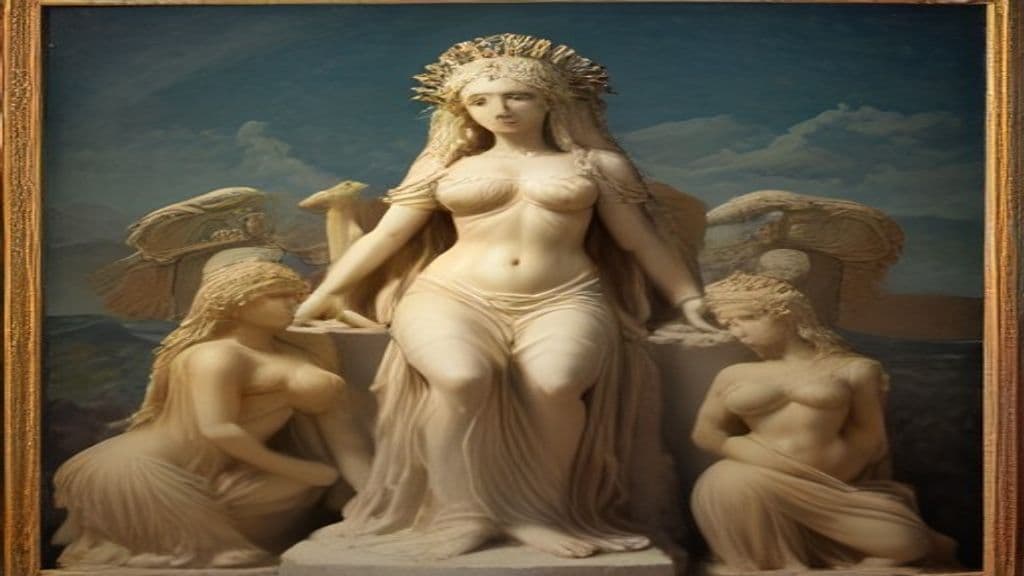
Muses
Divine inspirational figures of ancient Greek religion and mythology who personify and authorize the arts, literature, and learned knowledge; traditionally enumerated as nine daughters of Zeus and Mnemosyne in the Hesiodic account and associated with sacred springs and cult sites such as Mount Helicon and Delphi.
Aequitas
Aequitas is a Roman moral-legal concept denoting justice, equity, fair measure, and conformity that was sometimes personified as a female virtue in Roman iconography (notably on imperial coinage as Aequitas Augusti). Cicero frames aequitas as a tripartite standard linking obligations to the gods, the Manes, and other human beings.
Aesculapius (Asclepius)
Aesculapius (Greek Asclepius) is the classical divine-hero of medicine and healing in ancient Greek religion and later Roman cult. He functioned as the patron and legitimating divine figure for temples, attendants (therapeutae), and organized healing practices; his emblem, the rod of Asclepius (a snake-entwined staff), endures as a symbol of medicine.
Antevorta
Antevorta is a minor Roman goddess associated with the future and with protection in childbirth. She appears in classical sources as one of the Carmentae or as a companion/aspect of Carmenta, invoked (with her paired figure Postverta) at altars in Rome by pregnant women to avert dangers in labor.
Aventine Triad
A collective cultic grouping of three Roman deities—Ceres, Liber (Liber Pater) and Libera—venerated from the early Republic in a temple-temenos on or near the Aventine Hill. The label 'Aventine Triad' is modern scholarly shorthand for a plebeian, agricultural and fertility-focused set of cults that functioned as a communal religious and political focus for Rome's plebs.
Bacchus
Bacchus is the Roman identification of the Greek god Dionysus, a deity associated with wine, vegetation and fertility, ritual ecstasy and theatrical performance. In Roman religion he is conflated with the Italic Liber and known for rites that induce possession, frenzy (baccheia), and group revelry.
Bellōna
Bellōna is an ancient Roman goddess personifying war, especially the destructive, bloody, and tumultuous aspects of armed conflict. She had an active civic cult in Rome (including a temple associated with a war column, the columna bellica) and appears frequently in Roman literature and art as an armed, helmeted female figure who accompanies or intensifies battle.
Caelus
Caelus is the Roman personification and divine hypostasis of the sky (Latin caelum), treated in literature and art as a primordial heavenly principle whose generative ‘‘semina rerum’’ contribute to the ordering and origin of the world. He appears in Roman theological genealogies, Augustan and Imperial iconography, Etruscan-augural templum schema, and in syncretic contexts such as Mithraic dedications.
Concordia
Concordia is the Roman personification and goddess who embodies agreement and harmony, especially within marriage and in broader civic society. The name also appears in later secular toponyms and institutions derived from the same lexical root, but those are distinct from the mythological figure.
Di Penates
In ancient Roman religion the Di Penates are household divinities (dii familiares) associated with the storeroom and the material basis of family life; they are invoked in domestic rituals and also appear as public sacred objects (Penates Publici) connected to Rome's civic cult and foundation myth. They function as guardians of household provisions and as intimate protectors of household continuity rather than as distant, high gods.
Di inferi
A ritual-technical collective in Roman religion denoting the gods and powers 'below' (the underworld), the di inferi comprise chthonic deities, ancestral forces (often overlapping with the Manes), and other underworld entities who receive burnt offerings and are propitiated outside Rome's sacred boundary.
Diana
Diana is a Roman goddess of the countryside, wild animals and hunting, childbirth, crossroads, the night, and the Moon. In Roman religion she was equated with the Greek Artemis and absorbed much of Artemis' mythic profile; later receptions reinterpreted aspects of her in folklore and neo-pagan writing.
Dies
Dies is the Roman personification of Day, treated in literary and encyclopedic sources as the counterpart of the Greek Hemera and as a divine figure in genealogical accounts of cosmic forces.
Community Record
- [1]Camenae — Wikipedia. Wikipedia, 'Camenae' entry (summary of Roman literary and religious associations, identification with Muses, and associated figures Carmenta, Egeria, Antevorta/Postverta).wiki
- [2]Camena — Wikidata. Wikidata item Q857144 summarizing Camena/Camenae as a water deity.other
- [3]Manoscritto - Fondo Principale P_MSS_0261 (Biblioteca Civica 'Joppi' Udine). Manuscript catalog entry containing a Latin epigramic line referencing Camenae ('Quem Charites olim, quem dilexere Camenae') cited in archival descriptions of Tommaso Orca's poems.literary
- [4]Manoscritto - Fondo Principale P_MSS_0274 (Biblioteca Civica 'Joppi' Udine). Manuscript catalog entry preserving Latin poetic references that include Camenae in later poetic diction.literary
- [5]Manoscritto - Fondo Principale P_MSS_0272 (Biblioteca Civica 'Joppi' Udine). Manuscript catalog entry citing lines that mention Camenae among poetic antiquarian diction.literary