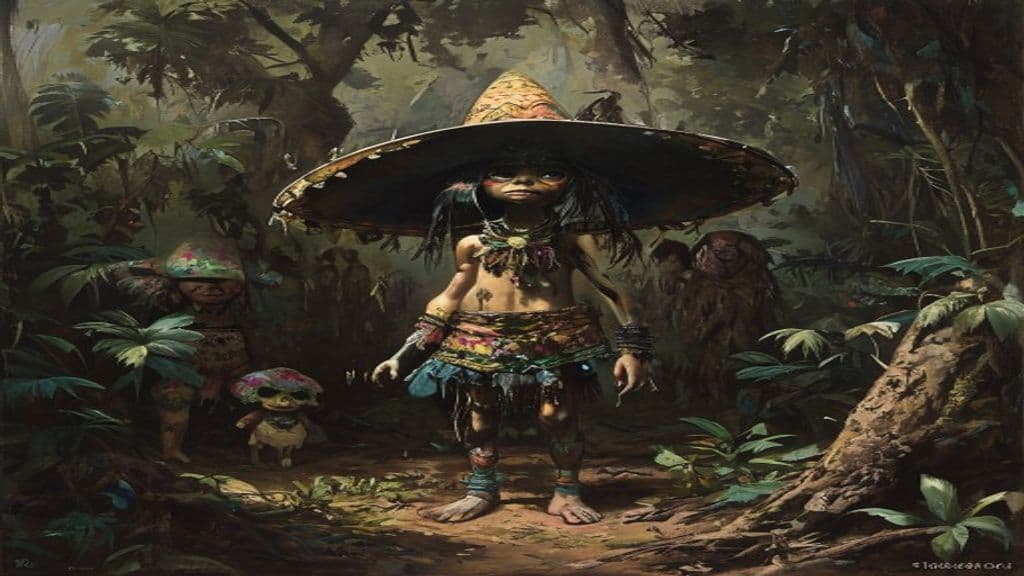
Sources frame the chaneque concept in Náhuatl as 'those who inhabit dangerous places' or 'owners of the house,' indicating an origin as place-spirits tied to specific natural features or domestic sites. Colonial and later sources variably reinterpret them — some inquisitorial and literary texts cast them as demonic, while folk accounts present them as indigenous guardians or tricksters associated with thresholds to underworld realms such as Mictlán or Chiconauhmictlán (in some accounts the entrance is located in a dried kapok/ceiba tree).
Descriptions vary regionally. Chaneques are generally short-statured or small and sprite-like; some accounts describe them as naked little men or 'boy doll' figures who hop and wear a wide-brimmed sombrero and are dark in color (Pedro Cholotio Temo citation). Other contemporary tales portray them as childlike with faces of elderly men or women. In comparative Yucatec descriptions of aluxo'ob they are about knee-high and resemble miniature, traditionally dressed Maya people. Visibility is reported to differ by age: children may see them when adults cannot.
Accounts attribute a range of behaviors and limited supernatural powers. They are guardians of nature and households in some local practices and can be propitiated with offerings to protect harvests and homes. They are also credited with mischief and harm: leading people astray (sometimes for days), causing memory lapses interpreted as transport to the Underworld, frightening intruders until the victim's soul leaves the body, and in some tales physically harassing or assaulting people (examples include throwing hay into a prisoner's mouth and beating a person in a colonial-era tale). Colonial archival narratives include instances of chaneques (or duende-like beings) abducting young men and women for sexual relations, but these are attested in specific archival/inquisitorial accounts rather than presented as a universal trait. Some summaries attribute communication with animals in jungle contexts to them, but this is presented as an attributed capability in certain accounts rather than a universally documented power.
Weaknesses
- conditionreciprocity/offerings
- conditionhuman intimidation (anecdotal threats such as threat to set fire)
- otherclothing worn inside out (folk protective custom)
Wards
- ritualofferings to chaneques
- conditionwearing clothing inside out when traveling in forest

Duende
Duende is a polyvalent category of Iberian and Ibero‑American household and nature spirits comprising many regional types (Anjanas, Busgosos, Diaños, Enanos, Trasgos, Nuberos, etc.). They range from benevolent water‑nymphs and shepherd‑helpers to mischievous household intruders and shapeshifters, and are rooted in rural popular cosmologies where specific places (springs, forests, homes) are inhabited by agents with varied moral dispositions.
Duende
Duende is a polyvalent category of Iberian and Ibero‑American household and nature spirits comprising many regional types (Anjanas, Busgosos, Diaños, Enanos, Trasgos, Nuberos, etc.). They range from benevolent water‑nymphs and shepherd‑helpers to mischievous household intruders and shapeshifters, and are rooted in rural popular cosmologies where specific places (springs, forests, homes) are inhabited by agents with varied moral dispositions.
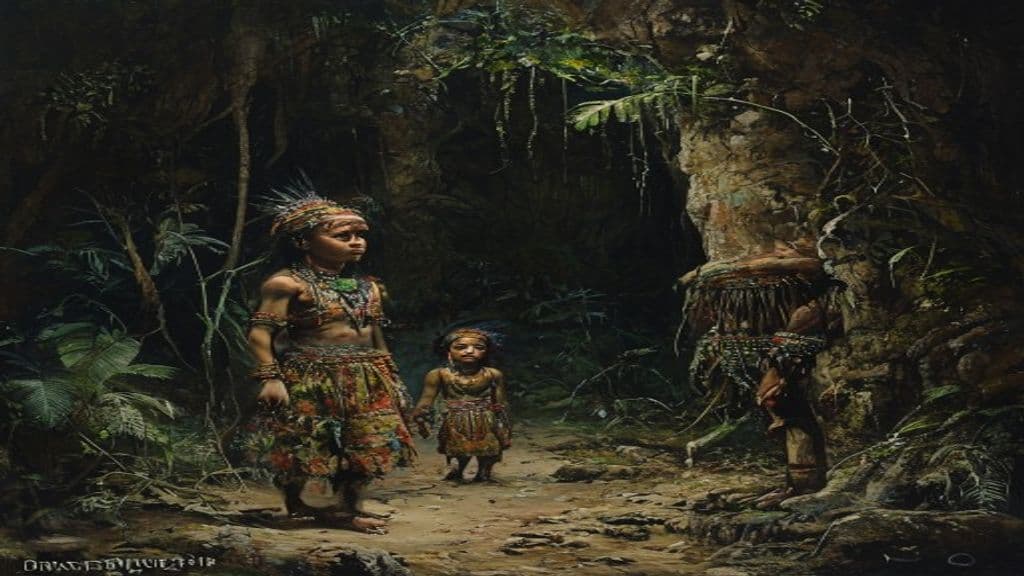
Alux (aluxoʼob)
The alux (plural aluxoʼob or aluxob) is a small, place-bound sprite or spirit in Maya tradition of the Yucatán Peninsula, Belize, and Guatemala, conceived as knee-high, miniature, traditionally dressed Maya-like beings created by ancient gods and normally unseen but able to assume physical form to communicate or frighten humans.
Chamunda
Chamunda (also Chamundeshwari, Chamundi) is described in the provided sources as a fearsome form of Chandi, a manifestation of the Hindu mother goddess (Mahadevi), and is counted among the seven Matrikas.
Chanda and Munda
Chanda and Munda are two named asura warriors in the Devi Mahatmya narrative who are sent by the demon-kings Shumbha and Nishumbha to confront the Goddess; their slaying by the goddess's terrifying war-aspect (Kali/Chamunda) gives rise to the epithet Chamunda.
Chandalika
A Dayan witch who has reached approximately 1600 years of age — the final threshold, beyond which she has become more force than person, capable of destroying entire lineages and withstanding divine invocations.
Chandi
Chandi (Caṇḍī / Caṇḍikā) is a fierce aspect of the Hindu Divine Feminine (Devi) prominent in Śākta traditions, celebrated in the Devi Māhātmya (Durga Saptashati) as a warrior‑protector and purifier. She is invoked in homa/chanting rites (Chandipath/Chandi Homam) to remove obstacles, cure evils, and bestow auspiciousness, and appears both in pan‑Indian scripture and varied local village forms especially in eastern India and Gujarat.
Chandra
Chandra is the Hindu divine personification of the Moon, appearing in Vedic, epic and Purāṇic literature. He functions as the lunar luminary, a member of the Navagraha (planetary regents), and is closely associated with plants/vegetation and the Vedic Soma tradition. Myths about Chandra include his marriages to the 27 Nakshatra personifications and the Tara–Brihaspati episode, in which his liaison produces the deity Budha and provokes cosmic dispute resolved by Brahma.
Chandraprabha
Chandraprabha is the eighth Tīrthankara of Jainism in the present half‑cycle (avasarpini). Venerated as an arihant/siddha, he attained Kevala Jnana and nirvana and functions as a liberated exemplar in Jain devotional, literary and iconographic traditions.
Chang'e
Chang'e (嫦娥), originally attested as Heng'e and linked to the older name Chang Xi, is the female lunar immortal of Chinese myth who resides in the Moon Palace (廣寒宮). Best known from the elixir-of-immortality tale in which she ascends to the Moon and is accompanied there by the Jade Rabbit, she functions across religious and literary contexts as a lunar goddess/immortal and a poetic symbol of solitude and longing.
Changeling
A changeling is a human-like substitute left by nonhuman beings (fairies, trolls, demons, etc.) after they abduct a human—most often an infant. Found throughout much of European folklore, the changeling functions as an uncanny domestic replacement whose presence explains sickness, developmental difference, or sudden loss.
Chann Pardesi
Chann Pardesi is the title of a 1981 Punjabi-language film from India; the provided sources document the film's production, cast, plot summary, and official promotional/trailer certification. The materials do not identify 'Chann Pardesi' as a supernatural being or wandering spirit within Punjabi folklore.
Chaos gods (tradition)
A class of mythic figures or modern fictional entities associated with primordial or elemental chaos. In comparative mythology they denote personifications of cosmic disorder; in modern fictional settings (notably Warhammer 40,000 fandom) the term is used for emergent intelligences formed from concentrated collective emotion or psychic energy.
Chaos/Nun (Ancient Egyptian)
Primordial, formless substance underlying the created world in Ancient Egyptian creation myths. (Note: 1. Power tier should be Primordial (as it's a primordial substance underlying all creation), but Primordial is typically reserved for cosmic entities, so consider revising to Ancient, as Chaos/Nun has)
Chariclo
Chariclo is a name assigned to one or two nymph figures in Ancient Greek myth. In surviving sources she appears either as the wife of the centaur Chiron and member of a Chironian household (nurse of Achilles in some scholia) or as a devotee/attendant of Athena who is the mother of the seer Tiresias; both roles place her among domestic, caregiving, and intercessory minor divine figures rather than as an independent cultic deity.
Community Record
- [1]Chaneque — Wikipedia. Wikipedia article 'Chaneque' (summary of folk attributes, etymology, behaviors, offerings, and Underworld associations).wiki
- [2]Chaneque — Wikidata entry Q1628701. Wikidata label and linked data entry for 'Chaneque'.wiki
- [3]Ajolote - Ondas Gélidas (liner/track notes summarizing alux traditions). Archive track notes summarizing Yucatec-Maya alux/aluxo'ob as small, knee-high, miniature traditionally dressed Maya people, generally invisible but able to assume form and enticed by offerings; used as comparative material to chaneque.folk
- [4]Alarido del terror (film synopsis, 1991). Film synopsis that frames a chaneque as 'ser diabólico' awakened from a tomb; cited as an example of media/Christian-era demonizing portrayals.literary