Charaxus appears in two separate narrative traditions rather than a single cohesive origin. In the heroic-mythic register he is listed among the Lapiths who fought the centaurs at the wedding of Pirithous and Hippodamia, a legendary episode in Thessalian heroic narrative in which he is mortally wounded by the centaur Rhoetus. In a distinct biographical/anecdotal register preserved in Hellenistic and later sources, Charaxus is presented as a merchant from the circle of archaic Lesbos and is known in stories as the brother of the lyric poet Sappho who travelled to Egypt to trade (attestations for these roles are of different types and dates and are not unified in the sources).
In the epic centauromachy passage he is described with vividly yellow/golden hair: his locks are compared to an autumn field and burn fiercely when set alight by a centaur's brand, and the account emphasizes his grievous mortal wounding. No physical description is provided in the surviving merchant/anecdotal materials beyond conventional social markers (a merchant who sailed to and from Egypt).
Sources portray Charaxus as a human actor. In the Lapith episode he performs feats of heroic/mortal strength (for example he lifts a large threshold stone 'a weight sufficient for a team of oxen' and bears it on his shoulders) — an epic exaggeration of human strength rather than an attribution of supernatural powers. In the biographical anecdotes he functions as an ordinary merchant who sails to Egypt to sell wine and return to Greece for more; no supernatural abilities are ascribed in the supplied material.
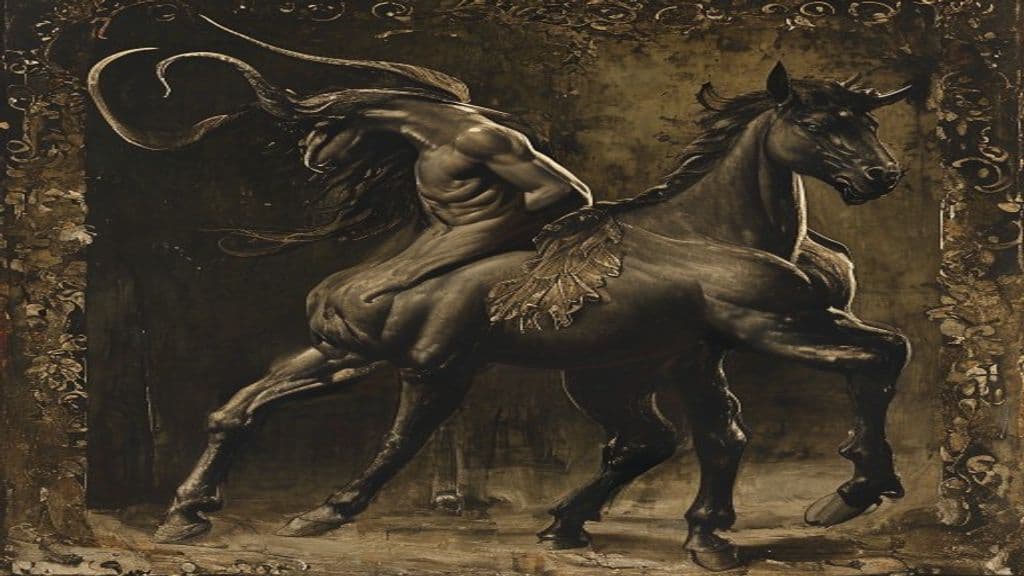
Centaur
A mythic hybrid from ancient Greek tradition with the upper body of a human and the lower body and legs of a horse. Centaurs appear as a tribal population associated with mountainous and wooded regions of Greece and embody tensions between human social order and untamed nature.
Cometes
Cometes (Ancient Greek: Κομήτης) is primarily a Greek personal name borne by several otherwise unrelated mythic figures in classical sources. The term also recurs in modern scientific, commercial, and artistic contexts (taxonomic genera, species names, product names, and usages referring to comets), but there is no single folkloric or spirit-class entity called Cometes in the provided sources.
*Péh₂usōn (reconstructed)
Péh₂usōn is a hypothetical Proto‑Indo‑European pastoral guardian reconstructed by comparative scholars from parallels in Greek and Vedic traditions. Proposed as a Graeco‑Aryan ancestor‑figure, the reconstruction describes a protector of flocks, roads, and travellers rather than an attested historical cultic personality.
3-D Man
3-D Man is a Marvel Comics superhero identity associated with a 1950s-era origin in which the body of Chuck Chandler can materialize in three-dimensional existence when activated by his brother Hal via a pair of glasses. The mantle was later assumed by Delroy Garrett (formerly Triathlon) in modern continuity.
5 Ronin
5 Ronin is a 2011 Marvel Comics five-issue limited series that reimagines five Marvel superhero archetypes as rōnin (masterless samurai) in a fictionalized post‑Sekigahara feudal Japan. The work places Wolverine, Hulk, Punisher, Psylocke, and Deadpool analogues into period roles to explore displacement, revenge, and identity in an era of political upheaval.
A Elbereth Gilthoniel
An Elvish hymn in Sindarin addressed to Elbereth (Varda) from J. R. R. Tolkien's legendarium. Presented in The Lord of the Rings and later musical and dramatic adaptations, the hymn functions as devotional poetic language that evokes Elvish reverence for the star-kindler rather than an independent supernatural agent.
A.R.G.U.S.
A.R.G.U.S. is a fictional clandestine United States government agency in the DC Comics universe that investigates, contains, and manages superhuman, meta-human, and supernatural incidents and assets. Introduced in The New 52 continuity, it functions as an institutional actor providing intelligence, logistical support, covert task forces (notably Task Force X / the Suicide Squad), and a dedicated magic division across comics and media adaptations.
Aba (disambiguation / name-form)
Aba is a polyvalent name-form attested across many unrelated contexts (place names, personal names, animal names, and brief mythological listings). The provided sources do not support a single, coherent supernatural entity called "Aba" and offer no descriptive or ritual material for such a being.
Abarbarea
Abarbarea is a name attested in classical Greek and Roman sources for freshwater nymphs (naiads). The name appears for at least two individual mythic figures — a naiad wife of Bucolion and a naiad counted among ancestors of the Tyrians — and Hesychius records plural forms that may indicate the name was also used as a class-name (Abarbareai / Abarbalaiai).
Abas
Abas (Ancient Greek: Ἄβας, gen.: Ἄβαντος) is not a single mythic being but a recurring personal name borne by multiple mortals and minor mythic figures in Greek epic and genealogical traditions — kings, founders, seers, warriors, attendants, a centaur, and a youth transformed by a goddess. The name is glossed in the sources as 'guileless' or 'good-hearted' and appears across Argive, Theban, Trojan, Euboean, and other local cycles.
Abderus
Abderus (Ancient Greek: Ἄβδηρος, romanized Ábdēros) is a mortal heroic figure in Greek myth closely associated with Heracles, remembered as the youth left in charge of the Mares of Diomedes who was killed by them. He functions as an eponymous local/divine-hero ancestor for the city of Abdera and received funerary commemoration and athletic agones at his tomb.
Abin Sur
Abin Sur is a fictional extraterrestrial Green Lantern from the planet Ungara in DC Comics. A former history professor turned Green Lantern of Space Sector 2814, he discovered and investigated a prophecy tied to the "Blackest Night," died wounded on Earth and chose Hal Jordan as his ring-successor, and was later reanimated as a Black Lantern in the Blackest Night storyline.
Abomination of Desolation
An apocalyptic prophetic phrase originating in the Book of Daniel designating a profaning thing or act that renders the Jerusalem Temple cult desolate; later reused in the Synoptic Gospels as an eschatological sign prompting urgent flight. The term denotes ritual/cultic impurity (Hebrew shiqquts) and is variously interpreted as pagan offerings or altar, a foreign cult statue, or (in some New Testament readings) an acting agent.
Absolute Green Lantern (tradition)
A modern comic-book reinterpretation in DC's Absolute Universe in which a giant green lantern-shaped vessel appears above Evergreen, Nevada, generates an impenetrable green dome, judges townspeople and sends the judged into the Lantern to await further adjudication in OA (Omega‑Alpha). The story reframes Green Lantern mythos as cosmic/religious horror with an "Enlightenment Spectrum" of flames (Qard, Rao, Sur, Aur) stewarded by Oans such as Abin Sur.
Community Record
- [1]Charaxus. Wikipedia: Charaxus (entry on Lapith/centauromachy episode and epic description)wiki
- [2]Charaxus (Wikidata Q16184753). Wikidata entry linking Charaxus to Sappho-related anecdoteswiki
- [3]Rhodopis (hetaera). Wikipedia: Rhodopis (context for merchant voyages, Naucratis, and anecdotes linking Charaxus and Rhodopis)wiki
- [4]Historia Amoris (Brian Carnell's Wiki). Historia Amoris (collection/summary of love-related anecdotes, including Sappho/Charaxus material)other
- [5]Help with Sapphic proper names - Textkit forum. Textkit forum discussion noting the Ancient Greek form Χάραξος and speculative etymology (uncertain)other
- [6]Rhodopis, the Courtesan Who Annoyed Sappho – Antigone. Antigone essay summarizing anecdotes connecting Rhodopis, Sappho, and Charaxus (modern literary/critical treatment)literary