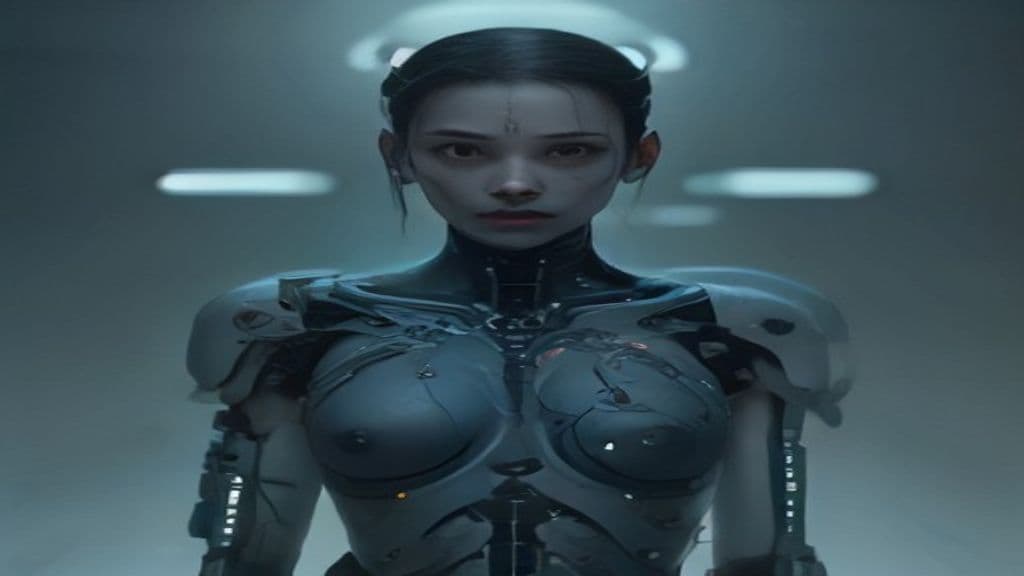
The lexical origin of the term "cyborg" is a 1960 coinage by Manfred Clynes and Nathan S. Kline, formed as a portmanteau of "cybernetic" and "organism." The term entered scientific, medical, and popular discourse to name beings—real or imagined—whose biological functions are integrated with cybernetic (feedback-capable) technology.
No single canonical morphology is prescribed. Appearances range from near-normal organisms with internal implants (for example pacemakers or cochlear implants) to visibly hybridized bodies with external prostheses, engineered limbs, exoskeletons, or overt mechanical parts as depicted in various works of fiction. Specific media examples portray both subtle biomedical augmentations and overtly mechanical wartime cyborgs.
Abilities attributed to cyborgs in the sources are technical and functional rather than supernatural: restoration of lost biological function (e.g., cardiac pacemakers, cochlear implants) and enhancement beyond baseline capacities (improved strength, sensory extensions, computational augmentation). The defining technical feature is incorporation of cybernetic feedback loops. In cultural and theoretical usage, cyborgy arrangements also enable distributed cognition and altered social agency when humans are extended through networked technologies.
Cusco Quechua
Cusco Quechua (Qusqu qhichwa simi / Qusqu runasimi) is a regional variety of Southern Quechua spoken in the city and Department of Cusco, Peru. It is part of the Southern Quechua grouping (including Puno and Bolivian varieties) and is the variety used and promoted by the Academia Mayor de la Lengua Quechua in Cusco; sources note debates over vowel analysis and orthography and list the variety as vulnerable in language-vitality metadata.
Cuélebre
A legendary long‑lived reptilian guardian from Asturian and Cantabrian folklore, depicted as a giant winged serpent or dragon that inhabits caves and watery liminal places, guards treasure, and is sometimes said to hold xanas (fairy‑like beings) captive. Folktales attribute to it senescent physical changes, a miraculous healing byproduct, and specific folkloric countermeasures.
Cyane
Cyane (Ancient Greek Κυάνη, Kuánē, 'dark blue') is a Sicilian water-nymph (naiad) associated with a spring or pool near Syracuse. In myth she attempts to block Hades' abduction of Persephone, pleads by citing her own consensual relationship with the river-god Anapus, and—after failing—dissolves into the waters of her pool; the spring is thereafter sacred and named for her.
Cyanippus
Cyanippus (Greek: Κυάνιππος) is a personal name attested for at least three distinct mortal men in Greek mythic traditions: an Argive/Achaean warrior-king connected to the Trojan Horse cycle, a Thessalian hunter whose dogs kill his wife, and a Syracusan who omitted worship of Dionysus and whose divinely induced crime leads to oracle-driven expiation. He is presented as human rather than as a supernatural being.
Cybele
An Anatolian mother goddess (Phrygian Matar Kubileya) whose cult centers on mountains, city protection, fertility, and wild nature; adopted and reinterpreted by Greek and Roman religion where she became associated with ecstatic rites, a eunuch priesthood (the Galli), and the Roman Magna Mater cult.
Cybernary
Cybernary is a fictional comic-book character and the title of a WildStorm series; presented as a cybernetically enhanced human whose body and systems carry or host other consciousnesses. Originating in 1990s American comics, Cybernary functions as a cybernetic anti‑heroine and narrative construct within post‑apocalyptic / cyberpunk superhero fiction.
Cyborg Superman
A fictional comic-book supervillain identity in the DC Comics universe: a technomorphic hybrid that blends organic (including Kryptonian-derived tissue in some incarnations) and cybernetic components. Most famously embodied by Hank Henshaw, the role functions as an impostor/replacement of Superman and as a transhuman antagonist operating on terrestrial and cosmic scales.
Cychreides
Cychreides (Greek Κυχρείδης) is a serpent- or dragon-like monster of Greek myth associated with the island of Salamis and, in some variants, with the goddess Demeter. Traditions differ: it is variously portrayed as a terrorizing beast slain or driven off by humans, a serpent kept by Demeter (including as one of the pair that drew her chariot), or as an epithet applied to the hot‑tempered Cychreus himself.
Cychreus
Cychreus is a legendary local hero and king of Salamis in Greek tradition, son of Poseidon and the nymph Salamis, variably portrayed as slayer, keeper, or figurative ‘dragon’ in traditions that connect him to cult practice and Athenian political uses.
Cyclopean Masonry (Greek Tradition)
In Greek tradition, Cyclopean masonry is an architectural style characterized by massive limestone boulders roughly fitted together without mortar, associated with the mythical one-eyed giants. (Note: * Power tier: Primordial seems too high for an architectural style; consider Lesser or Greater. * Appearance: While massive structures can be imposing, unease or foreboding is more subjective interpre)
Cyclops
In ancient Greek tradition the Cyclopes are one‑eyed giant beings appearing in multiple, sometimes contradictory strands: Hesiodic primordial artisan brothers who forge the gods' arms; Homeric solitary, cave‑dwelling shepherd‑monsters such as Polyphemus; and a legendary explanation for monumental ‘Cyclopean’ masonry.
Cycnus (son of Ares)
Cycnus (Ancient Greek Κύκνος) is one of several mythic personages named ‘Cycnus’ whose narratives culminate in transformation into a swan; the son of Ares is one attested bearer of that name within the wider Greek motif of human/divine metamorphosis into the bird and occasional stellar aetiology linking the figure to the constellation Cygnus.
Community Record
- [1]Cyborg (Wikipedia). Wikipedia contributors, 'Cyborg', Wikipedia, The Free Encyclopediawiki
- [2]Cyborg (novel) — Martin Caidin. Wikipedia contributors, 'Cyborg (novel)', Wikipedia, The Free Encyclopedialiterary
- [3]Mikadroid (1991) — Archive listing. Archive.org listing for Mikadroid (1991)literary
- [4]Cyborg Foundation — media.ccc.de recording. Cyborg Foundation presentation (media.ccc.de)other